LewRockwell.com
ANTI-STATE•ANTI-WAR•PRO-MARKET
Darkness Over All: John Robison and the Birth of the Illuminati Conspiracy
April 3, 2014


Conspiracy theories of a secretive power elite
seeking global domination have long held a place in the modern
imagination. Mike Jay explores the idea’s beginnings in the writings of
John Robison, a Scottish scientist who maintained that the French
revolution was the work of a covert Masonic cell known as the
Illuminati.
 At the beginning of 1797, John Robison was a man with a solid and
long-established reputation in the British scientific establishment. He
had been Professor of Natural Philosophy at Edinburgh University for
over twenty years, an authority on mathematics and optics; he had
recently been appointed senior scientific contributor on the third
edition of the Encyclopaedia Britannica, to which he would
At the beginning of 1797, John Robison was a man with a solid and
long-established reputation in the British scientific establishment. He
had been Professor of Natural Philosophy at Edinburgh University for
over twenty years, an authority on mathematics and optics; he had
recently been appointed senior scientific contributor on the third
edition of the Encyclopaedia Britannica, to which he would
contribute over a thousand pages of articles. Yet by the end of the year his professional reputation had been eclipsed by a sensational book that vastly outsold anything he had previously written, and whose shockwaves would continue to reverberate long after his scientific work had been forgotten. Its title was Proofs of a Conspiracy against all the Religions and Governments of Europe, and it launched on the English-speaking public the enduring theory that a vast conspiracy, masterminded by a covert Masonic cell known as the Illuminati, was in the process of subverting all the cherished institutions of the civilised world into instruments of its secret and godless plan: the tyranny of the masses under the invisible control of unknown superiors, and a new era of ‘darkness over all’.
The first edition of Proofs of a Conspiracy sold out within days, and within a year it had been republished many times, not only in Edinburgh but in London, Dublin and New York. Robison had hit a nerve by offering an answer to the great questions of the day: what had caused the French Revolution, and what had driven its bloody and tumultuous progress? From his vantage point in Edinburgh he had, along with millions of others, followed with horror the reports of France dismembering its monarchy, dispossessing its church and transforming its downtrodden and brutalised population into the most ruthless fighting force Europe had ever seen – and now, under the rising star of the young general Napoleon Bonaparte, attempting to export the carnage and destruction to its surrounding monarchies, not least Britain itself. But Robison believed that he alone had identified the hidden hand responsible for the apparently senseless eruption of terror and war that now appeared to be consuming the world.
 Many had located the roots of the revolution in the ideas of
Enlightenment figures such as Voltaire, Diderot and Condorcet, who had
exalted reason and progress over authority and tradition; but none of
these mostly aristocratic philosophes had advocated a revolution of the
masses, and indeed several of them had ended their lives on the
guillotine. In the early 1790s it had been possible to believe that the
power-hungry lawyers and journalists
of the Jacobin Club had whipped up the Paris mob into their destructive
frenzy for their own ends, but by 1794 Danton, Robespierre and the rest
of the Jacobin leaders had followed their victims to the guillotine:
how could they have been the puppet-masters when they had had their own
strings so brutally cut? What Robison was proposing in the meticulously
documented pages of Proofs of a Conspiracy was
that all these agents of revolution had been pawns in a much bigger
game, with ambitions that were only just beginning to make themselves
visible.
Many had located the roots of the revolution in the ideas of
Enlightenment figures such as Voltaire, Diderot and Condorcet, who had
exalted reason and progress over authority and tradition; but none of
these mostly aristocratic philosophes had advocated a revolution of the
masses, and indeed several of them had ended their lives on the
guillotine. In the early 1790s it had been possible to believe that the
power-hungry lawyers and journalists
of the Jacobin Club had whipped up the Paris mob into their destructive
frenzy for their own ends, but by 1794 Danton, Robespierre and the rest
of the Jacobin leaders had followed their victims to the guillotine:
how could they have been the puppet-masters when they had had their own
strings so brutally cut? What Robison was proposing in the meticulously
documented pages of Proofs of a Conspiracy was
that all these agents of revolution had been pawns in a much bigger
game, with ambitions that were only just beginning to make themselves
visible.
The French Revolution, like all convulsive world events before and since, had been full of conspiracies, bred by the speed of events, the panic of those caught up in them and the limited information available to them as they unfolded. In Britain, enemies of the revolution such as Edmund Burke had claimed from the beginning that ‘already confederacies and correspondences of the most extraordinary nature are forming in several countries’, and by 1797 most believed – and with good reason – that secret societies in Ireland were plotting with Napoleon to overthrow the British government and invade the mainland. The power of Robison’s revelation was that it identified within the buzzing confusion of conspiracies a single protagonist, a single ideology and a single overarching plot that crystallised the chaos into an epic struggle between good and evil, whose outcome would define the future of world politics.
 Robison’s vast conspiracy needed an imposing figurehead, a role for
which Adam Weishaupt, the founder of the Bavarian Order of the
Illuminati, seemed on the surface to be an unpromising candidate.
Obsessive and domineering, Weishaupt had from the beginning found
difficulty in attracting members to his secret society, where they were
expected to adopt mystical pseudonyms chosen by him, jump through the
hoops of his strict initiatic grades – Novice and Minerval, Illuminatus
Minor and Major, Dirigens and Magus – and take up subservient roles in
his grandiose but unfocused crusade for world domination. After 1784,
when the Order had been
exposed and banned by the Elector of Bavaria, Weishaupt had exiled
himself to Gotha in central Germany, since when he appeared to have done
little beyond producing a series of morose and self-justifying memoirs
of his adventures.
Robison’s vast conspiracy needed an imposing figurehead, a role for
which Adam Weishaupt, the founder of the Bavarian Order of the
Illuminati, seemed on the surface to be an unpromising candidate.
Obsessive and domineering, Weishaupt had from the beginning found
difficulty in attracting members to his secret society, where they were
expected to adopt mystical pseudonyms chosen by him, jump through the
hoops of his strict initiatic grades – Novice and Minerval, Illuminatus
Minor and Major, Dirigens and Magus – and take up subservient roles in
his grandiose but unfocused crusade for world domination. After 1784,
when the Order had been
exposed and banned by the Elector of Bavaria, Weishaupt had exiled
himself to Gotha in central Germany, since when he appeared to have done
little beyond producing a series of morose and self-justifying memoirs
of his adventures.
Yet there was much in the career of the Illuminati that offered, to Robison at least, a view of a far more expansive and sinister scheme. Weishaupt’s messianic sense of his own mission and the Order’s extravagant structures hinted at a far larger organisation than that which had been exposed, and its suppression had generated a furore quite out of proportion to the danger it represented. It had become a lightning-rod for the deep anxieties of church and monarchy about the agenda of reason and progress that was being seeded across Europe by the confident vanguard of philosophers and scientists. The Illuminati furore had generated hundreds of screeds, polemics, handbills and scandal sheets, all competing to file the most damning charges of godless infamy. It was these sources that Robison had spent years perusing intently for anecdotes and allegations to mould into the proofs of the conspiracy that he now presented. To the dispassionate observer, Weishaupt and his Illuminati might have offered an eloquent metaphor for the forces that were reconfiguring Europe, but for Robison they had become the literal cause: the centre, thus far invisible, of the web of events that had consumed the world.
 Robison may have been a distant spectator of the Illuminati furore, but he was no dispassionate observer. While Proofs of a Conspiracy came
as a surprise (and in most cases an embarrassment) to his friends and
scientific colleagues, there were many reasons why the Illuminati had
presented itself to him in this form. His discovery resolved
long-standing suspicions and conflicts in both his private and
professional life, and chimed in particular with his own curious
adventures in freemasonry.
Robison may have been a distant spectator of the Illuminati furore, but he was no dispassionate observer. While Proofs of a Conspiracy came
as a surprise (and in most cases an embarrassment) to his friends and
scientific colleagues, there were many reasons why the Illuminati had
presented itself to him in this form. His discovery resolved
long-standing suspicions and conflicts in both his private and
professional life, and chimed in particular with his own curious
adventures in freemasonry.
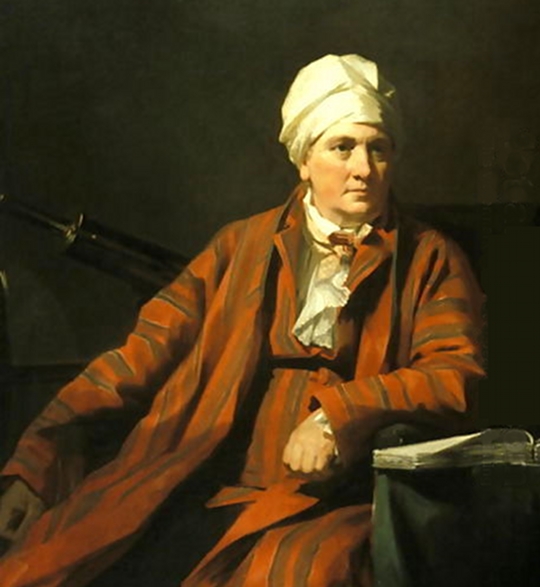
By 1797 Robison’s character had taken a grave and saturnine turn, far removed from the cheerful and convivial temperament of his youth. In 1785 he had begun to suffer from a mysterious medical condition, a severe and painful spasm of the groin: it seemed to emanate from beneath his testicles, but its precise origin baffled the most distinguished doctors of Edinburgh and London. Racked with pain and frequently bed-ridden, by the late 1790s he had become a withdrawn and isolated figure; he was using opium frequently, a regime which according to some of his acquaintances made him vulnerable to melancholy, confusion and paranoia. As the successive crises of the French Revolution shook Britain, the panic was particularly intense in Scotland, where ministers and judges whipped up constant rumours of fifth columnists and secret Jacobin cells. Tormented, heavily medicated and assailed by terrifying news from the outside world, Robison had all too many dark threads to weave into the plot that came to consume him.
 Politics had also thrown a long shadow across his professional life.
The physical sciences were in the grip of another French revolution, led
by Antoine Lavoisier. During the 1780s Lavoisier had overthrown the
chemistry of the previous century with his discovery of oxygen, from
which he had been able to establish new theories of combustion and to
begin the process of reducing all material substances to a basic table
of elements. Lavoisier’s revolution had split British chemistry: some
recognised that his technically brilliant experiments had transformed
the science of matter, but for others his new and foreign terminology
was, like the French metric system and the revolutionary Year Zero, an
arrogant attempt to wipe away the accumulated wisdom of the ages and to
eliminate the role of God. The old system of chemistry, with its
mysterious forms of energy and its languages of essences and principles,
had readily contained the idea of a life-force and the mysterious
breath of the divine; but in Lavoisier’s cold new world, matter was
reduced to inert building-blocks manipulated by the measurable forces of
pressure and temperature.
Politics had also thrown a long shadow across his professional life.
The physical sciences were in the grip of another French revolution, led
by Antoine Lavoisier. During the 1780s Lavoisier had overthrown the
chemistry of the previous century with his discovery of oxygen, from
which he had been able to establish new theories of combustion and to
begin the process of reducing all material substances to a basic table
of elements. Lavoisier’s revolution had split British chemistry: some
recognised that his technically brilliant experiments had transformed
the science of matter, but for others his new and foreign terminology
was, like the French metric system and the revolutionary Year Zero, an
arrogant attempt to wipe away the accumulated wisdom of the ages and to
eliminate the role of God. The old system of chemistry, with its
mysterious forms of energy and its languages of essences and principles,
had readily contained the idea of a life-force and the mysterious
breath of the divine; but in Lavoisier’s cold new world, matter was
reduced to inert building-blocks manipulated by the measurable forces of
pressure and temperature.
Robison had never accepted the French theories, and by 1797 had worked the new chemistry deep into his Illuminatist plot. For him, Lavoisier – along with Britain’s most famous experimental chemist, the dissenting minister Joseph Priestley – was a master Illuminist, working in concert with infiltrated Masonic lodges to spread the doctrine of materialism that would underlie the new atheist world order. Madame Lavoisier’s famous salons, at which the leading Continental philosophes met, were now revealed by Robison to have been the venues for sacreligious rites where the hostess, dressed in the ceremonial robes of an occult priestess, ritually burned the texts of the old chemistry. Implausible though this image might seem, it was of a piece with other proofs that Robison had assembled in his book – for example, the anonymous German pamphlet that claimed that, at the great philosopher Baron d’Holbach’s salons, the brains of living children bought from poor parents were dissected in an attempt to isolate their life-force.
 The Illuminati had infiltrated Robison’s professional life, but his
most personal connection with their conspiracy came through freemasonry
itself. He had been a member of the Scottish Rite for decades without
ever regarding its lodges as more than ‘a pretext for passing an hour or
two in a fort of decent conviviality, not altogether void of some
rational occupation’; but his career had frequently taken him abroad,
where he had been shocked to discover that not all masonic orders were
so innocent. In 1770 he had spent a year at Catherine’s court in St.
Petersburg, learning Russian and lecturing on navigation; during the
course of his travels he had met with other masons and visited lodges in
France, Belguim, Germany and Russia. What he saw had shocked him: by
comparison with the Scottish Rite, the Continental lodges were ‘schools
of irreligion and licentiousness’. Their members seemed to him consumed
by ‘zeal and fanaticism’, their religious views ‘much disturbed by the
mystical whims of J. Behmen [Jacob Boehme] and Swedenborg – by the
fanatical and knavish doctrines of the modern Rosycrucians
– by Magicians – Magnetisers – Exorcists, &c.’. Now, thirty years
later, as he recalled the occultism and freethinking to which he had
been briefly but unforgettably exposed, he had no doubt as to the source
of the destruction that had engulfed the Continent.
The Illuminati had infiltrated Robison’s professional life, but his
most personal connection with their conspiracy came through freemasonry
itself. He had been a member of the Scottish Rite for decades without
ever regarding its lodges as more than ‘a pretext for passing an hour or
two in a fort of decent conviviality, not altogether void of some
rational occupation’; but his career had frequently taken him abroad,
where he had been shocked to discover that not all masonic orders were
so innocent. In 1770 he had spent a year at Catherine’s court in St.
Petersburg, learning Russian and lecturing on navigation; during the
course of his travels he had met with other masons and visited lodges in
France, Belguim, Germany and Russia. What he saw had shocked him: by
comparison with the Scottish Rite, the Continental lodges were ‘schools
of irreligion and licentiousness’. Their members seemed to him consumed
by ‘zeal and fanaticism’, their religious views ‘much disturbed by the
mystical whims of J. Behmen [Jacob Boehme] and Swedenborg – by the
fanatical and knavish doctrines of the modern Rosycrucians
– by Magicians – Magnetisers – Exorcists, &c.’. Now, thirty years
later, as he recalled the occultism and freethinking to which he had
been briefly but unforgettably exposed, he had no doubt as to the source
of the destruction that had engulfed the Continent.
Although Proofs of a Conspiracy became a handsome bestseller, the Illuminati conspiracy never gripped the imagination of the British political class as it did in mainland Europe. Once the crisis of the French revolution was past, some conservative voices would attribute this to superior British common sense, but in truth Britain at that time had more serious threats and conspiracies to contend with. Tom Paine’s Rights of Man, a far more incendiary and radicalising work than any of the Bavarian Illuminati’s ‘secret texts’, had sold over two hundred thousand copies in its cheap sixpenny edition, a number that far exceeded what until that point had been considered the entire book-buying public. With the British fleet convulsed by mutinies and the government struggling to contain mass protests and riots, it was hardly surprising that the doings of a long-disbanded Bavarian lodge seemed less than a pressing concern.
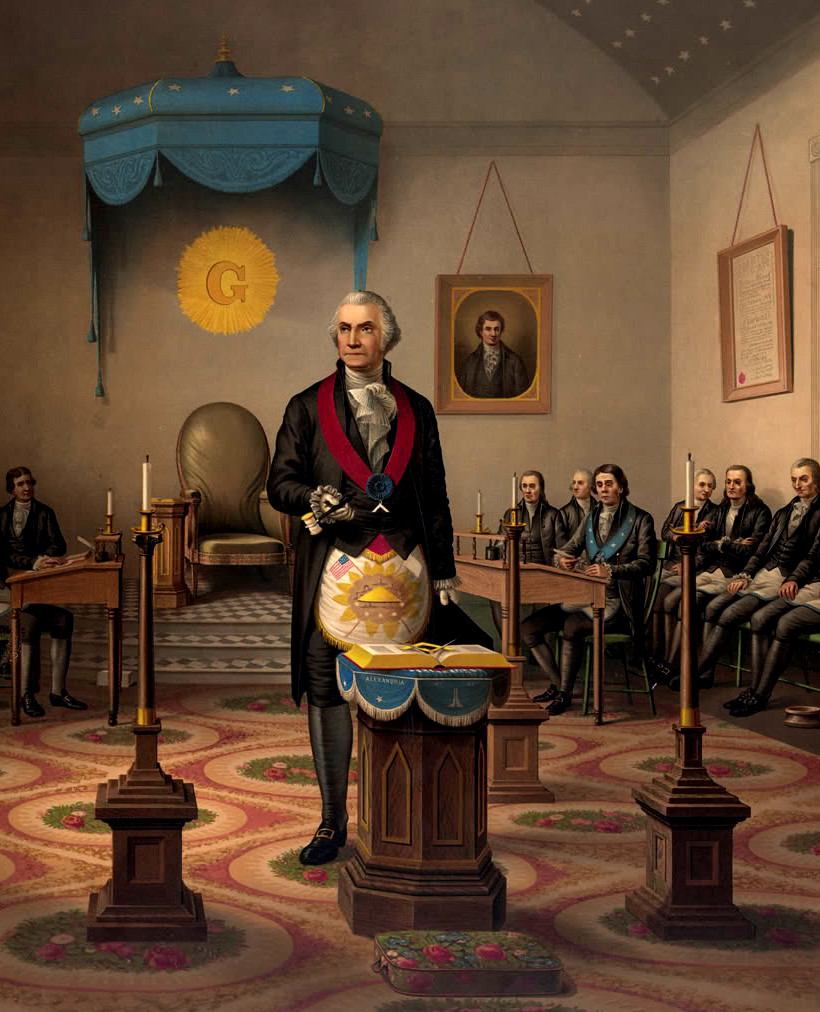 Robison’s book, however, had a profound and enduring impact in the
United States of America. Here, the polarised forces of revolution and
reaction that had swept Europe were playing out in a form that
threatened to split the Founding Fathers and destroy their fledgling
Constitution. While the likes of Thomas Jefferson saw themselves as
cousins of a French republic that had thrown off the shackles of
monarchy and with whom they traded amid British naval blockades, other
founders such as Alexander Hamilton, whose Federalist party favoured a
powerful state geared towards protecting the interests of its wealthy
citizens, feared the infiltration of the radical ideals of the French
revolution. In an overheated political milieu where accusations of
treason were hurled from both sides, Proofs of a Conspiracy was
seized on eagerly by the Federalists as evidence of the hidden agenda
that lurked behind fine-sounding slogans such as democracy, the
abolition of slavery and the rights of man. Robison’s words were
repeated endlessly in New England pulpits and pamphlets through 1798 and
1799, and Jefferson was publicly accused of being a member of
Weishaupt’s Order.
Robison’s book, however, had a profound and enduring impact in the
United States of America. Here, the polarised forces of revolution and
reaction that had swept Europe were playing out in a form that
threatened to split the Founding Fathers and destroy their fledgling
Constitution. While the likes of Thomas Jefferson saw themselves as
cousins of a French republic that had thrown off the shackles of
monarchy and with whom they traded amid British naval blockades, other
founders such as Alexander Hamilton, whose Federalist party favoured a
powerful state geared towards protecting the interests of its wealthy
citizens, feared the infiltration of the radical ideals of the French
revolution. In an overheated political milieu where accusations of
treason were hurled from both sides, Proofs of a Conspiracy was
seized on eagerly by the Federalists as evidence of the hidden agenda
that lurked behind fine-sounding slogans such as democracy, the
abolition of slavery and the rights of man. Robison’s words were
repeated endlessly in New England pulpits and pamphlets through 1798 and
1799, and Jefferson was publicly accused of being a member of
Weishaupt’s Order.
But such charges were never substantiated; the ‘Illuminati Scare’ petered out and the Federalists lost power, never to regain it. Yet the episode had touched a nerve deep within the American political mindset, and it has been woven into many subsequent paranoias and panics. Robison’s ideas would continue to be rediscovered and reinvented, and to influence modern politics in curious ways. The doyenne of modern conspiracy theory, Nesta Webster, swallowed his theory whole but then came to believe the Illuminati were a smokescreen: the true conspirators were the ‘Jewish peril’ whose agenda had, she believed, been accurately exposed in the Protocols of the Elders of Zion. Although Webster later consigned herself to the margins by joining the British Union of Fascists, her support at the time was more broadly based, and she even won admiring citations in the journalism of Winston Churchill. ‘The conspiracy against civilization dates from the days of Weishaupt’, Churchill wrote for the Sunday Herald in 1920; ‘as a modern historian Mrs. Webster has so ably shown, it played a recognisable role in the French revolution’. Many on the isolationist right continue to believe Robison’s theory to this day: the official John Birch Society line, for example, remains that Weishaupt’s Illuminati ‘was the ancestor of the Communist movement and the model for modern subversive conspiratorial movements’.
 After Robison’s death following a final medical crisis in 1805 his
Edinburgh colleague, the pioneering geologist John Playfair, wrote a
respectful memoir that
focused on his scientific achievements but was unable to avoid mention
of the work for which he was best remembered. ‘The alarm excited by the
French revolution’, Playfair suggested tactfully, ‘produced in Mr.
Robison a degree of credulity which was not natural to him’. It was a credulity,
he stressed, that had been shared by many who were unable to believe
that the revolution had been a genuine mass movement reacting to the
oppression of a tyrannical regime; they had clung to their belief that
it must have been orchestrated by a small cell of fanatics, and that the
lack of evidence for any such conspiracy was itself evidence for the
conspirators’ cunning in concealing their operations from public view.
After Robison’s death following a final medical crisis in 1805 his
Edinburgh colleague, the pioneering geologist John Playfair, wrote a
respectful memoir that
focused on his scientific achievements but was unable to avoid mention
of the work for which he was best remembered. ‘The alarm excited by the
French revolution’, Playfair suggested tactfully, ‘produced in Mr.
Robison a degree of credulity which was not natural to him’. It was a credulity,
he stressed, that had been shared by many who were unable to believe
that the revolution had been a genuine mass movement reacting to the
oppression of a tyrannical regime; they had clung to their belief that
it must have been orchestrated by a small cell of fanatics, and that the
lack of evidence for any such conspiracy was itself evidence for the
conspirators’ cunning in concealing their operations from public view.
There was much plain sense in Playfair’s analysis, and it could equally be applied to many who subsequently came to believe in Robison’s theories, and who continue to believe them today. But if the shock of the modern world erupting into existence before his eyes had unbalanced Robison’s judgement, it had also given him a vivid, even visionary perspective on the new dangers that might result from wresting politics away from church and monarchy and placing it in the hands of the people. Forged in the same crucible as every modern political ideology from conservatism to nihilism, anarchy to military dictatorship, the Illuminati conspiracy has become a modern myth: not merely in the dismissive sense that its factual basis evaporates under scrutiny, but as a shapeshifting narrative capable of adapting its meaning to accommodate new and unforeseen scenarios. Since the 1970s, it has been gleefully satirised as a baroque folly of conservative thought by counterculture figures from Robert Anton Wilson onwards, yet this has only increased its fame and mystique: Dan Brown’s Angels and Demons demonstrates that today’s readers will still lap up Robison’s unreconstructed version of the story in their millions. In popular culture and old-time religion, satire and nationalist politics, the Illuminati conspiracy still resonates with its warning that the light of reason has its shadows, and even the most enlightened democracy can be manipulated by hidden hands.
Reprinted from The Public Domain Review.
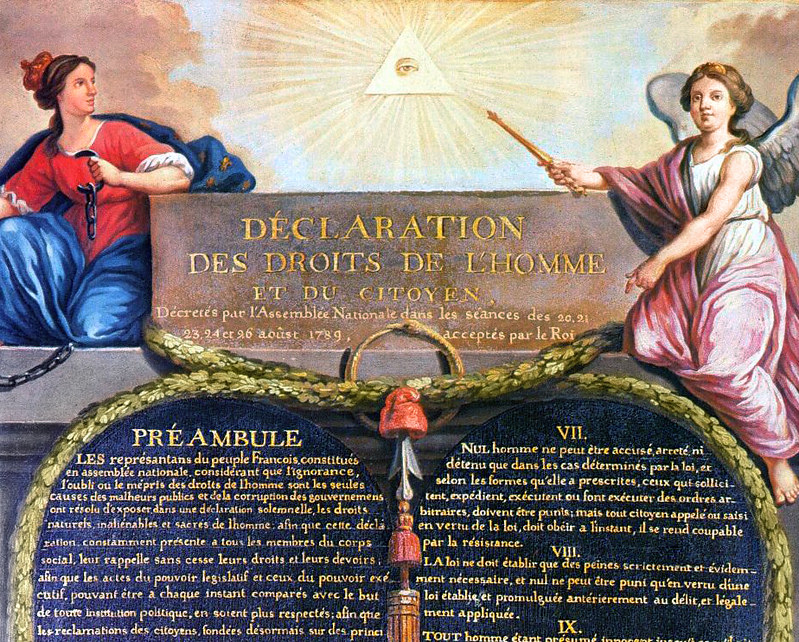
Representation
of the Declaration of the Rights of Man and of the Citizen in 1789
painted by Jean-Jacques-François Le Barbier in 1789. His depiction
includes the “eye of providence” and also the red Phrygian cap, two
symbols associated with freemasonry.
contribute over a thousand pages of articles. Yet by the end of the year his professional reputation had been eclipsed by a sensational book that vastly outsold anything he had previously written, and whose shockwaves would continue to reverberate long after his scientific work had been forgotten. Its title was Proofs of a Conspiracy against all the Religions and Governments of Europe, and it launched on the English-speaking public the enduring theory that a vast conspiracy, masterminded by a covert Masonic cell known as the Illuminati, was in the process of subverting all the cherished institutions of the civilised world into instruments of its secret and godless plan: the tyranny of the masses under the invisible control of unknown superiors, and a new era of ‘darkness over all’.
The first edition of Proofs of a Conspiracy sold out within days, and within a year it had been republished many times, not only in Edinburgh but in London, Dublin and New York. Robison had hit a nerve by offering an answer to the great questions of the day: what had caused the French Revolution, and what had driven its bloody and tumultuous progress? From his vantage point in Edinburgh he had, along with millions of others, followed with horror the reports of France dismembering its monarchy, dispossessing its church and transforming its downtrodden and brutalised population into the most ruthless fighting force Europe had ever seen – and now, under the rising star of the young general Napoleon Bonaparte, attempting to export the carnage and destruction to its surrounding monarchies, not least Britain itself. But Robison believed that he alone had identified the hidden hand responsible for the apparently senseless eruption of terror and war that now appeared to be consuming the world.
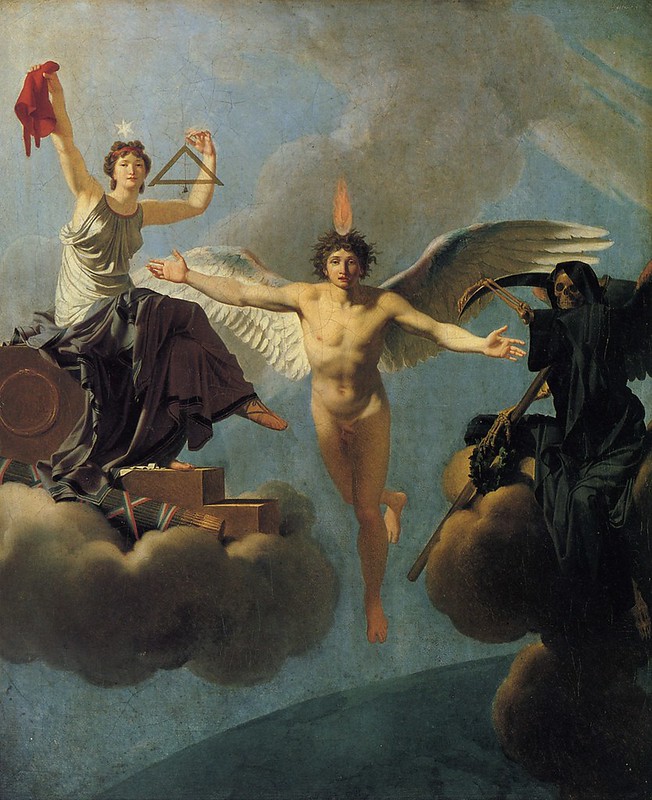
La
Liberté ou la Mort (1795) by Jean-Baptiste Regnault. Note the red
Phyrigian cap, a symbol of the French revolution also associated by some
with Freemasonry – Source.
The French Revolution, like all convulsive world events before and since, had been full of conspiracies, bred by the speed of events, the panic of those caught up in them and the limited information available to them as they unfolded. In Britain, enemies of the revolution such as Edmund Burke had claimed from the beginning that ‘already confederacies and correspondences of the most extraordinary nature are forming in several countries’, and by 1797 most believed – and with good reason – that secret societies in Ireland were plotting with Napoleon to overthrow the British government and invade the mainland. The power of Robison’s revelation was that it identified within the buzzing confusion of conspiracies a single protagonist, a single ideology and a single overarching plot that crystallised the chaos into an epic struggle between good and evil, whose outcome would define the future of world politics.
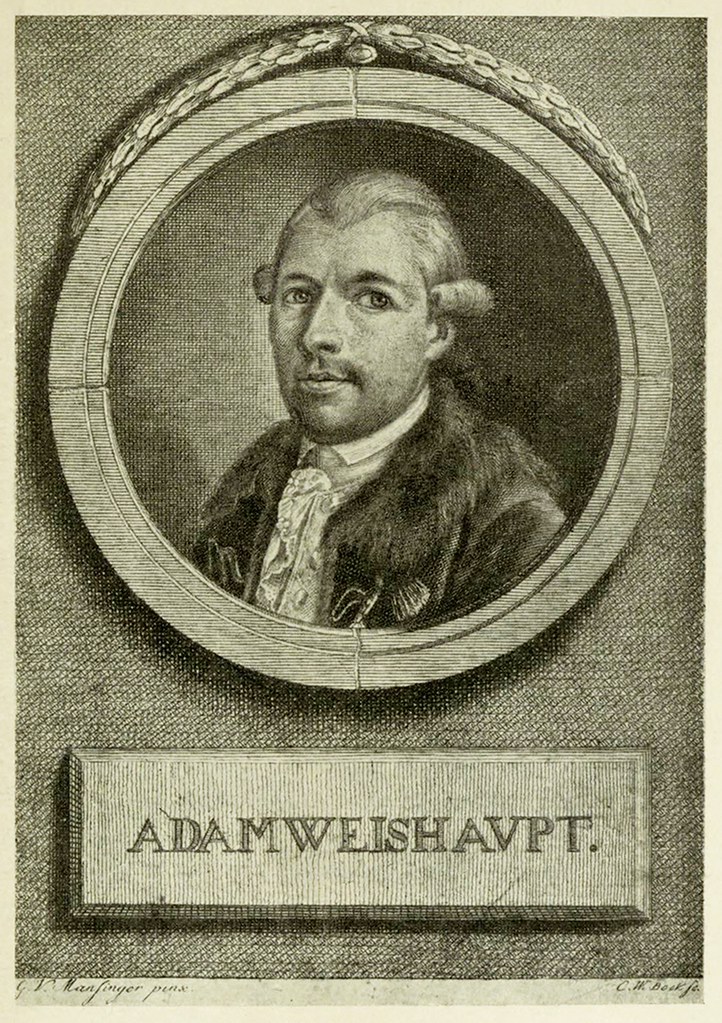
Portrait of Adam Weishaupt featured in Cagliostro: the splendour and misery of a master of magic (1910) by W.R.H. Trowbridge – Source.
Yet there was much in the career of the Illuminati that offered, to Robison at least, a view of a far more expansive and sinister scheme. Weishaupt’s messianic sense of his own mission and the Order’s extravagant structures hinted at a far larger organisation than that which had been exposed, and its suppression had generated a furore quite out of proportion to the danger it represented. It had become a lightning-rod for the deep anxieties of church and monarchy about the agenda of reason and progress that was being seeded across Europe by the confident vanguard of philosophers and scientists. The Illuminati furore had generated hundreds of screeds, polemics, handbills and scandal sheets, all competing to file the most damning charges of godless infamy. It was these sources that Robison had spent years perusing intently for anecdotes and allegations to mould into the proofs of the conspiracy that he now presented. To the dispassionate observer, Weishaupt and his Illuminati might have offered an eloquent metaphor for the forces that were reconfiguring Europe, but for Robison they had become the literal cause: the centre, thus far invisible, of the web of events that had consumed the world.
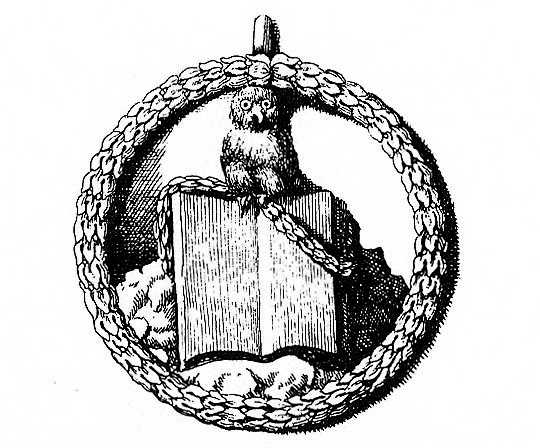
The original insignia of the Bavarian Illuminati: the owl of Minerva, symbolising wisdom, on top of an opened book – Source.
By 1797 Robison’s character had taken a grave and saturnine turn, far removed from the cheerful and convivial temperament of his youth. In 1785 he had begun to suffer from a mysterious medical condition, a severe and painful spasm of the groin: it seemed to emanate from beneath his testicles, but its precise origin baffled the most distinguished doctors of Edinburgh and London. Racked with pain and frequently bed-ridden, by the late 1790s he had become a withdrawn and isolated figure; he was using opium frequently, a regime which according to some of his acquaintances made him vulnerable to melancholy, confusion and paranoia. As the successive crises of the French Revolution shook Britain, the panic was particularly intense in Scotland, where ministers and judges whipped up constant rumours of fifth columnists and secret Jacobin cells. Tormented, heavily medicated and assailed by terrifying news from the outside world, Robison had all too many dark threads to weave into the plot that came to consume him.
Portrait of John Robison (1798) painted by Henry Raeburn – Source.
Robison had never accepted the French theories, and by 1797 had worked the new chemistry deep into his Illuminatist plot. For him, Lavoisier – along with Britain’s most famous experimental chemist, the dissenting minister Joseph Priestley – was a master Illuminist, working in concert with infiltrated Masonic lodges to spread the doctrine of materialism that would underlie the new atheist world order. Madame Lavoisier’s famous salons, at which the leading Continental philosophes met, were now revealed by Robison to have been the venues for sacreligious rites where the hostess, dressed in the ceremonial robes of an occult priestess, ritually burned the texts of the old chemistry. Implausible though this image might seem, it was of a piece with other proofs that Robison had assembled in his book – for example, the anonymous German pamphlet that claimed that, at the great philosopher Baron d’Holbach’s salons, the brains of living children bought from poor parents were dissected in an attempt to isolate their life-force.
Initiation
of an apprentice Freemason around 1800, an engraving (ca. 1805) based
on that by Gabanon on the same subject dated 1745 – Source.
Although Proofs of a Conspiracy became a handsome bestseller, the Illuminati conspiracy never gripped the imagination of the British political class as it did in mainland Europe. Once the crisis of the French revolution was past, some conservative voices would attribute this to superior British common sense, but in truth Britain at that time had more serious threats and conspiracies to contend with. Tom Paine’s Rights of Man, a far more incendiary and radicalising work than any of the Bavarian Illuminati’s ‘secret texts’, had sold over two hundred thousand copies in its cheap sixpenny edition, a number that far exceeded what until that point had been considered the entire book-buying public. With the British fleet convulsed by mutinies and the government struggling to contain mass protests and riots, it was hardly surprising that the doings of a long-disbanded Bavarian lodge seemed less than a pressing concern.
Detail
from “Washington As Master Mason”, a print showing U.S. President
George Washington presiding over a meeting of the Lodge of the
Alexandria, Virginia Masonic Lodge, by James Fuller Queen (1870) – Source.
But such charges were never substantiated; the ‘Illuminati Scare’ petered out and the Federalists lost power, never to regain it. Yet the episode had touched a nerve deep within the American political mindset, and it has been woven into many subsequent paranoias and panics. Robison’s ideas would continue to be rediscovered and reinvented, and to influence modern politics in curious ways. The doyenne of modern conspiracy theory, Nesta Webster, swallowed his theory whole but then came to believe the Illuminati were a smokescreen: the true conspirators were the ‘Jewish peril’ whose agenda had, she believed, been accurately exposed in the Protocols of the Elders of Zion. Although Webster later consigned herself to the margins by joining the British Union of Fascists, her support at the time was more broadly based, and she even won admiring citations in the journalism of Winston Churchill. ‘The conspiracy against civilization dates from the days of Weishaupt’, Churchill wrote for the Sunday Herald in 1920; ‘as a modern historian Mrs. Webster has so ably shown, it played a recognisable role in the French revolution’. Many on the isolationist right continue to believe Robison’s theory to this day: the official John Birch Society line, for example, remains that Weishaupt’s Illuminati ‘was the ancestor of the Communist movement and the model for modern subversive conspiratorial movements’.
A
version of the reverse of the Great Seal of the United States printed
in a 1909 U.S. Government booklet on the Great Seal. According to Henry
A. Wallace, this was the version of the Great Seal reverse which caught
his eye, causing him to suggest to President Franklin Roosevelt to put
the design on a coin, at which point Roosevelt decided to put it on the
back of the dollar bill – Source.
There was much plain sense in Playfair’s analysis, and it could equally be applied to many who subsequently came to believe in Robison’s theories, and who continue to believe them today. But if the shock of the modern world erupting into existence before his eyes had unbalanced Robison’s judgement, it had also given him a vivid, even visionary perspective on the new dangers that might result from wresting politics away from church and monarchy and placing it in the hands of the people. Forged in the same crucible as every modern political ideology from conservatism to nihilism, anarchy to military dictatorship, the Illuminati conspiracy has become a modern myth: not merely in the dismissive sense that its factual basis evaporates under scrutiny, but as a shapeshifting narrative capable of adapting its meaning to accommodate new and unforeseen scenarios. Since the 1970s, it has been gleefully satirised as a baroque folly of conservative thought by counterculture figures from Robert Anton Wilson onwards, yet this has only increased its fame and mystique: Dan Brown’s Angels and Demons demonstrates that today’s readers will still lap up Robison’s unreconstructed version of the story in their millions. In popular culture and old-time religion, satire and nationalist politics, the Illuminati conspiracy still resonates with its warning that the light of reason has its shadows, and even the most enlightened democracy can be manipulated by hidden hands.
Reprinted from The Public Domain Review.

LRC Blog
- Investigating the Illuminati
- Are Campaign Donations ‘Free Speech’?
- College Kids Unbrainwashed About Politics
- They Think They Know How to Pick Successful Presidential Candidates
- So What?
- For Once I Agree with Sarah Palin
- Conservatives Defame a Good Man
- The Threat to Religious Liberty in the Military
- Onward Christian Soldiers
- The Grand Illusion: Safety Provided by Government
Podcasts
- Bill Sardi: Defending Health Against the Government
- Lew Rockwell: the NY Times Doesn’t Like Me
- Lew Rockwell: The Truth Shall Make Us Free
- Ralph Weber: Against Fascist Healthcare
- John Denson: My Two Famous Cousins in WWII

No comments:
Post a Comment