The History of the Hazard Circular
The History of the Hazard Circular
Aside October 20, 2014 fileandclaw322 Primary DocumentsBank of England, conspiracy, Hazard Circular, Wall Street
Slavery is
likely to be abolished by the war power, and chattel slavery destroyed. This I
and my European friends are in favor of, for slavery is but the owning of labor
and carries with it the care of the laborer, while the European plan, led on by
England, is capital control of labor by controlling wages. THIS CAN BE DONE BY
CONTROLLING THE MONEY.
– Hazard Circular, 1862
While re-reading the Gustavus Myers book “The History of the
Great American Fortunes”, I stumbled upon a little factoid, caught in the
massive spiderweb of knowledge that is that three volume tome. Pulling upon
that thread I was lucky enough to find at the end of it a book that I am
reasonably certain has been long forgotten, and so I am currently reading it
into an audiobook format for your listening pleasure. However, as is always the
case, I have stumbled upon yet another
interesting bit of information in this current book, and this would be the
“Hazard Circular”. In the book it was simply referenced as a circular (or
letter) from “the creditors” of the United States, circa 1862, to every bank in
New York and New England. The contents of this circular are very provocative;
they set out the fact that the banks use the control of the creation of money
to enslave people through devaluing their wages. I was quite shocked by this
brazen statement and so I set forth in search of its origins. Little information
was readily available on the internet, so I turned to the old and mouldering
books and periodicals of a century ago to disinter the true history of the
“Hazard Circular”…
THE GENESIS
First and foremost, it would be wise to lay out the contents of the circular in
full form and provide a little background about the time in which it was
allegedly written. The circular (or private letter) was purported to have been
brought to America by a Mr. Charles Hazzard, from whom the circular derives its
name. Mr. Hazzard, it is said, was an agent of the capital and banking
interests in London. The circular letters, with which he was charged with
distributing, were to be given to the capitalists and bankers in New York and
New England. The full letter reads as follows:
Slavery is
likely to be abolished by the war power, and chattel slavery destroyed. This I
and my European friends are in favor of, for slavery is but the owning of labor
and carries with it the care of the laborer, while the European plan, led on by
England, is capital control of labor by controlling wages. THIS CAN BE DONE BY
CONTROLLING THE MONEY. The great debt that capitalists will see to it is made
out of the war must be used as a measure to control the volume of money; to
accomplish this the bonds must be used as a banking basis. We are now waiting
to get the Secretary of the Treasury to make this recommendation to Congress.
It will not do to allow the “greenback,” as it is called, to circulate as money
any length of time, for we cannot control them, but we can control the bonds,
and through them the bank issue.
Chas. Hazzard.
 $1
Greenback from 1862 At the time of the circular’s alleged distribution by Mr.
Hazzard in 1862, the United States had been fractured and was deeply embroiled
in the sanguinary combat of the American Civil War. It would
indeed be by the force of this “war power” that the institution of chattel
slavery would be undone in the United States, a fact that was, whether by
coincidence or prescience, eerily predicted in the “Hazard Circular”, for it
would not be until 1863, that President Lincoln delivered the Emancipation
Proclamation, making the abolition of chattel slavery a goal of
the war effort. The “Greenback”
currency mentioned in the circular, was the fiat-stuff which
sustained the Union Government during the period of the war. The expenditures
of the conflict far exceeded the revenues of the Union, and rather than turn to
usurious loans from foreign powers, the Government would print about
$450,000,000 of the paper money, backed by nothing, but free of debt. This
short experiment with Government issued notes was to be just that. Again, as
the “Hazard Circular” predicted, after the war, agitation began immediately to
return to the gold-standard and abandon the Greenback, and its circulation was contracted over
several years. This was punctuated by the Panic of 1873 and the resulting
“Great Depression” (a period of economic distress only overshadowed by the
events of the 1930’s), which would help to bring monetary policy to the
forefront of the public’s mind. These were a few of the events in the years
surrounding and succeeding the distribution of the “Hazard Circular” in 1862,
although it would not become known to the general public for another 20 or so
years.
$1
Greenback from 1862 At the time of the circular’s alleged distribution by Mr.
Hazzard in 1862, the United States had been fractured and was deeply embroiled
in the sanguinary combat of the American Civil War. It would
indeed be by the force of this “war power” that the institution of chattel
slavery would be undone in the United States, a fact that was, whether by
coincidence or prescience, eerily predicted in the “Hazard Circular”, for it
would not be until 1863, that President Lincoln delivered the Emancipation
Proclamation, making the abolition of chattel slavery a goal of
the war effort. The “Greenback”
currency mentioned in the circular, was the fiat-stuff which
sustained the Union Government during the period of the war. The expenditures
of the conflict far exceeded the revenues of the Union, and rather than turn to
usurious loans from foreign powers, the Government would print about
$450,000,000 of the paper money, backed by nothing, but free of debt. This
short experiment with Government issued notes was to be just that. Again, as
the “Hazard Circular” predicted, after the war, agitation began immediately to
return to the gold-standard and abandon the Greenback, and its circulation was contracted over
several years. This was punctuated by the Panic of 1873 and the resulting
“Great Depression” (a period of economic distress only overshadowed by the
events of the 1930’s), which would help to bring monetary policy to the
forefront of the public’s mind. These were a few of the events in the years
surrounding and succeeding the distribution of the “Hazard Circular” in 1862,
although it would not become known to the general public for another 20 or so
years.
THE CIRCULAR SURFACES
It was not until 1886, that the “Hazard Circular” would be disclosed to the
general public. The disclosure would percolate through the presses of the
United States over the next decade, and become a keystone of the partisan
rhetoric of the blossoming “Populist”
Movement. During the 1890’s the “Hazard Circular” and several
other provocative letters would make their rounds through the public
conscience. To some, the letters were seen as one of the “greatest infamies
of civilized history“[1],
and proofs of a vast conspiracy by the industrial-capitalist class to
manipulate the American economy and therefore the destinies of the people.
Others would claim the letters to be “proven forgeries“[2], even going so far as to offer a
bounty of $100 in gold for any proof to the contrary[3].
While the debate raged on about the authenticity of the document, few actually
bothered to trace its origin. Little evidence was ever offered to prove the
“Hazard Circular” forged and spurious, and on the opposite side, it is doubtful
anyone ever claimed the $100 golden reward offered by Joseph W. Ady.
However, for the researcher not merely interested in the partisan mudslinging
of the time, further information on the circular slowly leaked through the
press.
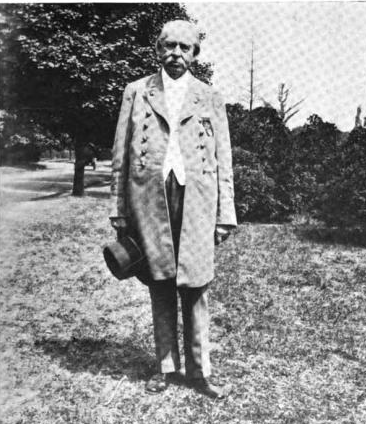 Col. Lee
Crandall – newspaper publisher and Confederate soldier. Sometime in 1893 (this
is the earliest date I could find), a letter which revealed the origins of the
“Hazard Circular” was printed[4]. In
the correspondence between newspaper publisher Lee Crandall and Isaac Sharp, a
lawyer from Kansas, the latter laid claim to the original publishing of the
infamous circular and revealed how it came into his possession (emphasis
added):
Col. Lee
Crandall – newspaper publisher and Confederate soldier. Sometime in 1893 (this
is the earliest date I could find), a letter which revealed the origins of the
“Hazard Circular” was printed[4]. In
the correspondence between newspaper publisher Lee Crandall and Isaac Sharp, a
lawyer from Kansas, the latter laid claim to the original publishing of the
infamous circular and revealed how it came into his possession (emphasis
added):
To Col.
Lee Crandall, Secretary of the National Executive Silver Committee:
SIR — In reply to your polite
request of yesterday, expressing a desire to be informed of the origin of the
copy of the Hazard Circular copied by the National View some four years ago
from the Council Grove Guard then
published by me in Council Grove, Kansas, I have to say that I obtained the original copy from a Mr.
J.W. Simcock, the cashier of the First National Bank of Council Grove, Kansas.
I, at that time — say about the year 1873 — was the attorney for that Bank, and one day when the cashier was writing up
and arranging a large number of accumulated letters and other papers of
supposed value, either he or I came across the Hazard Circular, together with
the circular of the American Bankers and signed by one, Buell. I asked Mr.
Simcock for these two circulars, and he gave them to me then; and, at the same
time, in reply to questions I asked him, he said that their day of usefulness
was over — that his friends in New York,
some Bankers there, sent them to him, that he might the better understand
the history and origin of the National Banking system, as he was comparatively
a new Banker. I kept them for the light they threw upon the financial questions
of the times, and first published the
Hazard Circular September 18th, 1886, omitting the date therefrom, for the
reason that it had dropped off — having been so folded that, when I came to
print it, the date had lost off. The date was that of the summer or fall of
1862, but the exact month or day I cannot recollect — November, I think.
Very respectfully,
(Signed) ISAAC SHARP
738 10th St. N.W., Washington, D.C,
August 20th, 1890.
ISSAC
SHARP AND THE BANK
Mr. Isaac “Ike” Sharp traces his lineage all the way back to Samuel Sharp, a
member of the Society of Friends
who
 Portrait
of Isaac Sharp of Council Grove, Kansas. emigrated to North America with
William Penn and settled the colony of Pennsylvania. This was the same Samuel
Sharp who was responsible for largely surveying the city of Philadelphia.
Isaac’s father was a respected Quaker physician, and the lad was born in
Lancaster county, Pennsylvania in 1832. There he lived and studied law under
the tutelage of Thaddeus Stevens, while teaching
students himself from the age of 17 to 24. In 1858, he headed out west to
commence in the Indian trade and went as far west as McPherson county in
Kansas. In 1862, he settled in Council Grove where he practiced law, was
elected mayor of Council Grove, and was two times a delegate and vice-president
of the Democratic National Convention, once in 1868 and again in 1872.[5] The apex of his political
career was an unsuccessful Democratic bid for Governor of Kansas in 1870 against
James M. Harvey.
Although losing by over 20,000 votes, he managed to salvage from the run the
title of Governor, which was continually bestowed upon him in order to enhance
his importance and reputation,[6]
despite the fact that he “was never governor of anything, not even of his own
appetite.”[7]
Portrait
of Isaac Sharp of Council Grove, Kansas. emigrated to North America with
William Penn and settled the colony of Pennsylvania. This was the same Samuel
Sharp who was responsible for largely surveying the city of Philadelphia.
Isaac’s father was a respected Quaker physician, and the lad was born in
Lancaster county, Pennsylvania in 1832. There he lived and studied law under
the tutelage of Thaddeus Stevens, while teaching
students himself from the age of 17 to 24. In 1858, he headed out west to
commence in the Indian trade and went as far west as McPherson county in
Kansas. In 1862, he settled in Council Grove where he practiced law, was
elected mayor of Council Grove, and was two times a delegate and vice-president
of the Democratic National Convention, once in 1868 and again in 1872.[5] The apex of his political
career was an unsuccessful Democratic bid for Governor of Kansas in 1870 against
James M. Harvey.
Although losing by over 20,000 votes, he managed to salvage from the run the
title of Governor, which was continually bestowed upon him in order to enhance
his importance and reputation,[6]
despite the fact that he “was never governor of anything, not even of his own
appetite.”[7]
From this quick biographic sketch, we should note that Mr. Sharp was in Council
Grove and practicing law as early as 1862. This will coincide with information
furnished hereafter, on the operations of the First National Bank of Council
Grove. It should also be apparent that Sharp was a politically well-connected
lawyer in his day, as being vice-president of the Democratic National
Convention is a position that carries a certain measure of clout; It should not
be much of a stretch for the reader to imagine him employed as attorney for the
well-to-do bank of the city.
So what of this bank and it’s cashier, who are alleged to have passed the
“Hazard Circular” into Mr. Sharp’s possession? The First National Bank of
Council Grove was organized in 1872,[8]
in the flood of “national” banks that were erected following the passage of the
National Banking Acts of 1863-64.
It’s president was Edward S. Stover, and the bank was chartered with a capital
of $50,000[9], however, it would
only stay open for a mere four years before failing and moving into voluntary
liquidation in 1876[10], during the
“Great Depression” as has been mentioned previously. Four years though,
appears to have been just enough time for the “Hazard Circular”, to be sent to
from New York to the cashier at the First National Bank of Council Grove, John
W. Simcock, to aid in his comprehension of the National Banking system. His
name has several times been presented erroneously in national registers as John W. Simcook[11], but he was indeed the cashier for that bank during it’s time
of operations. John Simcock also had a banking firm in Council Grove by
the name of J. W. Simcock & Co., Bankers.[12]
From Mr. Simcock, several interesting evidentiary tributaries appear
which further strengthen the link between Isaac Sharp and the bank where
his copy of the “Hazard Circular” is alleged to have originated. In the
final month before the First National Bank of Council Grove was liquidated,
John Simcock was made its President, taking over the position held by one “R.
M. Ruggles.”[13] This would
appear to be the Hon. Robert M. Ruggles, who became a very prominent lawyer in
Emporia, Kansas around 1860, and two years later would be appointed to the
bench of the fifth district.[14]
After leaving the bench, Ruggles would resume his law practice with future
congressmen William R. Brown under the firm name of
Ruggles & Brown. However in 1867, Brown would be elected to the bench
as judge of the 9th circuit court and leave the practice. Ruggles, now needing
a new partner in the firm, would bring on board another future Congressman, Preston B. Plumb.[15] The firm of Ruggles &
Plumb became preeminently successful in Kansas, expanding business to all
corners of the state. It is in this company of men that connections start
appearing. Sharp, Ruggles, and Plumb, all being politically connected lawyers
in Kansas (within 40 miles of each other), were certainly well acquainted with
one another, and perhaps even in business together.
This fact is made apparent by a legal notice filed in the Emporia News newspaper in 1867, where the attorneys listed for the
plaintiff are “ISAAC SHARP, and RUGGLES & BROWN,”[16] and another legal notice filed a year later by attorneys
“RUGGLES & PLUMB & ISAAC SHARP.”[17]
Unfortunately, there is no currently available information as to whether Mr.
Sharp was in the employ of Ruggles & Plumb, or was merely working on the
same case with them, but the direct connection of the three is evident. To
further illustrate the connection, in an obituary for Preston Plumb, it is
revealed that Sharp had given Plumb his bar examination in 1860.[18]
Finally, it should be noted that Preston B. Plumb gradually withdrew from the
practice of law to go into that ever lucrative business of banking. In 1873, he
traveled to Washington D.C., to secure a charter for the First National Bank of
Emporia, of which institution he was later made President.[19] From there it was only four short years before he would
be elevated to the lofty playground of bankers and lawyers, the United States
Senate. Interestingly enough, shortly after being elected to the Senate,
Plumb would buy a large stake in a little banking firm in Council Grove by the
name of J. W. Simcock & Co., in 1878.[20]
Later that same year, J. W. Simcock & Co. would be dissolved and taken over
by the First National Bank of Emporia,[21]
the same where Plumb was formerly President.
BANKER FRIENDS IN NEW YORK
We are now beginning to see the pieces of Mr. Isaac Sharp’s story interlock as
verifiable facts. Dates and places and characters are beginning to align. But
who were these banker friends in New
York who sent John W. Simcock the “Hazard Circular” which eventually wound up
in the newspapers of America? Surely they must have been powerful Wall
Street financiers to be entrusted with such a sensitive scheme as is laid out
in the circular. Perhaps a clue is offered by the New York Correspondents
listed for the First National Bank of Council Grove: Northrup & Chick.[22]
Northrup & Chick was the banking house of Hiram M. Northrup, well-known
frontier trader and “trusted friend and counselor”[23] of the Indians, and Joseph S. Chick, known as “one of the
financial pioneers of the new West”.[24]
The two men appear to have had their start in a partnership which traded in
furs and “government annuities” with the local tribes in the Kansas City
area. Both of these trades were infamously known to be rife with fraud
& corruption[25], of which the firm Northrup &
Chick engaged in the common method of business at the time; that of extending
credit to the Indians for extortionately priced goods, inducing them woefully
to indebtedness, and then demanding payment from the government.
According to a report in the House of Representatives in 1895, the Pottawatomie
tribe had incurred, by the practices of the traders, the massive sum of
$98,601.11 of debt, of which, $5,552.68 was claimed by Northrup & Chick.
After careful scrutiny by a government committee, the exaggerated claims were
revised down to $43,365.91 in total, and Northrup & Chick’s claims were
reduced to $3,529.98. And what did these “trusted friends and counselors”
of the Indians do when it was suggested that only 50 cents on the dollar be
paid for these inflated debts? They “objected to this mode of settlement
and demanded payment in full.”[26]
Through methods such as these, the trade of the firm blossomed and they
established trading posts throughout the Indian Territories, with trade
reaching into Arizona, New Mexico, and what is now Colorado and Utah, and sales
reaching in excess of $300,000 annually. It was said of their power and
prestige as traders that at one point in time, their business houses were the
“headquarters of trade for the western country”. It was during this time
that Messrs. Northrup & Chick entered the lucrative field of banking, by
establishing a bank in Kansas City (Northrup & Co.), in 1857. From here
they expanded rapidly into the business with Mr. Northrup becoming the first
president of the newly opened Kansas City branch of the Union Bank of Missouri,
a position he held we are told, until the Missouri Legislature passed a law
forbidding “any private banker from holding office in any state bank”.[27]
It was now that the firm had reached a great plateau of prowess in the world of
American finance and with the outbreak of the Civil War, Mr. Northrup removed
himself to the playground of the financial elite, New York City, in 1861. Here
he boldly planted the flag of Northrup & Chick in that upper strata of
financial magnates, by establishing a banking house at No. 6, Wall Street.[28] His partner J. S. Chick,
would also move his family to New York a year or so later. It was during this
time that the firm became large holders in the New York Stock Exchange and entered into the shady world of
over-the-counter derivatives.
 (c) Bank
of England, no pun intended. During the opening months of the Civil War, the
uncertainty of the conflict lead to a massive drain in gold, causing the heads
of the top banks in New York City to meet on December 28th, 1861 and vote to
suspend specie payments. The US Government would follow suit two days later. By
the start of the next year, gold derivatives were being listed at the Stock
Exchange. As the war progressed the price of gold fluctuated with extreme
volatility responding to constant flow of news on the wars progress, “advancing
on Federal defeats and declining on Federal victories.”[29] Perhaps it was for this reason that Congress briefly
enacted the Anti-Gold Futures
Act of 1864, severely limiting all transactions in gold by force
of imprisonment or heavy fine? Regardless, the act was soon repealed and
in October of 1864, the New York Gold Exchange was organized in a room in the
northeast corner of William and Beaver Streets and the firm of Northrup &
Chick was one the founding members. In 1867 the New York Gold Exchange Bank was organized as a clearing-house and
averaged about $70,000,000 a day in transactions,[30] which quickly increased exponentially.
(c) Bank
of England, no pun intended. During the opening months of the Civil War, the
uncertainty of the conflict lead to a massive drain in gold, causing the heads
of the top banks in New York City to meet on December 28th, 1861 and vote to
suspend specie payments. The US Government would follow suit two days later. By
the start of the next year, gold derivatives were being listed at the Stock
Exchange. As the war progressed the price of gold fluctuated with extreme
volatility responding to constant flow of news on the wars progress, “advancing
on Federal defeats and declining on Federal victories.”[29] Perhaps it was for this reason that Congress briefly
enacted the Anti-Gold Futures
Act of 1864, severely limiting all transactions in gold by force
of imprisonment or heavy fine? Regardless, the act was soon repealed and
in October of 1864, the New York Gold Exchange was organized in a room in the
northeast corner of William and Beaver Streets and the firm of Northrup &
Chick was one the founding members. In 1867 the New York Gold Exchange Bank was organized as a clearing-house and
averaged about $70,000,000 a day in transactions,[30] which quickly increased exponentially.
The New York Gold Exchange Bank, then
known as a clearing house, would now be considered a Central Counterparty
(CCP).[31] Today, these CCPs
are supposed to be firewalls for mitigating “counterparty credit risk”, by
“mutualizing” that risk between all the members of the CCP (think streamlining
the process of creating “To Big To Fail”). These are extremely important pillars
in the financial structure of the markets today, and even though back in the
19th century, they were mostly used for clearing payments in the commodity
futures markets of the time,[32]
their power and prominence should in nowise be underestimated.
Unfortunately of Northrup & Chick, the New
York Gold Exchange Bank would be massively stung by the the Black Friday Gold
Conspiracy of 1869, when Jay Gould and James Fisk attempted to
corner the gold market.[33] In
the aftermath of it’s failure, J. S. Chick would be asked to join the
directorship of the failing New York Gold
Exchange Bank, where he was said to be instrumental in helping liquidate
the bank and making sure that all stockholders, including his own firm,
“received par for their stock”.[34]
Both Northrup and Chick would return to Kansas in 1874 after taking a large hit
from the Panic the year before.
Although we have now strayed far from the Midwest and Council Grove, in
examining the financial connections of those who are at he heart of the initial
leaking of the “Hazard Circular,” we have unearthed tangible and direct lines
to Wall Street, and the large capitalists of the mid and late 19th centuries.
We have thoroughly shown that the First Bank of Council Grove, through their
correspondents of Northrup & Chick, had direct lines to financial power at
the Wall Street level, and that Mr. Simcock’s banker friends in Wall Street who
dispatched him the “Hazard Circular”, may very well have been somebody in the
powerful employ of H.M. Northrup and J. S. Chick.
SWORN TESTIMONY MUDDIES THE WATER
While the debate over the authenticity of the “Hazard Circular” raged on
amongst the people of America, another piece of the puzzle came to light in
1894 (although the earliest publishing I could find was in 1895).[35] Published under the title
“Hazzard was Here,” it contains the contents of a sworn affidavit from a Mr.
James G. Nisbett of Posey County Indiana.
In the affidavit, Nisbett claims to have encountered Charles Hazzard in
Lebanon, Kentucky, while on guard duty there as a member of the Indiana
Infantry during the Civil War. On orders from his superior, Nisbett stopped and
questioned Hazzard about his business, and then came into possession of a
package of envelopes containing the “Hazard Circular”, of which he kept an
original copy, and reads from it in the affidavit:
State of
Indiana,
County of Posey,
James G. Nisbett, being duly sworn
deposes and says: I am seventy-three years of age and live in Posey County,
Indiana, where I have resided for sixty-five years. In 1861 I and Sheridan
Anderson, who is now dead, of the same county, enlisted in the service of the
United States Army, Sixtieth Regiment and Company C of the Indiana Infantry. In
July, 1862, our command joined the forces of General Dumont at Lebanon, Ky.
About the twenty-fifth of the same month Mr. Anderson and myself were detailed
as guards and placed on police duty on Main Street. In passing near the
General’s headquarters we were hailed and ordered to “shadow” a party of three
persons – one woman and two men – who were then passing on the opposite side of
the street, find out their business and report. We learned that one man and the
woman were Kentuckians and the other man was an Englishman. We had considerable
conversation with the Englishman who gave his name as Chas. Hazzard. He said he
had recently come from England to confer with the business men of this country
in a financial scheme. We told him that he was lucky in striking a very large
body of
very busy men, and as representatives of
headquarters we desired tangible information of his business that we might
report it to the authorities. In response to this he took one of a small
package of envelopes and gave it to Mr. Anderson, saying its contents would
explain the business and allay any suspicions that might have arisen regarding
him. This occurred in the post-office, and we then reported the matter to
General Dumont at headquarters, giving him the circular in the presence of
several officers who happened to be present at the time. An exact copy of that
document was kept by us, and the following is a correct reading of the same.
[Here follows the circular printed
above.]
James G. Nisbett.
Subscribed and sworn to before me this
29th day of May, 1894.
John B. Smith,
(Seal) Notary Public.
While the testimony is very interesting, it immediately
raises a few questions. Why would Hazzard, who is alleged to be an agent
of English bankers on a confidential mission, give out so much information on
his business? Why should he reveal that he is in America to conduct a
“financial scheme”? Why give away so many copies of the secret and
sensitive document? Why give away any at all? For these questions
which cast some doubt upon the story presented, no answers are forthcoming. I
have not been able to verify much of this piece of evidence, except to note
that it is very likely that James G. Nisbett is a real person, and that he may
have ran for Congress in the early 1880’s.[36]
WHO HAS AN ORIGINAL COPY AND OTHER LEADS
Last but not least, a short paragraph on who is known to have a copy of the
“Hazard Circular” and other leads as to finding an original copy. Isaac
Sharp is the first and obvious source. He was the one who initially published
it in the Council Grove Guard in 1886. Lee Crandall is another who may
potentially have an original copy. He was the publisher and editor of the
periodical The National View,[37] where the “Hazard Circular” was
printed and reached a wider audience. Mr. Crandall was also responsible
for publishing Isaac Sharp’s letter on the origin of his possession of the
circular. Other individuals I have not yet checked out would be Col.
Jesse Harper of Dansville, Illinois and Seymour F. Norton, who published the
Chicago Sentinel, both of whom are also alleged to have original copies of the
“Hazard Circular”.[38]
Finally, there is supposed to be some information in a manuscript published by
Gordon Clark, entitled “The Anarchists of
Wealth: An Exposure of the Plot of the Red-Shield (Rothschild) to Destroy a
Republic“. This manuscript is listed on Google Books but
unavailable at the time of publishing.
——————————
Research and Written by FURIOUS STYLES
10/20/2014
I will be uploading the documentation for this article soon, please be patient!
Feel free to leave any comments or criticisms on the blog here. If you
have any info on “Hazard Circular”, you can always drop me an email at:
fileandclaw322(at)gmail(d0t)com
Or find me on Twitter: @fileandclaw322
——————————
FOOTNOTES
[1] “THE THREE GREATEST INFAMIES”; Goodland Republic; May 25, 1894; pg. 2.
[2] “FORGED DOCUMENTS.”; North Platte Semi-Weekly Tribune; Oct.
13, 1896; pg. 3.
[3] “UNION LABOR DOCTRINES”; Western Kansas World; Sep. 15, 1888; pg.
8.
[4] “THE FINANCIAL CONSPIRACY.”; Dakota Farmers Leader; Aug. 25, 1893;
pg. 1.
[5] The United States Biographical
Dictionary: Kansas Volume; S. Lewis &
Co.; 1879; pgs. 502-503.
[6] “Ex-Governor of Kansas Endorses
Peruna.” Advertisement; Salt Lake Tribune;
Jul. 9, 1905; pg. 5.
[7] Untitled Newspaper Clipping; Witchita Daily Eagle; Aug. 8, 1903; pg.
4.
[8] House Executive Documents Vol. IV,
42nd Congress, 3rd Session; US Gov’t
Printing Office; 1873; pgs. 274-277.
[9] The Banker’s Almanac for 1873; I. Smith Homans; 1873; pg. 19.
[10] The Banker’s Almanac and Register; I. Smith Homans; 1883; pg. 312.
[11] The Banker’s Almanac for 1873; I. Smith Homans; 1873; pg. 137*.
[12] “UP THE NEOSHO.”; Emporia News; Nov. 4, 1870; pg. 4.
[13] The Banker’s Magazine, Volume 31; I. Smith Homans; 1877; pg. 322.
[14] “DEATH OF JUDGE ROBERT M.
RUGGLES.”; Emporia News; May 2, 1879;
pg. 3.
[15] The Life of Preston B. Plumb; William E. Connelley; 1913; pg. 213.
[16] “Notice.” Legal Advertisements; Emporia News; Jun. 7, 1867; pg. 2.
[17] “Notice.” Legal Advertisements; Emporia News; Sep. 18, 1868; pg. 4.
[18] “Respect and Affection.”; Phillipsburg Herald; Dec. 31, 1891; pg.
2.
[19] The Life of Preston B. Plumb; William E. Connelley; 1913; pg. 216.
[20] “State News.”; Emporia News; Jan. 18, 1878; pg. 2.
[21] The Banker’s Magazine, Volume 33; I. Smith Homans; 1879; pg. 75.
[22] The Banker’s Almanac for 1873; I. Smith Homans; 1873; pg. 19.
[23] History of Wyandotte County,
Kansas: Volume 1 by Perl Wilbur Morgan; 1911; pg. 74.
[24] Magazine of Western History, Vol X;
1889; pg. 224.
[25] See our on-going audiobook of
Gustavus Myers’, “History of Great American Fortunes”, particularly, parts dealing with John
Jacob Astor’s American Fur Company.
[26] House of Representatives, 53rd
Congress, 3rd Session: Report No. 1927.
[27] The
United States Biographical Dictionary: Kansas Volume by S. Lewis & Co.;
1879; pg. 81.
[28] Trow’s New York City Directory; H. Wilson; 1872; pg. 860.
[29] The New York Stock Exchange; Francis L. Eames; 1894; pg. 109.
[30] Ibid; pgs. 111-113.
[31] Reforming Over-the-Counter Markets:
The role of central counterparties; Oshani
Perara; 2012; pg. 5.
[32] Central counterparties: what are
they, Why do they matter, how does the bank supervise them?; Amandeep Rehlon and Dan Nixon; 2013; pg.
2.
[33] Again, see the audiobook of “History of Great American Fortunes“.
[34] Magazine of Western History, Vol X;
1889; pg. 225.
[35] The Little Statesman; K. L. Armstrong; 1895; pgs. 213-214.
[36] Annual Reports of the Officers of
the State of Indiana; State of Indiana;
1884; pg. 123.
[37] Centennial History of the city of
Washington, D.C.; Harvey W. Crew;
1892; pgs. 463-464.
[38] “THAT BANK CIRCULAR.”; Los Angeles Herald; Oct. 16, 1896; pg.
4.
Posted by Baldwin Templeton at 4:13 AM 
Email ThisBlogThis!Share to TwitterShare to FacebookShare to Pinterest

No comments:
Post a Comment