| |||
| |||
These
are STRONG results. The ethical burden now lies on public agencies:
replicate or explain why not. Silence or deflection here would be
damning and that's EXACTLY what we will get. |


BREAKING STUDY: Infant Vaccination Increases Death Risk by Up to 112% vs Unvaccinated
Louisiana Department of Health death records reveal that infants vaccinated at 2 months are far more likely to die in the following month than unvaccinated infants.
|

| |||||||||||||||


A new study by Drs. Karl Jablonowski and Brian Hooker of Children’s Health Defense titled, Increased Mortality Associated with 2-Month Old Infant Vaccinations, analyzed linked Louisiana Department of Health immunization and death registry data to evaluate whether routine 2-month infant vaccinations (administered at 60–90 days of life) are associated with mortality in the subsequent month (90–120 days).
Using individual-level records from 1,225 infants who later died before age three, investigators compared infants vaccinated in the 2-month window with those unvaccinated during the same period, while holding age-at-death constant.
Infants vaccinated at 2 months showed consistently higher odds of death in the following month, with statistically significant risk increases spanning individual vaccines, cumulative exposure, sex, race, and combination products.
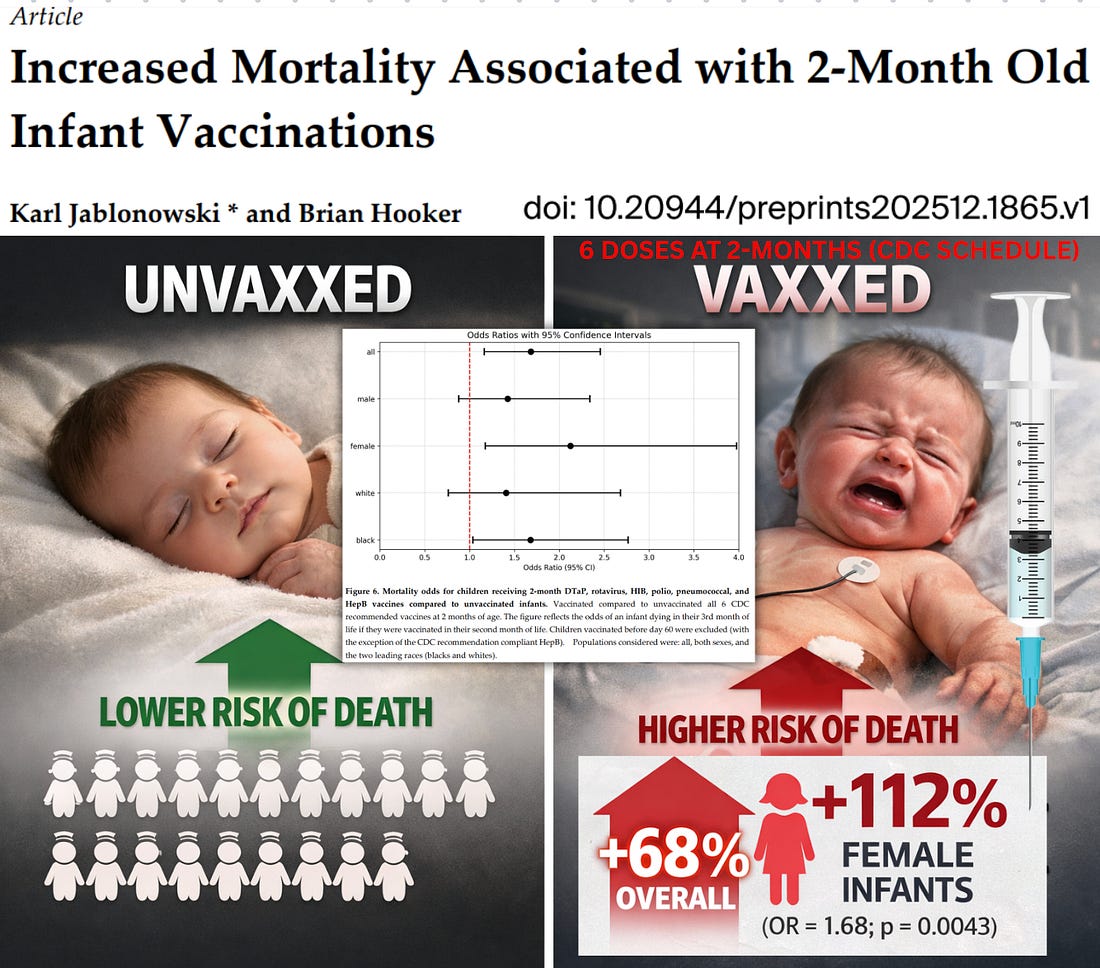
Most alarming, infants who received all six recommended 2-month vaccines had a 68% higher odds of death overall (OR = 1.68; p = 0.0043), with the risk surging to +68% in Black infants and +112% in female infants (OR = 2.12; p = 0.0083).
 |
Mortality risk increased with cumulative vaccine exposure (dose–response)
A clear cumulative risk pattern emerged as more vaccines were administered at the 2-month visit:
All five 2-month vaccines (DTaP, rotavirus, HIB, polio, and pneumococcal vaccines) compared to unvaccinated infants:
+60% (OR = 1.60; p = 0.0084 — statistically significant)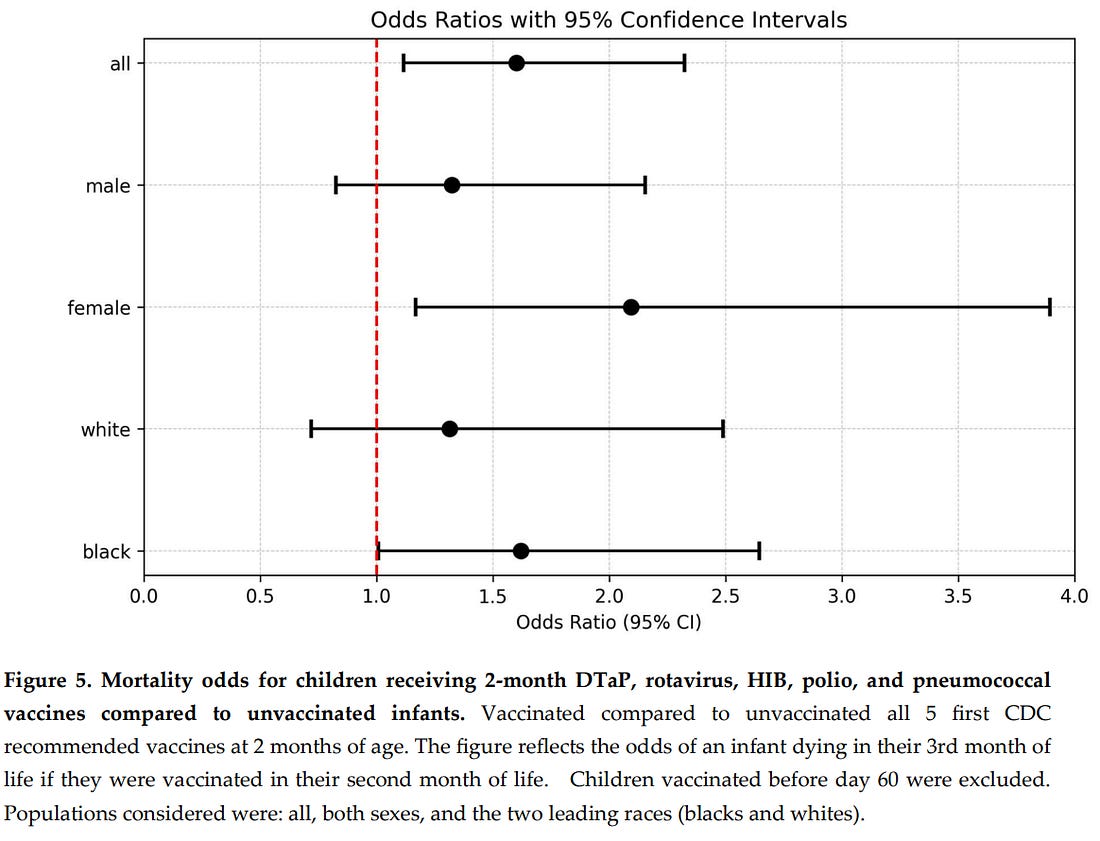
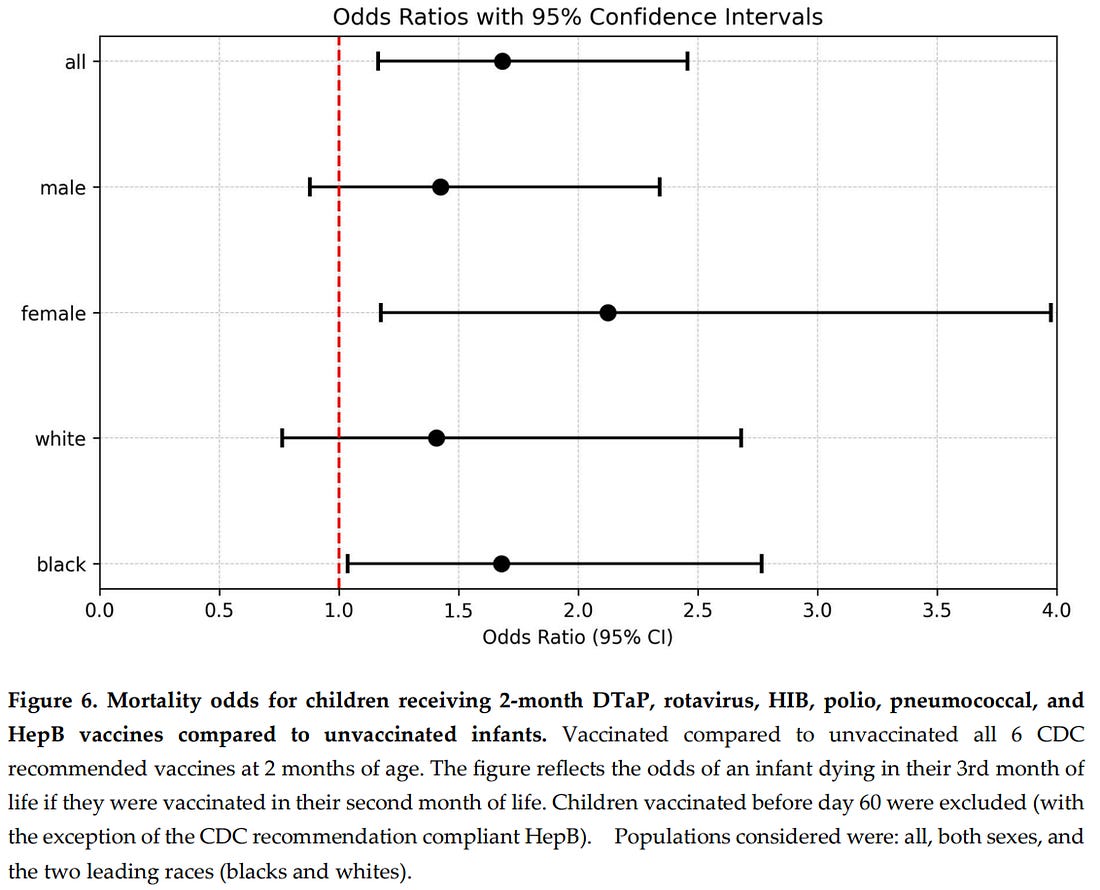
All six recommended vaccines (DTaP, rotavirus, HIB, polio, pneumococcal, and HepB vaccines) compared to unvaccinated infants:
+68% (OR = 1.68; p = 0.0043 — statistically significant)
 |
Subgroup analyses also showed even stronger cumulative effects:
Black infants (6 vaccines): +68% (OR = 1.68; p = 0.0311 — statistically significant)
Female infants (6 vaccines): +112% (OR = 2.12; p = 0.0083 — statistically significant)
This cumulative analysis—summarized in the paper’s abstract and Figure 6—represents one of the study’s central findings.
Individual 2-month vaccines were consistently associated with higher mortality
Compared with infants unvaccinated at 2 months, those receiving individual vaccines showed increased odds of death in the following month:
DTaP: +42% (OR = 1.42)
Hepatitis B: +29% (OR = 1.29)
Hib: +35% (OR = 1.35)
Polio: +32% (OR = 1.32)
Pneumococcal: +41% (OR = 1.41)
Rotavirus: +74% (OR = 1.74; 95% CI 1.26–2.41; p = 0.0005 — statistically significant)
For every vaccine examined, mortality was lower among infants who were unvaccinated during the same age window .
Female infants bore the greatest statistically significant risk
Sex-stratified analyses revealed that females consistently experienced far greater mortality increases than males:
DTaP: +98% in females (OR = 1.98; p = 0.013 — significant) vs +10% in males
Hib: +87% in females (OR = 1.87; p = 0.019 — significant) vs +6% in males
Polio: +77% in females (OR = 1.77; p = 0.036 — significant) vs +5% in males
Pneumococcal: +85% in females (OR = 1.85; p = 0.020 — significant) vs +14% in males
Rotavirus: +89% in females (OR = 1.89; p = 0.0088 — significant) vs +62% in males (OR = 1.62; p = 0.0277 — significant)
Combination vaccines produced the strongest mortality signals
Marketed combination products showed some of the largest and most statistically robust effects:
Pediarix® + Hib:
+40% overall
+96% in females (OR = 1.96; p = 0.0295 — significant)
Pentacel® + HepB:
+32% overall
+84% in females (increase noted; borderline or non-significant)
Vaxelis®:
+153% overall (OR = 2.53; p = 0.0054 — statistically significant)
+150% in females
+122% in Black infants
Vaxelis®, an 11-antigen combination vaccine containing aluminum adjuvants, exhibited the largest mortality association in the entire analysis .
CONCLUSION
Not only do the vaccinated experience far higher rates of chronic disease than the unvaccinated across all 12 comparison studies, but they now also appear to die at higher rates.
All 12 Vaccinated vs. Unvaccinated Studies Found the Same Thing: Unvaccinated Children Are Far Healthier | ||||||
| ||||||
 | ||||||
by Nicolas Hulscher, MPH | ||||||
|
Using official state records, this study shows that infant vaccines increase the risk of infant death compared to the unvaccinated—exposing a claim long used to shut down inquiry: that population-level harms are “undetectable.” They are detectable. And here, they were.
Mortality risk rose with cumulative exposure, disproportionately affecting female and Black infants, and reached statistical significance across multiple analyses. Replication across all states is no longer optional—it is a scientific and ethical imperative.
Epidemiologist and Foundation Administrator, McCullough Foundation
www.mcculloughfnd.org
Please consider following both the McCullough Foundation and my personal account on X (formerly Twitter) for further content.

No comments:
Post a Comment