House COVID report claims the COVID vaccines saved millions of lives citing statistical models as evidenceWhy they ignored direct measures of case rates and case fatality rates is a mystery to me.
Executive summaryAfter 2 years of work, the House Select Subcommittee on the Coronavirus Pandemic issued its final report. One stunning conclusion that caught my eye:
The references to back up their claimThey cited two articles, both of which referenced statistical modeling instead of direct measurements to make their claims: Two Years of U.S. COVID-19 Vaccines Have Prevented Millions of Hospitalizations and Deaths and Vaccines prevented up to 140,000 COVID-19 deaths in the U.S. The problem of course is that the models can’t explain the data that was actually observed. There are only two known ways a vaccine can possibly save livesTo save lives, a vaccine must do at least one thing really well:
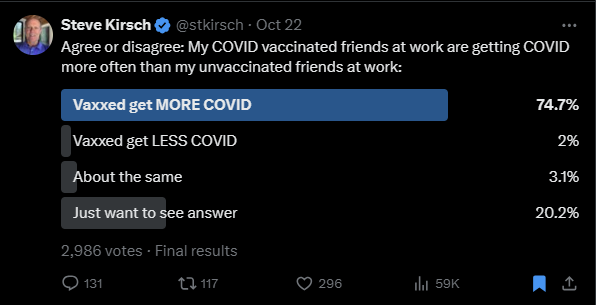
But the evidence that anyone can easily collect shows neither was true. The vaccinated were more likely to get COVIDYou can’t reduce the risk of infection of a respiratory virus through injection. This has never been done. In fact, it was shown in the two Cleveland Clinic studies that more vaccines lead to more infections and it can easily be verified by polling your friends like I did. Funny how nobody on their side wants to do the same poll, isn’t it?
The vaccinated were more likely to die from COVID if infectedEasily verified in my own home town using data posted by the Public Health Department in plain sight of everyone.  SummaryI’d love to understand why the House committee thinks statistical models are better than direct measures. One of us is very badly mistaken. And it isn’t me. Invite your friends and earn rewardsIf you enjoy Steve Kirsch's newsletter, share it with your friends and earn rewards when they subscribe.
|






No comments:
Post a Comment