I
continue to post literature for the purpose of educating people how
advanced nanotechnology really is and how long it has been around. When
doctors and scientist say there are no nanorobots, it just means they
have not taken the time to educate themselves towards a subject that has
been developed now for DECADES and is for many difficult to understand
due to its sophistication. The military is a major sponsor of the
development of micro and nano electronics, in fact the US military is a
leader in nanoweapons worldwide, as I have discussed in previous posts. I
have previously written articles and show historic military documents
to elucidate this point.
DOD Defense Nanotechnology Research And Development Program 2009 - Insights Into Development Of Self Assembly Nanotechnology
NASA Future Strategic Warfare Compared To Current Events. Are We In A War Of Our Military Against Us - We The People?
Here
I share an article from 2016 - 8 years ago - which explains the bio
engineering of microbes into full computers and sensors - and filaments
that are as effective as Carbon Nanotubes. Remember the plan is to
digitize all life on earth, computerize it, utilize it for data
harvesting for AI and battlespace interrogation. Humanity is the
battlespace.
A
microbe so common it’s found everywhere from the muddy bottom of the
Potomac River to soil hundreds of meters into the earth could one day be
wiring the military’s nanotechnology and sensing toxic chemicals from
unmanned vehicles.
The bacteria, called Geobacter,
thrive where organic life normally couldn’t in an “unprecedented” way,
said Derek Lovley, a microbiology professor at the University of
Massachusetts Amherst working with the U.S. Navy.
Here’s
how it works. Rather than expelling electrons through oxygen-based
respiration, Geobacter grow hair-like protein filaments that transfer
electrons out of the cell onto surrounding iron minerals. Over the past
year, Lovley and a team of researchers genetically modified those
protein filaments to supercharge their conductivity, as part of an
ongoing collaboration with the Office of Naval Research. The researchers
tweaked two of the protein’s amino acids, halving their size and increasing their conductivity 2,000-fold, ONR officials announced Tuesday:
"Research
like Dr. Lovley's could lead to the development of new electronic
materials to meet the increasing demand for smaller, more powerful
computing devices," said Linda Chrisey, a program officer in ONR's
Warfighter Performance Department, which sponsors the research. "Being
able to produce extremely thin wires with sustainable materials has
enormous potential application as components of electronic devices such
as sensors, transistors and capacitors."
The filaments conduct electricity the same way copper does,
making them promising alternatives for wiring in the military’s future
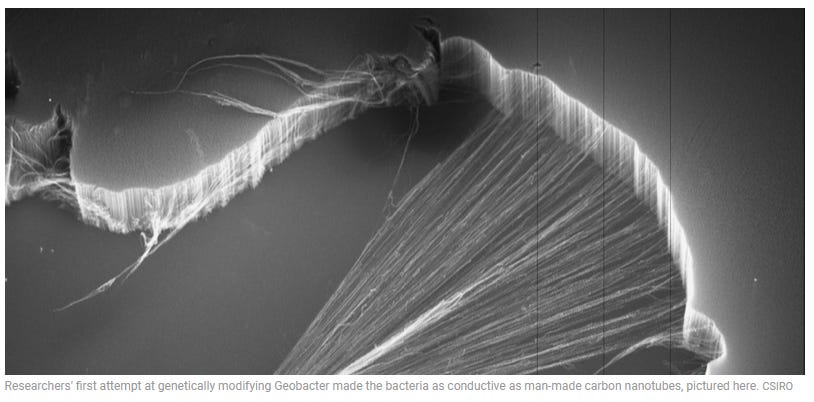
nanoelectronics. Although this first test comes nowhere near copper’s
conductivity, the modified Geobacter pili already are as effective as man-made alternatives like carbon nanotubes, Lovley
said. Better yet, they have none of the issues associated with
manufacturing large quantities of the carbon nanotubes, which has proved
difficult to scale up due to resource constraints and laborious purification processes.
“We
usually grow [Geobacter] on acetate, or acetic acid, which is basically
what’s in vinegar—those kind of cheap and renewable resources,” he
said. “And it’s very stable for a protein … so for example, they’re
stable in boiling water. Stable at a very basic or very high pH. For a
protein for they’re remarkably robust and stable.”
The
bacteria could pair with other synthetic biological innovations the
military is pursuing, including transmitting electricity to other
bioengineered microbes producing butanol as an alternative fuel for the
military’s remote outposts.
Beyond
wiring and transistor applications, Lovley said he envisions a future
with “the wire itself being a sensor.” If there’s a chemical the
military wants to detect without exposing troops to—say, one found in
explosives or toxic pollutants—researchers could further modify
Geobacter so the nanowire itself binds with that chemical whenever the
two come into contact, Lovley said. The altered bacteria could then be
added to a silicon chip on an unmanned vehicle.
Though
Lovley and his team discovered Geobacter’s conductive nanowires a
decade ago, it was only last year that they started brainstorming in
earnest with colleagues in polymer science about modifying the
bacteria’s properties.
“The
idea that there was a microbe that would make a wire to conduct
electricity out of the cell was pretty revolutionary, and there was a
lot of controversy,” he said. “So we really spent like nine of those 10
years studying the biological role.”
ONR’s
Rear Adm. Mat Winter said the Navy has been sponsoring the Geobacter
research for many years among the three-to-four thousand grants it
awards to academic partners annually.
“It’s
important to keep that volume focused” on basic research, said Winter,,
at the Center for Strategic and International Studies last month. That
creates “solution space so that ideas that can be knitted together for
capabilities to emerge.”
In Geobacter’s case, this has paid off. Before genetically engineering the microbe’s filaments, Lovley’s team had already discovered its ability to serve as microbial fuel cells. The Navy is exploring applications of that now, including sustainably powering sensors embedded on the ocean floor.
“We
continue to focus on advanced materials in our laboratories and
understanding how we can do microbial energy, where we’re taking the
positive electrons that are made on the microbes on the seabed, and
we’re capturing those, and we’re hooking up some red and black
connectors, and we’re gathering the electricity,” Winter said at CSIS.
“So we’re not there yet, but … machines at the nano-level are going to be an incredible game-changer.”








No comments:
Post a Comment