Scientific
American warns “We have no reason to believe 5G is safe,” and that
“contrary to what some people say, there could be health risks”
Unlike the 4G
technology currently in use, which relies on 90-foot cell towers with
about a dozen antenna ports on each, the 5G system uses “small cell”
facilities or bases, each with about 100 antenna ports. These cell bases
will be mounted to already existing infrastructure such as utility
poles
No 5G safety
studies have been conducted or funded by the Federal Communications
Commission or the telecom industry, and none is planned
While it may
take years to fully ascertain the full effects of 5G, there are early
warning signs. Residents in Gateshead in the U.K. started reporting
insomnia, chronic nosebleeds and stillbirths after the installation of
streetlamps that emit 5G radiation in 2016
Considering how
many are already struggling with electromagnetic hypersensitivity,
saturating cities and suburban areas with 5G will undoubtedly add many
more to this once-rare affliction, and could easily make life unbearable
for a growing number of the population
According to the telecom industry, 5G, the “5th Generation” wireless network,
is required to give people the wireless freedom they crave and need.
Described by HP as “blazingly fast,” 5G, which is 70 times faster than
its predecessor, 4G, “will replace cable internet for good,” allowing
you to download a two-hour high-definition movie in three seconds flat.1
5G is also being touted as necessary to enable the development and
proliferation of self-driving cars and other future technologies.
However, as noted in a May 2019 Forbes article,2
robocar designers are not, in fact, relying on 5G for their
development, and the cars themselves do not actually need that kind of
bandwidth to perform the required functions.
While “blazingly fast” 5G might sound attractive to many who have grown up in the internet era, there are significant health and environmental concerns relating to 5G radiation that are not being properly addressed, which may have profound implications both in the short and long term.
If increased internet speed and reliability are the end goal, then
fiber optic connections would be a far better (and safer) way forward.
Indeed, we need more wired connections and fewer wireless ones as it
is. With 5G, microwave radiation exposures will so massively increase,
there’s no doubt in my mind that mankind will eventually end up
regretting its shortsightedness.
Remember that no one has problems with the faster speeds of 5G, no
one. What any serious student of health has concerns with is that the
data are being distributed wirelessly, when in most cases the data
could be distributed easier and less expensively over fiber optic
cables.
No Safety Studies Have Been Done
Unlike the 4G technology currently in use, which relies on
90-foot cell towers with about a dozen antenna ports on each, the 5G
system uses “small cell” facilities or bases, each with about 100
antenna ports.3
These cell bases will be mounted to already existing infrastructure
such as utility poles. Ultimately, many if not most homeowners can
expect to end up with a 5G cell base mounted right outside or very near
their home.
As noted by a Federal Communications Commission representative
during a February 6, 2019, senate commerce hearing (above), no 5G safety
studies have been conducted or funded by the agency or the telecom
industry, and none is planned.4,5
In short, there’s no telling exactly what might happen to our
ecology and the people being exposed to this novel wireless technology
24/7, once it’s deployed. As noted by Dr. Cindy Russell,6 executive director of Physicians for Safe Technology, in her August 2018 paper in the journal Environmental Research:7
“Like other common toxic exposures, the effects of
radiofrequency electromagnetic radiation (RF EMR) will be problematic
if not impossible to sort out epidemiologically as there no longer
remains an unexposed control group.
This is especially important considering these effects are
likely magnified by synergistic toxic exposures and other common health
risk behaviors. Effects can also be non-linear.
Because this is the first generation to have cradle-to-grave
life span exposure to this level of man-made microwave (RF EMR)
radiofrequencies, it will be years or decades before the true health
consequences are known. Precaution in the roll out of this new
technology is strongly indicated.”
Advertisement
There’s No Safe Way to Implement 5G
Similarly, in an article8
on the Environmental Health Trust’s website, Ronald Powell, Ph.D., a
retired Harvard scientist of applied physics, notes “there is NO SAFE
WAY to implement 5G in our communities; rather, there are only ‘bad
ways’ and ‘worse ways,’” and rather than argue about who should have
control over its deployment, we should focus on preventing its
employment altogether.
Indeed, mounting research9,10
suggest the proliferation of 5G for the sake of faster wireless
internet could be a public health disaster, so if 5G does end up
“replacing cable internet for good,” humanity may be in for a
devastating shock in coming decades, if not sooner.
While it may take years to fully ascertain the full effects of 5G,
there are early warning signs. People have reported mass die-offs of
bees around 5G towers in California,11
for example, and residents in Gateshead in the U.K. started reported
insomnia, chronic nosebleeds and stillbirths after the installation of
streetlamps that emit 5G radiation in 2016.12
‘No Reason to Believe 5G Is Safe,’ Scientific American Says
In an October 17, 2019, article,13
Scientific American warns “We have no reason to believe 5G is safe,”
and that “contrary to what some people say, there could be health
risks.” The article, written by Joel M. Moskowitz, Ph.D., director for
the Center for Family and Community Health in the School of Public
Health at the University of California, Berkeley, notes:14
“The telecommunications industry and their experts have
accused many scientists who have researched the effects of cell phone
radiation of ‘fear mongering’ over the advent of wireless technology's
5G.
Since much of our research is publicly-funded, we believe it is
our ethical responsibility to inform the public about what the
peer-reviewed scientific literature tells us about the health risks
from wireless radiation.”
Moskowitz points out that the FCC has recently announced15
its intention to reaffirm and maintain current radio frequency
radiation (RFR) exposure limits, which were originally adopted in the
late 1990s. However, there are significant problems with this.
Current RFR limits are based on studies from the 1980s looking at
the behavioral effects of microwave radiation on rats, “and were
designed to protect us from short-term heating risks due to RFR
exposure,” Moskowitz writes.16
These limits are already outdated for our current levels of
exposure, so they’re surely bound to be completely inadequate for 5G.
Since the 1980s, more than 500 studies17
have identified harmful health or biological effects at RFR intensities
far below those needed to produce heating, yet the FCC is ignoring
these clearly established facts. As noted by Moskowitz:18
“The FCC’s RFR exposure limits regulate the intensity of
exposure, taking into account the frequency of the carrier waves, but
ignore the signaling properties of the RFR. Along with the patterning
and duration of exposures, certain characteristics of the signal (e.g.,
pulsing, polarization) increase the biologic and health impacts of
the exposure.
New exposure limits are needed which account for these
differential effects. Moreover, these limits should be based on a
biological effect, not a change in a laboratory rat’s behavior.”
What Science Says About 5G
A 2-page fact sheet19
on 5G can be downloaded from the Environmental Health Trust’s website.
There, you can also access a long list of published scientific studies
showing cause for concern.20
Remember, 5G will result in an exponential increase in RFR exposure,
and there are already thousands of studies demonstrating biological
effects from low-intensity electromagnetic fields (EMFs).
More than 1,800 studies summarized in the BioInitiative Report21
(2007 and 2012) show immune system effects, neurological effects,
cognitive effects and much more. For example, cumulative daily EMF exposure from cellphones and Wi-Fi is associated with cancer,22,23 altered brain development in children and reproductive damage in both sexes.
Prenatal exposure to magnetic fields can nearly triple a pregnant woman’s risk of miscarriage.24 Several other studies have come to similar conclusions.25,26,27,28,29 In men, studies show EMF radiation from cellphones and laptops reduces sperm motility and viability,30,31 and increases sperm DNA fragmentation.32
In 2011, the International Agency for Research on Cancer classified
cellphones as a Group 2B “possible carcinogen” based on the available
evidence,33 and two recent studies (one by the U.S. National Toxicology Program (NTP)34 and one by the Ramazzini Institute in Italy35) have reconfirmed its carcinogenic potential.
The NTP study found heart tumors (malignant schwannomas) in male
rats, “similar to acoustic neuromas, a benign tumor in people involving
the nerve that connects the ear to the brain, which some studies have
linked to cellphone use.”
Many studies have been published since 2011, and RFR is currently listed36
as one of the “high priority” items to be reassessed by the IARC within
the next five years. Based on the expanded evidence base, the IARC
could potentially end up upgrading the carcinogenic classification of
RFR.
What Makes 5G Different?
Considering how many are already struggling with electromagnetic hypersensitivity,
saturating cities and suburban areas with 5G will undoubtedly add many
more to this once-rare affliction, and could easily make life
unbearable for those who are already struggling at current exposure
levels.
A significant problem with 5G technology is that it relies primarily
on the bandwidth of the millimeter wave or MMW, which operates between
30 gigahertz (GHz) and 300GHz.37 The MMW is known to penetrate 1 to 2 millimeters of human tissue38,39 and has been linked to a number of potential health problems, including:40,41,42,43
Pain44
(MMW is actually what’s used in crowd control weapons by the U.S.
Department of Defense, as it has the ability to cause a severe
burning sensation45)
Suppressed immune function46
Impacted heart rate variability — an indicator of stress — in rats47,48 and heart rate changes (arrhythmias) in frogs49
Cancer50
Cellular stress and increase in harmful free radicals51
Genetic damage52
Reproductive problems53,54,55
Neurological disorders56
Eye problems such as lens opacity in rats (which is linked to the production of cataracts57) and eye damage in rabbits58,59
Depressed growth and increased antibiotic resistance in bacteria60
We’re Flying Blind, But Warning Signs Abound
Again, 5G is so new that we simply do not have the same volume of
research demonstrating its specific health effects as we do for earlier
generations of RF radiation. The fact that the issues above have
already been identified should be a giant red flag.
Certainly, there’s absolutely nothing to suggest that 5G is going to
produce LESS harm than current technologies in use, and there are
thousands of studies showing harmful effects from that. What’s more, 5G
will be used in addition to our current technologies; it’s not
replacing them all. As noted by Moskowitz:61
“Since 5G is a new technology, there is no research on health
effects, so we are ‘flying blind’ to quote a U.S. senator. However, we
have considerable evidence about the harmful effects of 2G and 3G.
Little is known the effects of exposure to 4G, a 10-year-old technology,
because governments have been remiss in funding this research …
5G will … accompany 4G for the near future and possibly over the
long term. If there are synergistic effects from simultaneous
exposures to multiple types of RFR, our overall risk of harm from RFR
may increase substantially.
Cancer is not the only risk as there is considerable evidence
that RFR causes neurological disorders and reproductive harm, likely
due to oxidative stress.”
Indeed, research62
by Martin Pall, Ph.D., details how excessive oxidative stress
triggered by microwave exposure from wireless technologies can lead to
reproductive harm and neurological disorders such as anxiety, depression, autism and Alzheimer’s.
You can learn more about the exact mechanisms in my 2017 interview with Pall, featured in “The Harmful Effects of EMFs Explained.” Pall is also interviewed by Sharyl Attkisson in the Full Measure special, “5G Whiz,”63
above, in which he points out that the health effects of 5G are going
to be far more significant than what we’re already seeing with 2G
through 4G.
If you think we’re not seeing health effects from these previous
generations of tech, think again. Do you feel anxious? Have trouble
sleeping? Do you feel tired “all the time”? Do you have frequent
headaches? Have trouble concentrating?
All of these are effects of EMF exposure and telltale signs
indicating that you’re being affected. Matters will only get worse from
there, unless you take steps to lower your exposure.
Many Experts Have Expressed Concern
Over the years, many hundreds of experts have expressed concern
about where we are going, technologically. Since 2004, the
International Association of Firefighters have officially opposed cell
towers on fire stations, as research showed firefighters suffered
neurological damage from them, including memory problems, intermittent
confusion and feelings of weakness.64
In 2015, more than 230 scientists in 41 countries engaged in the
study of biological and health effects of nonionizing EMFs signed an
international appeal65
to the United Nations, calling for protection from nonionizing EMF
exposure due to evidence of health effects even at low levels.
In a 2016 letter to the FCC, Dr. Yael Stein of the Hadassah Medical
Center in Jerusalem, Israel, who has studied 5G MMW technology and its
interaction with the human body, pointed out that:66
“The use of sub-terahertz (millimeter wave) communications
technology (cellphones, Wi-Fi, antennas) could cause humans to percept
physical pain via nociceptors.
Potentially, if G5 Wi-Fi is spread in the public domain we may
expect more of the health effects currently seen with RF/ microwave
frequencies including many more cases of hypersensitivity (EHS), as
well as many new complaints of physical pain and a yet unknown variety
of neurologic disturbances.”
Stein also warned that “It will be possible to show a causal
relationship between 5G technology and these specific health effects,”
and that “affected individuals may be eligible for compensation.” For
these reasons, Stein urged the FCC and U.S. Senate committees to vote
against 5G.
A year later, in 2017, more than 180 doctors and scientists from 35 countries signed a petition67
to enact a moratorium on the rollout of 5G due to the potential risks
to wildlife and human health. Despite all of that, U.S. leaders are
forging ahead with 5G without a second thought to what it might do to
the population and the environment.
Our Children Are at Significant Risk
The American Academy of Pediatrics68,69,70
has also been calling for federal action to protect children from EMF
exposures, citing research showing that living near mobile phone base
stations is associated with an increased risk for headaches, memory
problems, dizziness, depression and sleep disturbances.
Indeed, preliminary results from the largest long-term study71,72,73 of brain development and youth health in the U.S. — the Adolescent Brain Cognitive Development (ABCD) Study74
— reveals the brains of the most prolific users of smartphones, tablets
and video games look different compared to those who use electronic devices less frequently.
Children who use electronic devices for seven hours or more each day
have premature thinning of the brain cortex, the outer brain layer
that processes information from the five physical senses (taste, touch,
sight, smell and sound).
As little as two hours of screen time per day may impact cognition,
resulting in lower scores on thinking and language tests. 5G
installations will only magnify these and other health risks.
For a list of potential health effects associated with EMF exposure, see “Electromagnetic Radiation Specialist Reveals the Hidden Dangers of Electric Fields,” which features my interview with Oram Miller.
5G Threatens Weather Prediction
Interestingly, aside from potential health ramifications, a global
5G network will also threaten our ability to predict weather which, in
addition to putting civilians at risk will also jeopardize the Navy.75
According to a recent paper76
in the journal Nature, widespread 5G coverage will prevent satellites
from detecting changes in water vapor, which is how meteorologists
predict weather changes and storms.
In a recent letter to the FCC, democratic Democratic Sens. Ron
Wyden, Ore., and Maria Cantwell, Wash., urge the agency to rein in the
expansion of wireless communications in the 24 GHz band for this
reason.77
Protect Yourself and Your Family From Excessive EMF
There’s no doubt in my mind that microwave radiation from wireless
technologies is a significant health hazard that needs to be addressed
if you’re concerned about your health. Unfortunately, the rollout of 5G
will make remedial action all the more difficult, which is why we all
need to get involved and do what we can to prevent it in the first
place.
If you’re a Georgia resident, you can sign Change.org’s “Stop 5G” petition. Bath and North East Somerset also have a “Stop 5G” petition going on. Other petitions can be found now and then by searching online.
Apart from making your sentiments known to lawmakers, here are
several suggestions that will help reduce your EMF exposure and help
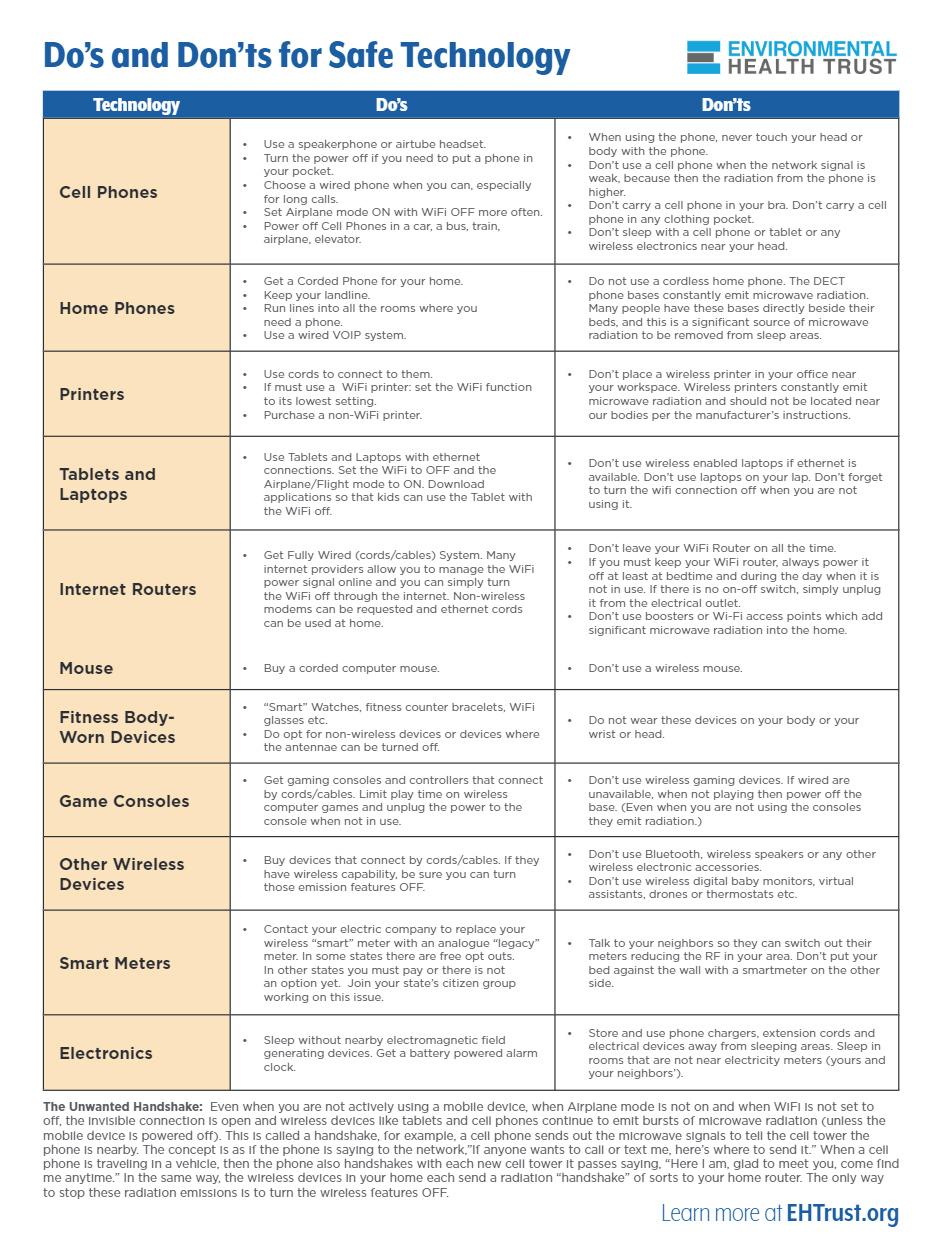
mitigate damage from unavoidable exposures. For even more do’s and
don’ts, see the infographics by the Environmental Health Trust below.
Identify major sources of EMF, such as your cellphone, cordless phones,
Wi-Fi routers, Bluetooth headsets and other Bluetooth-equipped
items, wireless mice, keyboards, smart thermostats, baby monitors, smart meters and the microwave in your kitchen. Ideally, address each source and determine how you can best limit their use.
Barring a life-threatening emergency, children should not use a
cellphone, or a wireless device of any type. Children are far more
vulnerable to cellphone radiation than adults due to having thinner
skull bones, and developing immune systems and brains.
Research78
also demonstrates that infants under the age of 1 do not effectively
learn language from videos, and do not transfer what they learn from
the iPad to the real world, so it’s a mistake to think electronic
devices provide valuable educational experiences.
Connect your desktop computer to the internet via
a wired Ethernet connection and be sure to put your desktop in
airplane mode. Also avoid wireless keyboards, trackballs, mice, game
systems, printers and portable house phones. Opt for the wired versions.
If you must use Wi-Fi, shut it off when not in
use, especially at night when you are sleeping. Ideally, work toward
hardwiring your house so you can eliminate Wi-Fi altogether. If you
have a notebook without any Ethernet ports, a USB Ethernet adapter will
allow you to connect to the internet with a wired connection.
Avoid using wireless chargers
for your cellphone, as they too will increase EMFs throughout your
home. Wireless charging is also far less energy efficient than using a
dongle attached to a power plug, as it draws continuous power (and
emits EMF) whether you’re using it or not.
According to Venkat Srinivasan, director of Argonne Collaborative
Center for Energy Storage Science, keeping your cellphone or tablet
fully charged at all times will also reduce the life of the battery,
which will necessitate the purchase of a brand-new phone.79
As a lithium ion battery charges and discharges, ions pass between
a positive electrode and a negative electrode. The higher the
battery is charged the faster the ions degrade, so it's better to
cycle between 45 percent and 55 percent.
Shut off the electricity to your bedroom at
night. This typically works to reduce electrical fields from the
wires in your wall unless there is an adjoining room next to your
bedroom. If that is the case you will need to use a meter to determine
if you also need to turn off power in the adjacent room.
Use a battery-powered alarm clock, ideally one without any light. I use a talking clock for the visually impaired.80
If you still use a microwave oven, consider
replacing it with a steam convection oven, which will heat your food
as quickly and far more safely.
Avoid using “smart” appliances and thermostats
that depend on wireless signaling. This would include all new “smart”
TVs. They are called smart because they emit a Wi-Fi signal and,
unlike your computer, you cannot shut the Wi-Fi signal off. Consider
using a large computer monitor as your TV instead, as they don’t emit
Wi-Fi.
Refuse a smart meter on your home as long as you
can, or add a shield to an existing smart meter, some of which have
been shown to reduce radiation by 98 to 99 percent.81
Consider moving your baby’s bed into your room
instead of using a wireless baby monitor. Alternatively, use a
hard-wired monitor.
Replace CFL bulbs with incandescent bulbs.
Ideally remove all fluorescent lights from your house. Not only do
they emit unhealthy light, but more importantly, they will actually
transfer current to your body just being close to the bulbs.
Avoid carrying your cellphone on your body unless
in airplane mode and never sleep with it in your bedroom unless
it is in airplane mode. Even in airplane mode it can emit signals,
which is why I put my phone in a Faraday bag.82
When using your cellphone, use the speaker phone
and hold the phone at least 3 feet away from you. Seek to radically
decrease your time on the cellphone. Instead, use VoIP software
phones that you can use while connected to the internet via a wired
connection.
Avoid using your cellphone and other electronic
devices at least an hour (preferably several) before bed, as the blue
light from the screen and EMFs both inhibit melatonin production.83,84 If you must use your phone make sure you have the blue light filters activated and have it in dark mode.
Research clearly shows that heavy computer and cellphone users are more prone to insomnia.85 For example, one 2008 study86
revealed that people exposed to radiation from their mobile phones
for three hours before bedtime had more trouble falling asleep and
staying in a deep sleep.
The effects of EMFs are reduced by
calcium-channel blockers, so make sure you’re getting enough
magnesium. Most people are deficient in magnesium, which will worsen
the impact of EMFs. As noted by Pall in a previous interview:
“It is clear that when you’re deficient in magnesium, you get
excessive activity of the VGCCs. You also get excessive calcium
influx through the N-methyl-D-aspartate receptor, caused by magnesium
deficiency, which is also problematic, so it’s important to allay
that deficiency.”
Pall has also published a paper87
suggesting that raising your level of Nrf2 may help ameliorate EMF
damage. One simple way to activate Nrf2 is to consume Nrf2-boosting
food compounds. One of the best ways to activate the Nrf2 pathway is
with molecular hydrogen tablets that can be taken at a dose of two to
three tablets dissolved in 12 to 16 ounces of water, once a day.88
Exercise, calorie restriction
(such as intermittent fasting) and activating the nitric oxide
signaling pathway (one way of doing that is the Nitric Oxide Dump
exercise) will also raise Nrf2.



No comments:
Post a Comment