We now have the technology to develop vaccines that spread themselves
The
Humanity First Technocracy and AI Live Stream was very interesting to
me in understanding the level of comprehension in the participants as to
the current threat level to the natural humans. I was very impressed by
Nicole Shanahan’s comments, when she discussed that human augmentation
society is inevitable at this time, but that she is fighting for the
rights of natural humans, that would live similar to the Amish exiled
from society of the Artificial Technology augmented humans. Her focus is
to fight for the human rights of the natural human, to limit
geoengineering to some areas since the natural human will not be able to
survive in the coming 6G geoengineered space. My thoughts are as
follows:
The
2020 article in the Scientist discussed that self spreading vaccines
are already here, is absolutely true and they have been deployed with
the COVID19 bioweapons. Shedding is self spreading. Replicon vaccines
cause self spreading shedding on steroids.
Nanorobots
can be aerosolized as they are like gas, which can be inhaled or
penetrate the skin of non augmented ( presumed unvaccinated) humans.
That was discussed in the Pfizer trial documents, which outlined that if
an unvaccinated man inhales the air around a vaccinated woman, that man
can transmit the vaccine to another unvaccinated woman. I have shown
evidence by Dr Staninger, that aerial spraying has vaccinated an
individual in California against Polio in 2009 via nanotechnology.
EXPOSURE
TO POLIO VACCINE THROUGH AERIAL VACCINES AND NANO GENE DELIVERY SYSTEMS
by Hildegarde Staninger, Ph.D., 2009. Humanity Has Been Vaccinated Via
Aerial Spraying For A Long Time
My
main concern about the entire discussion is that some people are not
even recognizing the self assembly nanotechnology that has been
deployed, and that military literature considers Vaccines as human
augmentation.
Human Augmentation – The Dawn of a New Paradigm - UK Ministry of Defense States: Vaccination IS Human Augmentation
The
neuralink brain chip literally is yesterdays news. I have shown on my
substack the research by Dr. Staninger which proves that human beings
have been microchipped via inhalation and medical procedures since
before 2011. She published her book on these findings in 2012:
GLOBAL
BRAIN CHIP AND MESOGENS Nano Machines for Ultimate Control of False
Memories - Computer System For Collective Mind Control
“To
understand the technology of mesogens and their multiple smart
functional uses for sensing, payload delivery systems, and other related
aspects of their design, one must always remember that the mesogen is
the tool or device – like the wheel on a car for the nano machine. The
nano machine can be designed to become the robot, surgical scalpel,
camera, the voice within your skull, or even the “false” collective
consciousness when integrated into a computer system for collective mind
control or a “global brain.”
I
have also been showing on my substack the chemical and microscopic
analysis of such illegally implanted microchips on civilians. Nobody can
argue with this evidence that has been used in court cases and has
fully documented chain of custody.
Advanced Implanted Nanotechnology Microchips From Targeted Individual Made Of Diamonoids - Analysis By Dr. Hildegarde Staninger
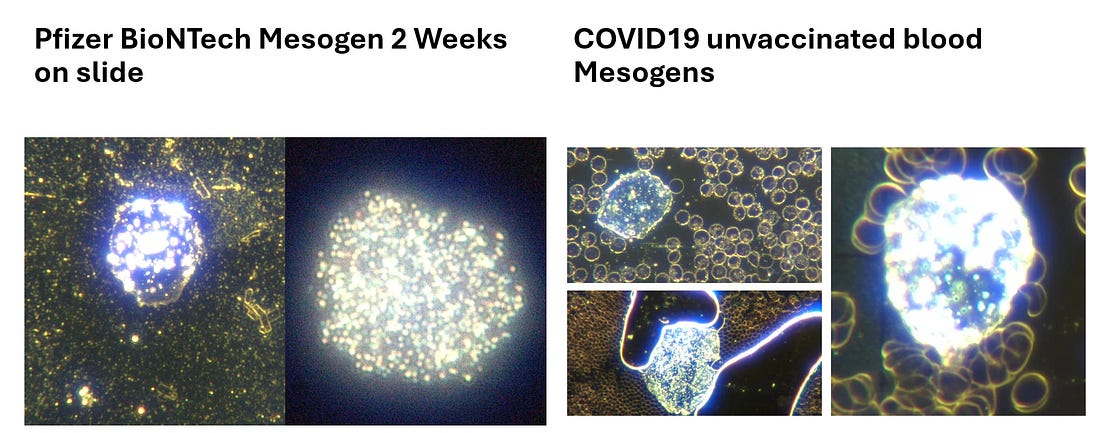
These
same microchips are now found self assembling in COVID19 unvaccinated
blood. I have shown the mesogen microchip self assembly in Pfizer
BioNTech vials and the blood of the unvaccinated. The mesogens are
identical:
Pfizer
BioNTech COVID19 Solution Builds Mesogen Microchips When Left At Room
Temperature. Exactly What We See In COVID Unvaccinated Blood From
Shedding. Two Week Follow Up
Karen
Kingston rightfully said: “Ignorance is lethal” at this point. Because
the technological advances are now developing at an exponential pace the
time to ignore the global evidence that the nanotechnological platform
for Cyborg Transhuman transformation has already been deployed - is
over. Natural humans are running out of time. The nanorobots are in
everyone - via vaccination, shedding, smart dust from geoengineering,
food, water. If people would only look at the blood you can see the
evidence in everyone.
As
I have said for several years now, the health care system has been
weaponized against us and the technologies for the 4th Industrial
Revolution to collect biometric data from people for the Internet of bio
nano things have already been deployed for a long time, but started to
be injected under the skin for the COVID19 biological and technological
weapons of mass destruction.
Video: COVID19 unvaccinated blood affected by shedding - nanorobots harvesting red blood cells building mesogen microchips.
Louis
Del Monte wrote the book Nanoweapons: A Growing Threat to Humanity.
Below is a book review by a Major from the US Air Force. It discusses
that self replicating nanorobots are a military weapon of mass
destruction - they are so dangerous because you cannot see them ( unless
you have a microscope then you can see what they self assembled on a
microscopic scale). And they act as if they were biological pathogens.
Does that sound familiar? Monte predicted human extinction from
Nanoweapons by 2100. I say that is way too far out, just as Cyborg
Soldier 2050 is happening now. On Monday my new interview airs with
weapons expert Mark Steele, and you will hear him talk about the
directed energy weapons on traffic lights in smart cities that can
pulverize anybody who has large amount of metals in them. Why do you
think I am working to expose the threat of toxic metals within people
from Geoengineering sources, food, supplements, “detox modalities”,
“vaccines”? Because the more metals you have, the more of a target you
are for this extermination. Radar, facial recognition, satellite
surveillance has a much harder time to detect natural humans without
heavy metals in them and the kill effect of laser directed energy
weapons is increased in people who have high levels of heavy metals.
Nanoweapons: A Growing Threat to Humanity by Louis A. Del Monte. Potomac Books, 2017, 244 pp.
When
new technologies cross from industry to the battlefield, calls arise to
slow the process and consider international implications of using these
weapons. Louis A. Del Monte’s Nanoweapons is one of those calls. A physicist and former executive at IBM and Honeywell, Del
Monte led advancements in microelectronics and sensors. His work is a
serious attempt to use publicly available information to address the
development and use of nanotechnology as weapons. The author brings
together ideas normally relegated to science fiction (e.g., laser
weapons, artificial intelligence, and self-replicating nanorobots) and
uses his technical background to inform the reader as to what is science
fact. While his most alarming predictions for humanity’s
survival project to the year 2050 and beyond, he argues that his
concerns are timely. He indicates that while revolutionary military
nanotechnologies (e.g., stealth aircraft) may take decades to field,
they are nonetheless currently being developed. Now, according to the
author, is the time to discuss the dangers of nanoweapons.
The author’s main thesis is that nanoweapons are a danger to humanity that demand greater attention. Despite the secrecy surrounding the development of nanoweapons, Del Monte is confident of their threat. This fear is based in part on the ranking
of nanotechnology weapons by the Global Catastrophic Risk Conference
at the University of Oxford as the most probable means to cause human
extinction by the end of this century. Examples of
nanoweapons discussed in the book include nano-enhanced lasers, smaller
munitions with increased explosive force, and self-replicating smart nanorobots
(SSN). SSNs search for and destroy targets without human input and
self-replicate with materials found in the environment. According to
the author, SSNs are gravely dangerous nanoweapons that
humanity should prohibit. Central to his concern for humanity’s
survival is what he sees as the inherent difficulty in mounting
defenses to nanoweapons given their capability to avoid detection and
the ability of those who use these arms to escape attribution. While
considerable resources have been dedicated to countering nuclear
weapons, little is publicly known about protection from nanoweapons. This
is especially concerning to the author because some nanoweapons have
characteristics similar to biological pathogens. Giving his readers
reason to be apprehensive, Del Monte turns to explaining how today’s
nanotechnology can be used to create nanoweapons.
While
nanotechnology is already improving our computers, sunscreens, and
building materials, the first section of the book provides the
nontechnical reader an easy-to-understand introduction to nanotechnology
and how it may be used in arms development. The author organizes
nanoweapons into five categories: offensive strategic, defensive
strategic, offensive tactical, defensive tactical, and passive.
Examples are provided for each category, along with an explanation of
its offensive, defensive, or passive nature. For
instance, the offensive strategic category includes artificially
intelligent nanorobots that can target particular individuals,
hypersonic glide missiles (whose development will rely on developing
certain nanomaterials), nano-enhanced fuels, and nonelectric guidance
systems. The other categories include additional
guidance for organizing nanoweapons. While readers will find these
categories helpful, a workable definition of nanoweapons is missing.
With
this deep level of organization dedicated to understanding
nanoweaponry, the reader would hope for a more useful definition of
nanoweapons. Nanoweapons are defined in the
book’s glossary as “any military technology which exploits the use of
nanotechnology (229).” Although this definition will capture all
nanoweapons, it will also include many items that are not weapons. This
definition would include a military finance office using a publicly
available desktop computer with a nanomanufactured microchip. Is
building a weapon with nanomanufactured components all that is required
to make the weapon a nanoweapon? If a dry-docked ship is sprayed with
anticorrosive nanocoating—increasing its hull strength tenfold (as an
MIT study referenced in the book suggests)—is the ship now a nanoweapon?
The book makes clear that nanotechnology is an enabling technology
that will empower a wide range of civilian and military applications.
But it does not wrestle with the problem that an SSN is fundamentally
different than an anticorrosive nanocoating. This issue of defining
nanotechnology is a common attribute of nascent scientific fields, but
the reader is nevertheless left wanting more. Without addressing this
definitional problem directly, Del Monte instead uses other methods to
discover what nations are emerging as nanoweapon leaders.
He
categorizes the factors needed to facilitate nanoweaponry development
and sorts nations by these factors into the Nanoweapons Offensive
Capability of Nations (NOCON) list. The most powerful group, nanoweapon
nations—such as the United States and China—has the ability to
commercialize nanotechnology, possesses a national desire to strengthen
its militaries, and demonstrates an ability to partner with other
leading nanotechnology nations. Del Monte goes on to mention other
nations on his NOCON list, all of which have varying interactions with
nanotechnology. Giving the reader reason to be concerned for the
international implications his NOCON suggests, he then highlights the
events that may tip us into a nanoweapon-driven war.
He predicts two singularities that will spawn nanoweapon-related international disruptions. In
addition to the creation of SSNs, the other singularity is the advent
of artificial intelligence (AI) that will exceed human intellect. AI
will solve many of humanity’s greatest problems, the author posits, but
it will also create better SSNs. If AI and SSNs are combined, alliances
will form to maintain advantages in a new cold war around the
development of AI-powered SSNs. Given their importance, international
power will then be rebalanced around nanoweapon capabilities. Nuclear
weapon use will increase since nanotechnology will empower their
miniaturization and reduce their fallout. It is these disruptions,
brought on by the AI and SSN singularities, that Del Monte claims will
dramatically increase the chance of human extinction by 2100. Given this
pessimistic prediction, Nanoweapons next discusses reasons for hope.
The
author maintains some optimism for humanity. He notes that humanity has
engaged in conflict since the beginning of our existence, but recent
developments, such as the Treaty on the Non-Proliferation of Nuclear
Weapons and the Biological Weapons Convention, show that humanity can
act to prevent its extinction. Once humanity comes to know the
existential threat that nanoweapons represent, humanity will act to
limit their use and thus avert disaster. What we recognize when we use a
new personal computer, he argues, is not the nanotechnology enabling
its use but the impressive performance it achieves. The author states
that humans understand technology by its function, not the technology
itself. Thus, to forestall the need to demonstrate a nanoweapon’s threat
to humanity, he indicates that current treaties and conventions
concerning weapons of mass destruction should also regulate strategic
nanoweapons.
A
workable and more precise definition of nanoweapons will improve this
area of study by allowing policy makers to grapple with nanoweaponry
development. It will empower leaders to specifically categorize an
adversary’s capabilities and document who is developing nanoweapons with
greater specificity. Assuming that Del Monte’s catastrophic
predictions are accurate, more scenarios are needed to better inform
technologists, military commands, and national leaders working on ways
to prevent the negative implications of these technologies. This work is
worth reading because it ties together the technical, political,
economic, and practical challenges associated with nanoweapons. The
initial portion of the book is especially worthwhile for those seeking
an approachable introduction to nanotechnology and its use as weaponry.
Suggestions for additional reading in this area of futurism are Peter
W. Singer’s Wired for War and Michio Kaku’s Physics of the Future.
Strategic leaders will appreciate the discussions on organizational
problems associated with fielding nanoweapons and rebalancing
international power. Tactical leaders will find themselves working
through different ways to use and defend against nanoweapons. Finally,
fans of science fiction will appreciate a technical introduction to many
real concepts previously relegated to fantasy.
Maj Patrick M. Milott, USAF
I
pray to God that influential people like Nicole Shanahan and others
will look at the facts that are already available. Technocratic
Transhumanism and human augmentation is happening without our consent,
from the skies, through medications, vaccinations, our food and water.
This is not something that will happen in the future. We are in the END
STAGES of this transformation, and if you want to remain a resemblance
of a natural human, we have to acknowledge the evidence now and mitigate
it appropriately.
We are in the fight of our lives to remain natural humans right now and the urgency of this fact could not be any more acute.
Dranamihalcea.com








No comments:
Post a Comment