William de Berg, The Morgenthau Plan Reborn
William de Berg
“That mortal is a fool who destroys a city, its temples, its tombs, and the precincts of the dead, making them a waste. He will be destroyed himself.” — Euripides
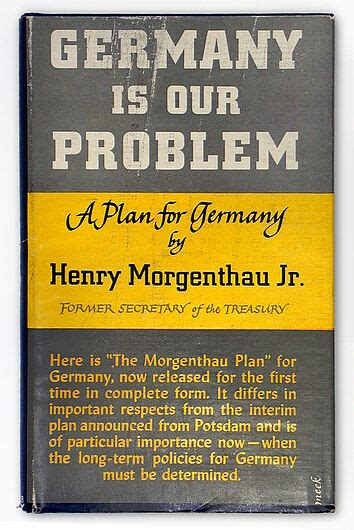
Even before the end of World War Two, the major allies (the U.S., Great Britain, and the Soviet Union) had agreed to force an unconditional surrender on Germany and Japan. That was a military decision, but an even more portentous decision was the implementation of JCS 1067, which called for the de-industrialization of Germany after World War Two. This directive, based on an earlier memorandum created by then-Treasury Secretary Henry Morgenthau, Jr. [1] and partially implemented by the American military occupation command, led to the dismantling of much of Germany’s industrial base after the war. From the start there were opponents, most notably Secretary of War Henry Stimson and even Winston Churchill, who feared the consequences of being “tethered to a dead man”[2] —namely, a de-industrialized Germany. But President Franklin Roosevelt tacitly accepted the plan, purportedly saying that he didn’t care if German people had to “live off soup kitchens” as punishment for the German government’s aggression during the war.[2]
It was quickly realized after implementation of JCS 1067 that the Morgenthau Plan was fomenting societal disaster, from economic depression and mass unemployment throughout Europe to famine in Germany. The latter has been estimated by some historians to have caused up to six million German deaths from 1945 to 1948 and an astounding infant mortality after the war of almost 70% in cities like Berlin. [3] As had been argued from the outset by Morgenthau opponents, Germany’s coal and other mineral resources and its industry and technology were too critical to Europe’s economy at large before the war to be dismembered. In particular, Germany imports of foodstuffs and other goods for the rest of the continent helped sustain many other European economies. Some American officials such as Herbert Hoover were appalled at the post-war conditions created by JCS 1067, while others were alarmed at the prospect of a totally destitute and desperate Europe becoming ripe for a Soviet takeover. By 1947 the tide had turned against the Morgenthau plan, and Secretary of State George Marshall and others convinced President Truman to rescind JCS 1067 in favor of JCS 1779.[4] This signaled the coming of the Marshall Plan that reversed the Morgenthau policy and provided large-scale assistance to Germany and other Western European nations beginning in 1948.
We are currently witnessing a rebirth of the Morgenthau Plan, with the American government pressuring European nations to place severe sanctions on Russia, especially in the energy area (coal, oil, and natural gas). Although this has been done in ostensible cooperation with most European governments, the proverbial stick has also been applied, most powerfully against the Russo-German Nord Stream 1 and 2 pipelines, the latter of which has been blown up in four places and the former of which had turbines and other key infrastructure stripped. Once again there appears to be a lack of insight into the crucial role German industry plays in driving the entire European economy and propping up the Euro.[5] With only 16% of its total population, Germany produces almost a third of the European Union’s cars, 25% of its steel and glass, and 25% of its total GDP and exports.[6] But these numbers actually underestimate Germany’s true economic force, as German companies are also heavily invested in the trade and industrial production in neighboring countries, such as Poland. So, if Germany goes down because of insufficient or overly expensive energy, so, too, may the rest of Europe.
Some believe the attack on German industry is designed to keep Germany in the clutches of the Anglo-American financial empire. Certainly, Russian natural gas is being partly replaced by American gas transported in tankers at a much higher price. Unlike the original Morgenthau Plan, which was promoted by the Soviet Union to punish Germany after the war and to foment economic desperation on the European masses so they would be more likely to embrace communism,[2] the reborn Morgenthau plan is primarily designed to weaken Russia on the world stage by throwing heaps of economic sanctions on it (none of which have worked thus far). De-industrialization of Germany is intended merely to punish Germany for its cooperation with Russia and to prevent future Russo-German trade, not to destroy the German industrial base per se.
Whatever the long-term goal, the immediate consequences of the massive sanctions against Russia and the breakdown in Russo-German trade echo the unofficial slogan of NATO: “Keep the Russians out, the Americans in, and the Germans down”.[7] Thus far, the European masses have not widely rebelled against their governments, and their continuing faith in the sanctity of the European Union—which few actually voted for—remains largely unshaken. But if economic collapse occurs this winter and Germans in particular start reviving memories of the original Morgenthau Plan, American officials may better start preparing for a tidal wave of Teutonic wrath.
William de Berg is the pen name of an American scientist and author of four conspiracy/truther fiction novels: Serpent and Savior, White Spiritual Boy, Divided We Stand, and Shield Down.
References
[1] http://docs.fdrlibrary.marist.edu/PSF/BOX31/t297a01.html
[2] Dietrich, J. (2002). The Morgenthau Plan: Soviet influence on American postwar policy. New York: Algora Pub.
[3] Bacque, J. (1997). Crimes and Mercies. Warner Books, London.
[4] https://second.wiki/wiki/jcs_1779
[5] https://www.nakedcapitalism.com/2022/09/michael-hudson-on-the-euro-without-germany.html
[6] https://www.worldatlas.com/articles/the-top-steel-producing-countries-in-europe.html; https://www.worldstopexports.com/top-glass-and-glassware-exports-by-country; https://worldpopulationreview.com/country-rankings/car-production-by-country
[7] https://www.nationalreview.com/2017/07/nato-russians-out-americans-germans-down-updated-rever
No comments:
Post a Comment