N-acetylcysteine
(NAC) has a long history of use as a first-aid remedy for acetaminophen
poisoning. Compelling research suggests it may also be useful against
COVID-19
By raising
glutathione, NAC combats oxidative stress, which is a main cause of the
cytokine storm associated with COVID-19. NAC also inhibits
hypercoagulation and breaks up blood clots, which is another
complication seen in some COVID-19 cases
NAC helps
loosen thick mucus in the lungs and improves a variety of lung-related
problems, including pneumonia and acute respiratory distress syndrome
(ARDS), both of which are common characteristics of COVID-19
NAC has been shown to inhibit replication of influenza virus
Aside from
increasing glutathione, NAC may also prevent or improve COVID-19
infection by improving T cell response and modulating inflammation
N-acetylcysteine (NAC) has a long
history of use as a first-aid remedy for acetaminophen poisoning.
Emergency room physicians will administer it in cases when you've taken
an overdose of Tylenol
or other acetaminophen products. The way it neutralizes the toxic
effects of the drug is by recharging glutathione, thereby preventing
liver damage.
Interestingly, NAC may also be useful against COVID-19, as explained
by pulmonologist Dr. Roger Seheult in the MedCram lecture above. By
raising glutathione, it helps combat oxidative stress, which is a main
factor in the cytokine storm associated with COVID-19.
A recent literature analysis1 linked glutathione deficiency to COVID-19 disease severity,
leading the author to conclude that NAC may be useful both for
prevention and treatment. NAC may also combat the abnormal blood
clotting seen in many cases, and helps loosen thick mucus in the lungs.
FDA Cracks Down on NAC
Interestingly, with COVID-19 treatment as a new indication, the U.S.
Food and Drug Administration is now suddenly cracking down on NAC,
claiming it is excluded from the definition of a dietary supplement, as
it was approved as a new drug in 1985.2 As such, NAC cannot be marketed as a supplement.
You certainly would not suspect this looking at the supplement market. As reported by Natural Products Insider,3
there are no fewer than 1,170 NAC-containing products in the National
Institutes of Health's Dietary Supplement Label Database.
Be that as it may, July 29, 2020, FDA announced4 it has issued warning letters to seven companies that market NAC as a remedy for hangovers. According to the FDA:
"A hangover can occur after alcohol intoxication. Alcohol
intoxication, like all poisonings, causes dose-related dysfunction and
damage, ranging from mild impairments to death … The products outlined
in these letters, which are labeled as dietary supplements, are
unapproved new drugs and have not been evaluated by the FDA to be safe
and effective for their intended use."
Members of the Council for Responsible Nutrition have expressed
concern that the warning letters may indicate the FDA is considering
targeting NAC more widely.
While the FDA makes no mention of COVID-19 in its warning letter,
the timing of its crackdown on NAC marketed for hangovers is
interesting, seeing how news of its potential benefits against the
viral infection have come into circulation, and research is now
underway to assess whether it might be used in the treatment of
COVID-19.
At present, seven studies involving NAC for COVID-19 are listed on Clinicaltrials.gov.5 Time will tell whether the FDA ends up trying to block access to NAC supplements, similarly to the way hydroxychloroquine access has been stifled.
NAC Inhibits Viral Replication
The idea that NAC can be helpful against viral infections is not
new. Previous studies have found it reduces viral replication of
certain viruses, including the influenza virus. As reported by
board-certified nutritionist Joseph Debé:6
"NAC was tested in a 6-month human study7
of influenza. It was a randomized, double-blind, placebo controlled
trial involving 262 people. Half of the subjects received 600 mg of
NAC, the other half received placebo, twice daily for 6 months.
NAC was found to improve immune function and reduce the severity
of influenza infections. Both groups had similar infection rates with
A/H1N1 virus influenza. However, whereas 79% of placebo-treated people
had symptomatic infections, only 25% of subjects treated with NAC were
symptomatic!
There were a total of 99 flu-like episodes (symptomatic periods)
that occurred in 62 people in the placebo group over the 6 month
study. 48% of these were classified as mild, 47% were moderate, and 6%
were severe.
In the NAC group, 46 flu-like episodes occurred in 37 subjects.
72% of these were mild, 26% were moderate and only 2% severe. There
were many fewer days of being bedridden in the NAC group."
It's worth noting that the number needed to treat (NNT) in the study8 cited by Debé is 0.5, which means for every two people treated with NAC, one will be protected against symptomatic influenza.
That's significantly better than influenza vaccines, which have an NNV (number needed to vaccinate) of 71,9 meaning 71 people must be vaccinated to prevent a single case of confirmed influenza. It's even better than vitamin D, which has an NNT of 33.10 Even among those with severe vitamin D deficiency at baseline, taking vitamin D still had an NNT of 4.
NAC Inhibits Proinflammatory Cytokines
NAC has also been shown to inhibit the expression of
pro-inflammatory cytokines in cells infected with highly pathogenic
H5N1 influenza virus. According to the authors of such a study:11
"The antiviral and anti-inflammatory mechanisms of NAC included
inhibition of activation of oxidant sensitive pathways including
transcription factor NF-kappaB and mitogen activated protein kinase p38
...
NAC inhibits H5N1 replication and H5N1-induced production of
pro-inflammatory molecules. Therefore, antioxidants like NAC represent a
potential additional treatment option that could be considered in the
case of an influenza A virus pandemic."
Proinflammatory cytokines play a crucial role in COVID-19 severity.
Researchers have confirmed that in severe cases, cytokines such as
interleukin-6 (IL6), interleukin-10 (IL10) and TNF-ɑ are all elevated.12
Once they reach excessive levels, a so-called cytokine storm develops,
causing significant tissue damage. NAC may be able to inhibit this
damaging cascade.
NAC — Potential Therapeutic Agent for SARS-CoV-2
A paper13
published in the October 2020 issue of Medical Hypotheses reviews the
potential therapeutic benefits of NAC in the battle against COVID-19
specifically. According to the authors:
"COVID-19 … continues to spread across the globe. Predisposing
factors such as age, diabetes, cardiovascular disease, and lowered
immune function increase the risk of disease severity.
T cell exhaustion, high viral load, and high levels of TNF-ɑ,
IL1β, IL6, IL10 have been associated with severe SARS-CoV-2. Cytokine
and antigen overstimulation are potentially responsible for poor
humoral response to the virus.
Lower cellular redox status, which leads to pro-inflammatory states mediated by TNF-ɑ
is also potentially implicated. In vivo, in vitro, and human clinical
trials have demonstrated N-acetylcysteine (NAC) as an effective method
of improving redox status, especially when under oxidative stress.
In human clinical trials, NAC has been used to replenish
glutathione stores and increase the proliferative response of T cells.
NAC has also been shown to inhibit the NLRP3 inflammasome pathway (IL1β
and IL18) in vitro, and decrease plasma TNF-ɑ in human clinical trials.
Mediation of the viral load could occur through NAC's ability to
increase cellular redox status via maximizing the rate limiting step
of glutathione synthesis, and thereby potentially decreasing the
effects of virally induced oxidative stress and cell death.
We hypothesize that NAC could act as a potential therapeutic
agent in the treatment of COVID-19 through a variety of potential
mechanisms, including increasing glutathione, improving T cell
response, and modulating inflammation."
A second report14
reviewing the evidence for using NAC in the treatment of COVID-19 was
published April 14, 2020, by The Centre for Evidence-Based Medicine at
the University of Oxford.
How NAC May Protect Against COVID-19
To fully understand how NAC might protect against COVID-19, a short
lesson in biochemistry is useful. Following is a summary of Seheult's
presentation, featured in the video above.
When you add an electron to an oxygen (O2) molecule, you get superoxide (O2), a reactive oxygen species (ROS). When you add another electron (for a total of two electrons), you get hydrogen peroxide (H2O2). An oxygen molecule with three electrons added becomes hydroxyl (O3), and oxygen with four electrons added becomes harmless water (H2O).
Not only does superoxide play a crucial role in the oxidative stress
associated with the comorbidities for COVID-19, such as obesity, heart
disease and diabetes, but superoxide-driven oxidative stress is also
at the heart of serious COVID-19 infection. Now, your body has built-in
defenses against oxidative stress. These defenses include:
• Superoxide dismutase (SOD), which converts damaging superoxide into hydrogen peroxide15 • Catalase, which converts hydrogen peroxide into oxygen and water • Glutathione peroxidase (GSHPX), which
does two things simultaneously: While reducing hydrogen peroxide into
water, it also converts the reduced form of glutathione (GSH) into
glutathione disulfide (GSSG), the oxidized form of glutathione.
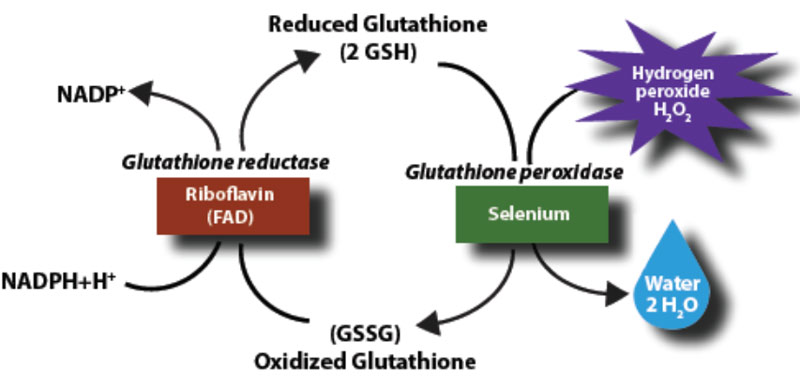
In other words, as GSHPX turns hydrogen peroxide into harmless
water, glutathione becomes oxidized. The oxidized GSSG is then
"recharged" or regenerated by NADPH (the reduced form of NADP+),
turning it back into GSH (the reduced form of glutathione). NADPH is
also converted into NADP+ through an enzyme called GSH reductase
As noted by Seheult, serious COVID-19 infection triggers a perfect
storm of superoxide-driven oxidative stress, as SARS-CoV-2 attaches to
the ACE2 receptor, triggering angiotensin 2 (AT-2), which stimulates
superoxide. Simultaneously, there's a deficiency of AT-1,7, which
inhibits superoxide. This deficiency allows superoxide to accumulate
further.
SARS-CoV-2 also attracts polymorphonuclear leukocytes (PMNs), a type
of white blood cell, which also produces superoxide in its efforts to
destroy pathogens. All of that superoxide is then converted into other
ROS that destroy endothelial cells.
This down-spiral can be inhibited by NAC, as it boosts GSSG. As
illustrated in Seheult's graphic below, when you add two GSH molecules
and hydrogen peroxide together, you end up with oxidized glutathione and harmless water, thereby alleviating the oxidative stress.
NAC Reduces Lung Injury
Previous studies have also shown NAC helps improve a variety of
lung-related problems, including pneumonia and acute respiratory
distress syndrome (ARDS),16
both of which are common characteristics of COVID-19. It's also been
shown to speed recovery, reduce intensive care unit (ICU) stays and
reduce the need for mechanical ventilation among those with respiratory
problems. Such studies include:
A 2017 meta-analysis,17
which found a significant reduction in ICU stays among ARDS patients
treated with NAC, even though there was no significant difference in
short-term mortality risk.
A 2007 study,18
which concluded that NAC improves ARDS by "increasing intracellular
glutathione and extracellular thiol molecules" along with general
antioxidant effects.
Research19 published in 2018 found NAC reduces oxidative and inflammatory damage in patients with community-acquired pneumonia.
Another 2018 study20 found NAC improves post-operative lung function in patients undergoing liver transplantation.
A 1994 study21
found NAC enhances recovery from acute lung injury, significantly
regressing patients' lung injury score during the first 10 days of
treatment, and significantly reducing the need for ventilation. After
three days of treatment, only 17% of those receiving NAC needed
ventilation, compared to 48% in the placebo group.
NAC Protects Against Blood Clots Too
In this MedCram video, Seheult reviews the abnormal blood clotting
aspects of COVID-19. Interestingly, NAC addresses this problem too, as
several studies22,23,24,25 have confirmed it counteracts hypercoagulation and reduces the risk of blood clots and stroke.
As noted in one of these studies,26
"NAC has anticoagulant and platelet-inhibiting properties." It also has
potent thrombolytic effects, meaning it breaks down blood clots that
have already formed.27 According to another study,28 NAC protects against stroke in part by enhancing GSH and correcting antioxidant levels.
Seheult's hypothesis for why NAC may be useful against COVID-19 can
be summarized as follows: SARS-CoV-2 attaches to and reduces the ACE2
receptor, which causes AT-2 to increase and AT-1,7 to decrease. This in
turn increases damaging superoxide that causes oxidative stress and
endothelial cell dysfunction.
It is important to note that COVID-19 is not just a respiratory
disorder, but also a vascular disorder that causes blood clots, which
impair the ability to exchange oxygen in the lungs.
Fortunately, the sulfur in NAC (from cysteine) also reduces the
intrachain disulfide bonds by von Willebrand factors that have
polymerized by dissociating the sulfur bonds holding them together thus
contributing to the clot. Once von Willebrand factor sulfur bonds are
broken, the clots starts to dissolve and the blood vessels open up
again allowing for exchange of oxygen and carbon dioxide.
Interestingly, NAC's mechanism of action does not appear to increase
bleeding disorders like heparin or coumadin would, and appears to
provide a safer alternative to these agents. This suggests that the "H"
of heparin in the MATH+ protocol could simply be replaced with NAC.
Overall, the more we learn about COVID-19, the more we come to find
there may be simple and inexpensive ways to treat this perplexing
illness. NAC in particular looks like a good candidate for
consideration. An added boon is NAC's excellent safety profile. As
noted by Seheult, many studies have shown there are no serious adverse
effects associated with its use.


No comments:
Post a Comment