Since
SARS-CoV-2 infectiousness increases with lower temperatures and humidity
levels, we’re likely going to see a reemergence of COVID-19 infections
in the fall, during normal influenza season
What this means
is you now have a known “deadline” for optimizing your vitamin D level.
To improve your immune function and lower your risk of viral
infections, you’ll want to raise your vitamin D to a level between 60
nanograms per milliliter (ng/mL) and 80 ng/mL by fall
First, you need
to find out what your base level is, which is done using a simple blood
test. Once you know your current level, you can determine your
individual vitamin D requirement using GrassrootsHealth’s chart or
vitamin D calculator
Retest your
vitamin D level in three to six months to determine how your sun
exposure and/or supplemental dosage is impacting your vitamin D level
To minimize a
second wave of COVID-19, speak to pastors in churches with large
congregations of people of color, and directors of assisted living
facilities, and help them start a program getting people on vitamin D
As reviewed in “Vitamin D Level Is Directly Correlated to COVID-19 Outcomes,”
there’s compelling evidence to suggest optimizing your vitamin D level
can reduce your risk of COVID-19 and other viral infections such as
seasonal influenza.
A number of different scientists are calling for people and
governments to prepare for a second wave of COVID-19 come fall, both in
the U.S. and abroad.1 Considering SARS-CoV-2 has been shown to be responsive to temperature and humidity,
with infectiousness increasing with lower temperatures and humidity
levels, we’re likely going to see a reemergence of COVID-19 infections
in the fall, during normal influenza season.
REALLY IMPORTANT: Optimize Your Vitamin D Level Before Fall!
What this means is you now have a known “deadline” for optimizing
your vitamin D level. To improve your immune function and lower your
risk of viral infections, you’ll want to raise your vitamin D to a level
between 60 nanograms per milliliter (ng/mL) and 80 ng/mL by fall. In
Europe, the measurements you’re looking for are 150 nanomoles per liter
(nmol/L) and 200 nmol/L.
Historically, December typically has highest flu activity in the U.S.,2
but it would probably be good to aim for October, or maybe even earlier
depending on your location. Optimizing your vitamin D is particularly
important if you have darker skin, as darker skin places you at higher
risk for vitamin D deficiency — and serious COVID-19 infection.
COVID-19 Racial Disparity Rooted in Vitamin D Deficiency
As reported by The Guardian,3
the COVID-19 mortality among black Americans is three times higher
than that of whites, and researchers have long known that blacks cannot
achieve optimal vitamin D levels from sun exposure at any time of the
year in Northern America.4
Research5
posted April 28, 2020, points out that vitamin D insufficiency is
prevalent in severe COVID-19 cases and that “Emerging health
disparities data regarding African-American and homeless populations
suggest that vitamin D insufficiency (VDI) may be an underlying driver
of COVID-19 severity.” Importantly, this study6 found 100% of COVID-19 patients under the age of 75 admitted to intensive care units had vitamin D insufficiency.
A letter to the editor,7
published in the Irish Medical Journal, also points out the many links
between vitamin D deficiency and factors known to play a role in
COVID-19, such as male sex, acute respiratory distress syndrome (ARDS)
and comorbidities like obesity, diabetes and heart disease, and
presents data from an in-hospital review of 33 male COVID-19 patients’
vitamin D levels.
The 12 patients who progressed to ARDS had a mean vitamin D level of
27 nmol/L (10.8 ng/mL), whereas those who did not progress to ARDS had
a mean level of 41 nmol/L (16.4 ng/mL).
It’s worth noting that 16.4 ng/mL is still grossly insufficient, as
40 ng/mL (100 nmol/L) has been established as a minimum level of
sufficiency for general health and disease prevention by
GrassrootsHealth.8 The same goes for the elderly, as you tend to lose the ability to convert vitamin D from sun exposure as you age.
Advertisement
Step 1: Measure Your Vitamin D
So, how do you go about optimizing your vitamin D level? First, you
need to find out what your base level is, which is done using a simple
blood test. An easy and cost-effective way of doing this is to order
GrassrootsHealth’s vitamin D testing kit.
Once you know what your blood level is, you can assess the dose
needed to maintain or improve your level. Again, the ideal level you’re
looking for is above 40 ng/mL, and ideally between 60 ng/mL and 80
ng/mL (European measurement: 100 nmol/L or, ideally, 150 nmol/L to 200
nmol/L).
The easiest way to raise your level is by getting regular, safe sun
exposure, but if you’re very dark-skinned, you may need to spend about
1.5 hours a day in the sun to have any noticeable effect.
Those with very light skin may only need 15 minutes a day, which is
far easier to achieve. Still, they too will typically struggle to
maintain ideal levels during the winter. So, depending on your
situation, you may need to use an oral vitamin D3 supplement. The next
question then becomes, how much do you need?
Step 2: Assess Your Individualized Vitamin D3 Dosage
The reason you do not want to get fixated on arbitrary dosage
recommendations is because the required dose can vary greatly depending
on several factors, including skin color, weight and other nutritional
deficiencies. As explained by GrassrootsHealth:9
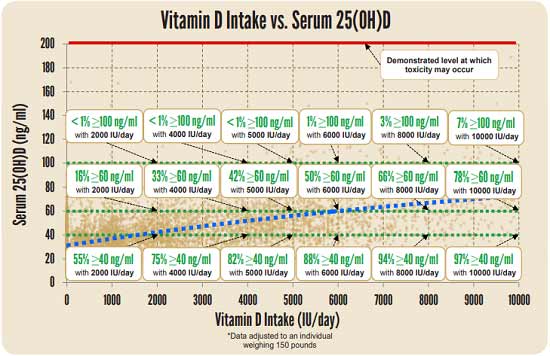
“One of the main factors contributing to this variability is a
person’s weight. Therefore, we also calculated a dose-response curve
adjusted to an individual weighing 150 pounds (68 kg), shown below.
Indicated on the chart are supplemental dose amounts that ensure
a specific proportion of the population achieves particular vitamin D
levels. For example, 55% of participants achieved at least 40 ng/ml
with 2000 IU/day and 94% of participants achieved at least 40 ng/ml with
8000 IU/day. This chart can be used as a guide to select your starting
dose.”
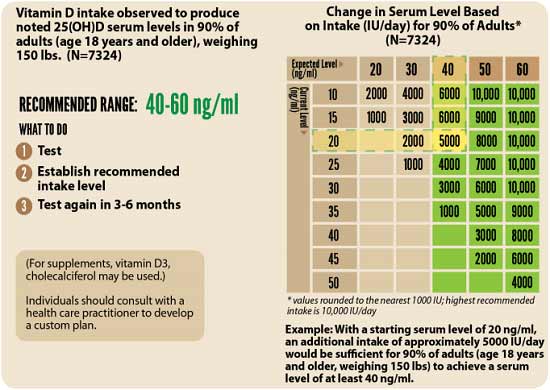
While this chart provides a starting point, you can fine-tune your
dosage further by taking into account your baseline vitamin D level. To
do that, you can either use the chart below, or use GrassrootsHealth’s
Vitamin D*calculator. To convert ng/mL into the European measurement (nmol/L), simply multiply the ng/mL measurement by 2.5.
How to Calculate Your Vitamin D From Sun Exposure
To calculate how much vitamin D you may be getting from regular sun
exposure in addition to your supplemental intake, consider using the
DMinder app,10
created by Dr. Michael Holick, author of “The Vitamin D Solution: A
Three-Step Strategy to Cure Our Most Common Health Problems.” The free
app is available for iPhone and android in the Apple store and Google
play respectively. As explained by imedicalapps.com:11
“The app attempts to calculate a patients’ vitamin D level based
on demographics imputed when first opening the app and then updates
the level based on either actual lab draws or data from the app. The
app even uses the phone’s GPS and clock to determine the ‘best’ time of
day for a patient to get the required sun exposure for vitamin D skin
conversion.”
Step 3: Retest
Next, you’ll need to re-measure your vitamin D level in three to six
months, to evaluate how your sun exposure and/or supplement dose is
working for you. As explained by GrassrootsHealth:
“The only way to know how much supplemental intake you need is
to test your levels. This will tell you whether the dose you are taking
is the right dose for you to reach optimum nutrient levels. It is also
important to check your nutrient levels at regular intervals because
lifestyle changes may create a need for dosing adjustments.”
What Is the D*action Project?
Aside from the DMinder app, another helpful tool is the myData-myAnswers online tracker created by GrassrootsHealth. You automatically have access to this tool when you buy their vitamin D testing kit and enroll in the D*action project.
You can track any given supplement with this tracker (not just
vitamin D). By tracking exactly how much you take and when, you can get
a clearer picture of your personal requirement to reach and maintain
an ideal level.
When you buy the GrassrootsHealth testing kit, you agree to enroll
in the D*action project, an international field study aimed at solving
the vitamin D deficiency epidemic.
By sharing your test results and anonymized personal health data
with GrassrootsHealth researchers, you will enable them to determine
the details of how vitamin D impacts health. As explained by
GrassrootsHealth:
“You may choose to enroll 1-time to test your levels with an
extended health questionnaire or you may participate for the full
5-year project where you provide your health information each 6 months
for the 5-year period. The participation fees are based on the tests
chosen; additional tests can be added to fit your individual needs.”
While I make these testing kits available in my online store, I do
not make any profit from their sale. All proceeds go directly to
GrassrootsHealth. If you prefer, you can also obtain the kit directly from their website.
Share and Inform Your Community
I urge everyone to share this information with friends, family and
community at large, so that we can minimize a second outbreak. For
example, you could speak to pastors in churches with large congregations
of people of color and help them start a program getting people on
vitamin D. Doing so could help save many lives; far more than any
vaccine program.
Additionally, if you have a family member or know anyone that is an
assisted living facility, you could meet with the director of the
program and encourage them to get everyone tested or at least start
them on vitamin D.


No comments:
Post a Comment