May 27, CNN
published an article that could have deadly consequences if believed. It
claims taking vitamin D supplements “can hurt a lot,” as “too much
vitamin D can lead to a toxic buildup of calcium in your blood, causing
confusion, disorientation and problems with heart rhythm, as well as
bone pain, kidney damage and painful kidney stones.” CNN does not
specify what “too much” vitamin D actually is
Hypercalcemia
(calcium buildup) is caused by insufficient vitamin K2 in relation to
vitamin D, not vitamin D per se. Vitamin K2 deficiency is what causes
“vitamin D toxicity” symptoms, but CNN does not explain this known fact
Reviews of
published trials have demonstrated there are no toxicity symptoms —
including hypercalcemia — at dosages up to 10,000 IU of vitamin D3 per
day, even when used long-term
Case histories
of patients with hypercalcemia and vitamin D toxicity reveal they were
taking between 3.6 million IUs and 210 million IUs over the course of
one to four months. That means taking 30,000 IUs of vitamin D per day
for 120 days on the lowest end, or 7 million IUs a day for 30 days on
the extreme upper end
CNN also cites a
British expert saying “there’s no evidence that very high vitamin D
levels are protective against COVID-19.” This, despite several recent
reports showing vitamin D levels appear to play an important role in
your risk of testing positive for COVID-19, as well as your risk of
severe infection and death
May 31, 2020, I posted an interview with three vitamin D experts
in which we discuss the importance of vitamin D for preventing
COVID-19 infection. A few days earlier, May 27, CNN published a report1 that could have deadly consequences if believed, claiming taking vitamin D supplements “can hurt a lot.”
The article was written by Sandee LaMotte — a medical producer and
writer for CNN and executive producer of video at pharma-biased WebMD.
Three other CNN reporters, Emma Reynolds, Shelby Lin Erdman and Rob
Picheta, also contributed to the story.
The article quotes Robin May, director of the British Institute of Microbiology and Infection as saying:2
"To date, there is no evidence that very high vitamin D levels are
protective against COVID-19 and consequently medical guidance is that
people should not be supplementing their vitamin D levels beyond those
which are currently recommended by published medical advice."
CNN Cites Vitamin D Recommendations Known To Be Incorrect
LaMotte cites dosing recommendations from the Institute of
Medicine’s National Academies' Food and Nutrition Board — a
nongovernmental organization — which advises a daily dose of just 600
IUs for anyone over the age of 4, and 800 IUs for those over 70. In the
U.K., the daily dose is a meager 400 IUs a day.
Nowhere does the article mention that the IOM’s dosage
recommendations are based on the levels thought to be adequate only for
bone health.3 They do not take into account the amount of vitamin D you need to prevent influenza, heart- or liver- disease, respiratory infections, cancer, or any of the many other diseases that have a clearly documented link to vitamin D deficiency.
LaMotte also fails to mention that the IOMs recommendations are off
by a factor of 10 due to a mathematical error, as reported by Science
Daily4 in 2015. Two papers5,6
confronting this issue have been published in the journal Nutrients,
both of which call for the IOM to correct its mistake, lest public
health suffer.
So, if IOM were to simply go back and correct this egregious
mistake, the “conventional medical advice” would be to take 6,000 IUs a
day, or 8,000 IUs if you’re over 70. These dosages are quite close to
the so-called “high-dose” recommendations suggested by many vitamin D
researchers.
The statement that there is “no evidence that very high vitamin D
levels are protective against COVID-19” is equally misleading,
considering a number of reports from COVID-19 researchers now show that
vitamin D appears to play a significant role in this infectious
disease.
Similarly, researchers demonstrated that the age-specific case
fatality rate of COVID-19 was highest in Italy, Spain and France —
European countries with the highest incidence of severe vitamin D
deficiency.7
In the video below, published May 11, 2020, on Medscape.com, Dr.
JoAnn E. Manson, professor of medicine and chief of division of
preventive medicine at Harvard Medical School, discusses the protective
role of vitamin D against COVID-19.
Advertisement
Vitamin D Deficiency Increases Risk of Positive COVID-19 Test
A May 2020 paper8
published on the preprint server MedRxiv (which means it’s still
awaiting peer-review) presents evidence that vitamin D deficiency
increases the risk of testing positive for COVID-19 infection. As
reported by News Medical Life Sciences:9
“The study by researchers at the University of Chicago looked at
over 4,300 patients with COVID-19 of whom 499 had been tested for
vitamin D levels in the previous year. Based on this, they were divided
into likely deficient (25%), likely adequate (58%), and uncertain
(16%).
Vitamin D deficiency was diagnosed by ‘the most recent
25-hydroxycholecalciferol <20ng/ml or 1,25-dihydroxycholecalciferol
<18pg/ml within one year before COVID-19 testing.’
Multiple variables were analyzed in this study. The researchers
found that people with vitamin D deficiency at the last testing, and
who did not receive higher doses of vitamin D (keeping them deficient
in all probability), are much more likely to be infected with the virus
than those with probably sufficient levels. The corresponding rates of
infection were 22% vs. 12%.”
Similarly, a May 6, 2020, report10
in the journal Nutrients pointed out that vitamin D concentrations are
lower in patients with positive PCR (polymerase chain reaction) tests
for SARS-CoV-2. As noted in this report, which retrospectively
investigated the vitamin D levels obtained from a cohort of patients in
Switzerland:11
“In this cohort, significantly lower 25(OH)D levels were found
in PCR-positive for SARS-CoV-2 (median value 11.1 ng/mL) patients
compared with negative patients (24.6 ng/mL); this was also confirmed
by stratifying patients according to age >70 years. On the basis of
this preliminary observation, vitamin D supplementation might be a
useful measure to reduce the risk of infection.”
Low Vitamin D Boosts Risk of Serious COVID-19 Infection
According to an editorial review12,13
by Irish researchers, people with vitamin D deficiency appear to be far
more prone to severe COVID-19 infections. According to the authors:14
“When mortality per million is plotted against latitude, it can
be seen that all countries that lie below 35 degrees North have
relatively low mortality. Thirty‐five degrees North also happens to be
the latitude above which people do not receive sufficient sunlight to
retain adequate vitamin D levels during winter. This suggests a
possible role for vitamin D in determining outcomes from COVID‐19 …
There are considerable experimental data showing that vitamin D
is important in regulating and suppressing the inflammatory cytokine
response of respiratory epithelial cells and macrophages to various
pathogens including respiratory viruses …
It is important to note that the hypothesis is not that vitamin D
would protect against SARS‐CoV‐2 infection but that it could be very
important in preventing the cytokine storm and subsequent acute
respiratory distress syndrome that is commonly the cause of mortality …
The evidence supporting a protective effect of vitamin D against
severe COVID‐19 disease is very suggestive, a substantial proportion
of the population in the Northern Hemisphere will currently be vitamin D
deficient, and supplements, for example, 1,000 international units (25
micrograms) per day are very safe.
It is time for governments to strengthen recommendations for
vitamin D intake and supplementation, particularly when under
lock‐down.”
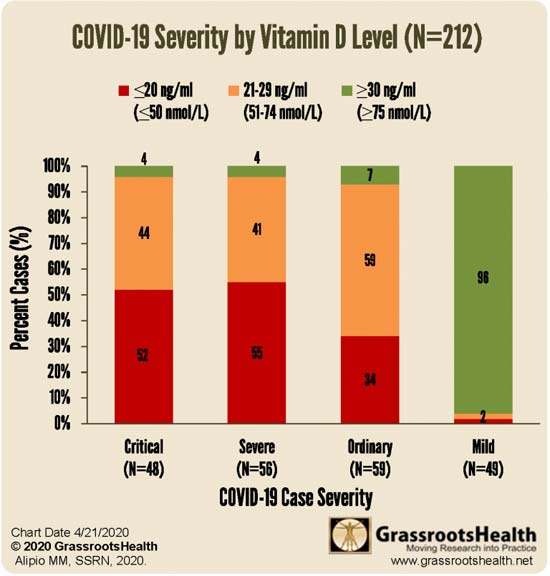
Similarly, Mark Alipio with GrassrootsHealth conducted a retrospective multicenter study15,16
involving 212 patients in Southeast Asia who had COVID-19. He too found
a strong correlation between vitamin D levels and disease severity.
Those with the mildest disease had the highest vitamin D levels, and
vice versa.
Normal vitamin D levels were defined as greater than 30 ng/ml;
insufficient levels were defined as 21 to 29 ng/ml; anything below 20
ng/mL was considered deficient. While Grassroots Health research has
determined that 40 ng/mL is the lower edge of optimal, with 60 ng/mL to
80 ng/mL being ideal for health and disease prevention, the benefit of
having a vitamin D level above 30 ng/mL was clear.
Low Vitamin D Levels Linked to Increased COVID-19 Mortality
The epidemiology of COVID-19 provides evidence that vitamin D might
be helpful in reducing risk associated with COVID-19 deaths.17 A May 6, 2020, report18 published in Aging Clinical and Experimental Research (its prepublication featured in the Daily Mail May 119) found that countries with lower vitamin D levels also have higher mortality rates from COVID-19. According to the authors:20
“The Seneca study showed a mean serum vitamin D level of 26
nmol/L in Spain, 28 nmol/L in Italy and 45 nmol/L in the Nordic
countries, in older people. In Switzerland, mean vitamin D level is 23
nmol/L in nursing homes and in Italy 76% of women over 70 years of age
have been found to have circulating levels below 30 nmol/L.
These are the countries with high number of cases of COVID-19
and the aging people is the group with the highest risk for morbidity
and mortality with SARS-CoV2.”
In the preprint version21
of this paper, the authors concluded: “We believe that we can advise
vitamin D supplementation to protect against SARS-CoV2 infection.” In
the final version,22 they toned down the recommendation to: “We hypothesize that vitamin D may play a protective role for COVID-19.”
Another study,23,24
which looked at data from 780 hospital patients in Indonesia, found
those with a vitamin D level between 20 ng/mL and 30 ng/mL had a
sevenfold higher risk of death than those with a level above 30 ng/mL,
and having a level below 20 ng/mL was associated with a 12 times higher
risk of death.
Vitamin D Is a Simple Strategy That Can Save Lives
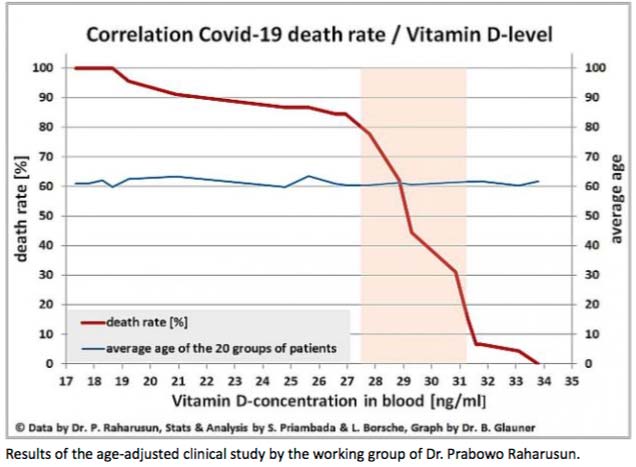
In a May 18, 2020, letter25
to the Federal Chancellor of Germany, Angela Merkel, retired biochemist
Bernd Glauner and Lorenz Borsche highlight these and other studies26 and ask whether a nationwide supply of vitamin D has been considered in Germany.
“Until a vaccine is available, vitamin D supplementation could
be a preventive measure that should be discussed to reduce the
lethality of covid-19. The available studies also suggest that vitamin D
shock treatment may protect patients already infected and hospitalized
with Covid-19 from lethal sepsis,” they write.
The following graph is included in the letter.
Glauner and Borsche continue:27
“… Scientific and clinical studies suggesting an alternative
treatment option are apparently ignored. One of these promising
approaches is the treatment with vitamin D. The available studies on
Covid-19 patients suggest that a large proportion of deaths could
possibly be prevented and severe courses could be reduced to milder ones
…
This way would be easy and does not cause high costs. It would
be sufficient to measure the vitamin D level in Covid-19 infected
persons, hospital staff and risk patients and, if necessary, to raise
it to healthy levels well above 35 ng/ml. In any case, no comparison to
the enormous costs of the lockdown. This could possibly save us
another lockdown and many more Covid-19 fatalities.”
No, Vitamin D Supplementation Is Not Dangerous
The CNN article is just another propaganda COVID-19 narrative of
mainstream media. This egregious behavior is similar to the
hydroxychloroquine paper published in The Lancet that the WHO has used
to discredit and stop using hydroxychloroquine for COVID-19. Over 100
scientists question the ethics and standards of this incredibly shoddy
study.28
Probably the most serious mistake in LaMotte’s CNN article are her
claims that vitamin D supplementation “can hurt a lot.” She claims “too
much vitamin D can lead to a toxic buildup of calcium in your blood,
causing confusion, disorientation and problems with heart rhythm, as
well as bone pain, kidney damage and painful kidney stones.”
She makes those claims without a) citing or referencing any
supporting evidence, b) clarifying that the “toxic buildup of calcium”
(hypercalcemia) is caused by insufficient vitamin K2 in relation to vitamin D, not vitamin D per se (a fact that is now well-established) and c) without specifying what “too much” actually might be.
A review29
of published trials have demonstrated there are no toxicity symptoms —
including hypercalcemia — at dosages up to 10,000 IU of vitamin D3 per
day, even when used long-term. A more recent paper found that Intakes
of vitamin D up to 15,000 IU/day are safe.30
In my search for horror stories, I discovered a case paper31
published in 2011, which presented the cases of 10 adult patients
diagnosed with hypercalcemia in relation to vitamin D supplementation.
Symptoms listed in this paper include vomiting, polyuria (excessive
urination), polydipsia (excessive thirst), hypercalcemia (excessive
calcium levels), encephalopathy (brain damage or disease causing memory
loss, personality changes or seizures, for example) and kidney
dysfunction.
It sounds scary, but when you consider that these patients were
taking MILLIONS of units of vitamin D — specifically, 3,600,000 (3.6
million) IUs and 210,000,000 (210 million) IUs over the course of one
to four months (median two months) — you start to see just how wrong it
is to warn people off vitamin D supplements.
For example, the dosages these people were getting would be like
taking 30,000 IUs of vitamin D per day for 120 days on the lowest end,
or 7 million IUs a day for 30 days on the extreme upper end. No one is
recommending you take these kinds of dosages, especially not for
extended periods of time.
Many may need 10,000 IUs a day — which is safe — to get their level
above 60 ng/mL. The maintenance dose, however, is typically lower. To
determine your ideal dose, you need to get your blood tested, ideally
twice a year. The level you’re looking for is between 60 ng/mL and 80
ng/mL. As of right now, there does not appear to be any significant
benefit to levels higher than 80 ng/mL.
REALLY IMPORTANT: Optimize Your Vitamin D Level Before Fall!
Experts are already warning that SARS-CoV-2 may reemerge in the fall
when temperatures and humidity levels drop, thereby increasing the
virus’ transmissibility.
I am in the process of writing an even more comprehensive and
detailed report on vitamin D in the prevention of COVID-19 and I hope
to enlist ALL of you to participate as an army to go out and tell all
your friends and family and get them on board to get their vitamin
levels optimized.
Once you have done that, the next step is to encourage pastors of
black churches to get their congregations on board. It will also be
important to reach out to mangers of nursing homes and assisted living
facilities as both of these populations have notoriously low vitamin D
levels that put them at greater risk of COVID-19.
You now have a known “deadline” for optimizing your vitamin D level.
Historically, December typically has highest flu activity in the U.S.,32 but it would probably be good to aim for October, or maybe even earlier depending on your location.
To improve your immune function and lower your risk of viral
infections, you’ll want to raise your vitamin D to a level between 60
nanograms per milliliter (ng/mL) and 80 ng/mL by fall. In Europe, the
measurements you’re looking for are 150 nanomoles per liter (nmol/L) and
200 nmol/L.
Again, optimizing your vitamin D is particularly important if you
have darker skin, as darker skin places you at higher risk for vitamin D
deficiency — and serious COVID-19 infection. What’s more, the elderly
tend to lose the ability to synthesize vitamin D from sun exposure, and
therefore tend to have suboptimal levels even if they spend plenty of
time outdoors.
One of the easiest and most cost-effective ways of measuring your vitamin D level is to participate in the GrassrootsHealth’s personalized nutrition project, which includes a vitamin D testing kit, either alone or in combination with the omega-3 test. This is done in the convenience of your home.
You’ll learn your nutrient levels, how effective your health actions
are, and you’ll be able to see thousands of other data sets that allow
you to compare health outcomes important to you. Knowledge is
empowerment, and that is particularly true during this pandemic. To make
sure your immune system has a chance to work optimally, follow these
three steps.
Step 1: Measure Your Vitamin D
First, find out what your base level is. This is done with a simple
blood test. An easy and cost-effective way of doing this is to order
GrassrootsHealth’s vitamin D testing kit.
Once you know what your blood level is, you can assess the dose
needed to maintain or improve your level. Again, the ideal level you’re
looking for is above 40 ng/mL, and ideally between 60 ng/mL and 80
ng/mL (European measurement: 100 nmol/L or, ideally, 150 nmol/L to 200
nmol/L).
The easiest way to raise your level is by getting regular, safe sun
exposure, but if you’re very dark-skinned, you may need to spend about
1.5 hours a day in the sun to have any noticeable effect.
Those with very light skin may only need 15 minutes a day, which is
far easier to achieve. Still, they too will typically struggle to
maintain ideal levels during the winter. So, depending on your
situation, you may need to use an oral vitamin D3 supplement. The next
question then becomes, how much do you need?
Step 2: Assess Your Individualized Vitamin D3 Dosage
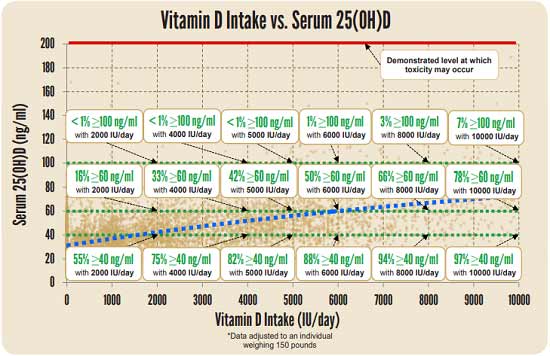
The following chart can provide you with a basic starting point:
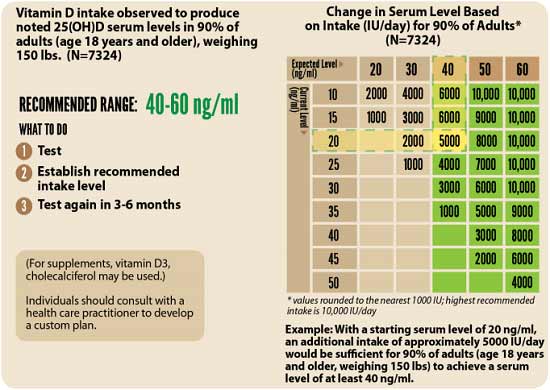
You can fine-tune your dosage further by taking into account your
baseline vitamin D level. To do that, you can either use the chart
below, or use GrassrootsHealth’s Vitamin D*calculator. To convert ng/mL into the European measurement (nmol/L), simply multiply the ng/mL measurement by 2.5.
How to Calculate Your Vitamin D From Sun Exposure
To calculate how much vitamin D you may be getting from regular sun
exposure in addition to your supplemental intake, consider using the
DMinder app,33
created by Dr. Michael Holick, author of “The Vitamin D Solution: A
Three-Step Strategy to Cure Our Most Common Health Problems.” The free
app is available for iPhone and android in the Apple store and Google
play respectively. As explained by imedicalapps.com:34
“The app attempts to calculate a patients’ vitamin D level based
on demographics imputed when first opening the app and then updates
the level based on either actual lab draws or data from the app. The
app even uses the phone’s GPS and clock to determine the ‘best’ time of
day for a patient to get the required sun exposure for vitamin D skin
conversion.”
Step 3: Retest
Lastly, you’ll need to remeasure your vitamin D level in three to
six months, to evaluate how your sun exposure and/or supplement dose is
working for you. Not only will optimizing your vitamin D be an
important strategy for you and your family, but it would be really
helpful to start thinking about your community as well.
If you can, speak to pastors in churches with large congregations of
people of color and help them start a program getting people on
vitamin D. Doing so could save far more lives than any vaccine program.
If you have a family member or know anyone who is in an assisted
living facility you could meet with the director of the program and
encourage them to get everyone tested or at least start them on vitamin
D.


No comments:
Post a Comment