August 10,
2018, a jury ruled in favor of plaintiff Dewayne Johnson in a truly
historic case against Monsanto. Jurors found Monsanto was responsible
for “negligent failure” by not warning consumers about the
carcinogenicity of Roundup
The jury
ordered Monsanto to pay $289 million in damages to Johnson, $33 million
of which was for noneconomic pain and suffering. In October, the judge
upheld the guilty verdict but reduced the total award to $78 million
Bayer/Monsanto
appealed. In its appellate brief, the company asks for reversal of the
damages awarded based on the fact that Johnson is near death
Recent research
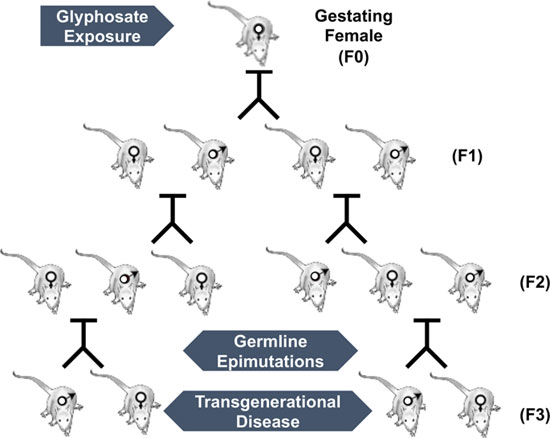
shows glyphosate has multi-generational effects. Pregnant rats exposed
to half of the no-observed-adverse-effect-level of glyphosate
established by the European Food Safety Authority between the eighth and
14th day of gestation had offspring with higher rates of birth defects,
obesity, and diseases of the kidneys, prostate, testes, ovaries and
mammary glands (breasts)
Third
generation males had a 30% higher rate of prostate disease than the
controls, while third generation females had a 40% higher rate of kidney
disease. Cancer increased in second-generation rats but not in the
first and third generations
August 10, 2018, a jury found Monsanto (now owned by Bayer AG1,2)
had “acted with malice or oppression” and was responsible for
“negligent failure” by not warning consumers about the carcinogenicity
of its weed killer, Roundup.3,4 The plaintiff in this historic case was 46-year-old Dewayne Johnson, who is dying from Non-Hodgkin lymphoma.
Johnson sprayed about 150 gallons of Roundup 20 to 40 times per year
while working as a groundskeeper for the Benicia Unified School
District in California, from 2012 through late 2015.5 His lawsuit, filed in 2016 after he became too ill to work, accused Monsanto of hiding the health hazards of Roundup.
The jury ordered Monsanto to pay $289 million in damages to Johnson,
$33 million of which was noneconomic damages for pain and suffering.
In October, the judge upheld the guilty verdict but reduced the total
award to $78 million.6,7,8
Monsanto/Bayer Wants Damages Reduced on Grounds That Plaintiff Is Near Death
As expected, Bayer/Monsanto
appealed. What’s shocking is the company’s argument for significantly
reducing the damage amount further. In its appellate brief,9
the company asks for reversal of the damages awarded based on the fact
that Johnson is near death. On page 87, the appeal states:10
“A jury may award future noneconomic damages only for pain
and suffering that a plaintiff is reasonably certain to experience
based on his ‘projected life span at the time of trial’ …
[‘[D]amages for future pain and suffering are based upon
plaintiff’s probable life expectancy in his or her injured condition
... [C]ompensation for pain and suffering is recompense for pain and
suffering actually experienced, and to the extent that premature death
terminates the pain and suffering, compensation should be terminated’] …
An award is excessive if it ‘suggest[s] the jury was influenced by
improper considerations’ … At closing argument, Plaintiff’s counsel
ignored these principles. He implored the jury to award $1 million per
year for both past and future noneconomic damages, and asserted that
Plaintiff ‘will live between two more to 33 years.’
In so doing, Plaintiff’s counsel urged the jury to disregard the
evidence presented through his medical expert, Dr. Nabhan, that
Plaintiff would not live past December 2019, or roughly one and a half
years after trial …
He then asked for $33 million in future noneconomic damages: ‘[I]f
he lives for only two years, then the remaining years that he doesn’t
get to live is also a million dollars. So it doesn’t matter if he dies
in two years or dies in 20 … [H]e deserves that money’ … [asking jury
to award $33 million in future noneconomic damages based on Plaintiff’s
‘potential life expectancy over the years he won’t live’ … ]).
And the jury awarded Plaintiff exactly what his lawyer requested:
$33 million in future noneconomic damages … The court posed two
questions for the parties to address at argument:
‘Is the $33 million award for future non- economic damages based
on Plaintiff’s argument to award $1 million for each year of lost life
expectancy? If so, is this award improper as a matter of law?’ Yet the
trial court declined to follow this line of inquiry to its inevitable
conclusion …
Dr. Kuzel also suggested that Plaintiff ‘could be cured of this
disease and live his normal life expectancy.’ But even under this
hypothetical … the jury had no basis to award damages for pain and
suffering occurring after Plaintiff was cured … In sum, the court
should reverse the award of future noneconomic damages because that
award is not supported by the evidence of Plaintiff’s projected life
expectancy at the time of trial.”
The company is essentially guilty of killing Johnson 33 years before
his time, if you assume he’d have a normal life span of 79, and now
Bayer wants reduced damages because he’s only got less than two years
to live! It’s a new low even for Monsanto, and clear proof of the
company’s callous disregard for human life.
Second Lawsuit Ends in Guilty Verdict and $80 Million in Damages
March 19, 2019, a U.S. jury ruled Roundup was a substantial
causative factor in the cancer of a second plaintiff, Edwin Hardeman.11,12
Judge Vince Chhabria had approved Monsanto’s motion to divide the trial
into two phases, the first phase limiting evidence to that relating to
causation only.
In the second phase, jurors heard evidence related to liability.
March 27, 2019, the jury found Monsanto had acted with negligence and
awarded Hardeman $80 million in damages, including $75 million in
punitive damages.13
A third case against Monsanto (Stevick et al v. Monsanto) was
originally slated to go to trial May 20, 2019. However, Chhabria
recently vacated the trial date and ordered Monsanto/Bayer to begin
mediation with all remaining plaintiffs in the federal multidistrict
litigation overseen by him — some 800 in all.14 Aside from these, Monsanto faces roughly 11,000 additional plaintiffs who claim Roundup caused their Non-Hodgkin lymphoma.15
Plaintiffs Request Restraining Order Against Monsanto Advertising
In another Roundup trial, this one in Alameda County Superior Court
of California, a married couple, Alva and Alberta Pilliod, claim they
both developed Non-Hodgkin lymphoma after regular use of Roundup. As
reported by U.S. Right to Know (USRTK):16
“Plaintiffs’ attorney Mike Miller asked judge Winifred Smith to
issue a temporary restraining order against Monsanto for heavy
advertising the company has been doing in defense of the safety of its
herbicides, including a full-page ad in the Wall Street Journal on March
25, the day the voir dire for jury selection in the Pilliod case
began.”
Monsanto’s legal team countered saying The Miller Firm has engaged
in its own ad campaign in an effort to add more clients for its Roundup
litigation. The firm also published an ad in the San Francisco
Chronicle seven days before the Pilliod case began, in which they
claimed Roundup exposure could double or triple the risk of Non-Hodgkin lymphoma.
Monsanto also argued 2,187 anti-Roundup ads have aired on TV and
radio between December 1, 2018 and March 21, 2019 in the San Francisco
market. In the end, Judge Smith denied the plaintiffs’ request to stop
Monsanto from advertising Roundup as having 40 years of safe product
use and science proving its safety.
Monsanto Documents Reveal Close Relationship With Reuters Reporter
In related news, documents unearthed during the many lawsuits
against Monsanto (colloquially and collectively known as The Monsanto
Papers17)
reveal the company enlisted Reuters reporter Kate Kelland in its
attempts to discredit the International Agency for Research on Cancer
(IARC), an arm of the World Health Organization (WHO), after IARC
scientists reclassified glyphosate as a probable human carcinogen in
2015.18,19 Investigative reporter for USRTK, Carey Gillam, writes:20
“Not only did Kelland write a 2017 story that Monsanto asked her
to write in exactly the way Monsanto executive Sam Murphey asked her
to write it (without disclosing to readers that Monsanto was the
source), but now we see evidence21
that a draft of a separate story Kelland did about glyphosate was
delivered to Monsanto before it was published, a practice typically
frowned on by news outlets … The final version22 was published on April 13, 2017.”
Another email 23
suggests Monsanto was involved in the crafting at least two other
Kelland reports that were critical of the IARC, including her “Special
Report: How the World Health Organization’s Cancer Agency Confuses
Consumers”24
story, published in April, 2016. According to Gillam, Kelland also
“helped Monsanto drive a false narrative about cancer scientist Aaron
Blair in his role as head of the IARC working group that classified
glyphosate as a probable carcinogen.”
Internal company correspondence shows Murphey sent the narrative and
talking points he wanted her to use and cover, including portions of a
deposition Blair had given that was not filed in court. Kelland
published the story,25 citing “court documents” as her source, when the source was in fact Monsanto.
“By falsely attributing the information as based on court
documents she avoided disclosing Monsanto’s role in driving the story,”
Gillam writes,26 adding,
“When the story came out, it portrayed Blair as hiding ‘important
information’ that found no links between glyphosate and cancer from
IARC.
Kelland wrote that a deposition showed that Blair ‘said the data
would have altered IARC’s analysis’ even though a review of the actual
deposition shows that Blair did not say that. Kelland provided no link
to the documents she cited, making it impossible for readers to see for
themselves how far she veered from accuracy.”
This story was widely used by Monsanto in its efforts to discredit
IARC and strip them of U.S. funding. Gillam adds, “On a personal note, I
spent 17 years as a reporter at Reuters covering Monsanto and I am
horrified at this violation of journalistic standards.”
According to Gillam, Reuters editor Mike Williams and ethics editor
Alix Freedman both stand by Kelland’s story on Blair and have refused
to issue a correction, to which she says, “It is particularly
noteworthy that Alix Freedman is the same person who told me I was not
allowed to write about many independent scientific studies of
Monsanto’s glyphosate that were showing harmful impacts.”
EPA Is Just Another Monsanto Captured Agency
Emails and internal documents also show high-ranking officials at
the U.S. Environmental Protection Agency (EPA) have colluded with and
protected Monsanto’s interests by manipulating and preventing key
investigations into glyphosate’s cancer-causing potential. In other
words, taxpayers’ money has been used to shield Monsanto from liability
and obstruct consumers’ ability to prove damages.
Monsanto has defended Roundup’s safety in court by leaning on a 2016
EPA report that found glyphosate is “not likely to be carcinogenic” to
humans.27
At the time, Jess Rowland was the deputy division director of the EPA’s
Office of Pesticide Programs (OPP), Health Effects Division,28 and Rowland was a key author of that report.
The EPA’s conclusion, which runs counter to the IARC’s determination
that glyphosate is probably carcinogenic, met with severe criticism —
so much so, a scientific advisory panel was recently convened to
evaluate the strength of the EPA’s decision. According to some of the
members on this panel, the EPA violated its own guidelines by
discounting and downplaying data from studies linking glyphosate to
cancer.29
Email correspondence between EPA toxicologist Marion Copley and
Rowland suggest Rowland colluded with Monsanto to find glyphosate
noncarcinogenic.30,31
Copley cited evidence showing glyphosate is toxic to animals and
accused Rowland of playing “political conniving games with the science”
to help Monsanto. Rowland also warned Monsanto of the IARC’s
determination months before it was made public,32 giving the company time to plan its defense strategy.
Email correspondence also showed Rowland helped stop a glyphosate
investigation by the Agency for Toxic Substances and Disease Registry
(ATSDR), which is part of the U.S. Department of Health and Human
Services, on Monsanto’s behalf.
In an email, Jenkins recounts a conversation he’d had with Rowland,
in which Rowland said, “If I can kill this I should get a medal,”33,34 referring to the ATSDR investigation.
In correspondence35
between Daniel Jenkins, Monsanto’s manager for regulatory affairs, and
Monsanto chief scientist William Heydens, Jenkins also confirms that
Monsanto indeed had far more reason to worry about the ATSDR than the
EPA, as the ATSDR had a reputation of being “VERY conservative and IARC
like,” and “hazard based.”
Rowland Wasn’t the Only EPA Official Working on Monsanto’s Behalf
In a 2017 Huffington Post article,36
Gillam cites evidence showing Rowland was not acting alone. Other
high-ranking EPA officials that also appear to have worked on
Monsanto’s behalf include Jim Jones, assistant administrator for the
Office of Chemical Safety and Pollution Prevention, who oversaw the
EPA’s OPP, “a presidential appointee who carried significant clout,”
Gillam writes,37 and OPP director Jack Housenger.
“Rather than encourage and assist the toxicology review of
glyphosate, Monsanto and EPA officials repeatedly complained to ATSDR
and HHS [U.S. Department of Health and Human Services] that such a
review was unnecessarily ‘duplicative’ and should take a back seat to an
EPA review also underway,” Gillam writes.38
In her article, she presents a day-by-day timeline of correspondence
(with links to the documents in question) taking place between May 19,
2015 and October 23, 2015, at which point the ATSDR review was “fully
on hold.”
New Study Shows Glyphosate Causes Multigenerational Health Damage
In other related news, Washington State University researchers report39
glyphosate has multigenerational effects. Said to be the first study of
its kind, the researchers found pregnant rats exposed to glyphosate
between the eighth and 14th day of gestation had offspring with higher
rates of birth defects, obesity and diseases of the kidneys, prostate,
testes, ovaries and mammary glands (breasts).
Third generation rats also had significantly higher rates of certain
pathologies. For example, third generation males had a 30% higher rate
of prostate disease than the controls, while third generation females
had a 40% higher rate of kidney disease.
One-third of second generation females also ended up having
difficult births, and 2 in 5 third-generation rats were obese.
Remarkably, the dose used (25 mg/kg of bodyweight per day) was half the
no-observed-adverse-effect-level (50 mg/kg/day) established by the
European Food Safety Authority in 2015.40,41
Cancer increased in second generation rats but not in the first and
third generations. Curiously, delayed puberty affected first and second
generation males, but not the third generation males, while in females
puberty was delayed only in the second generation. According to the
authors: 42
“The current study provides the first analysis of potential
transgenerational impacts of glyphosate in mammals. The exposure of a
gestating female directly exposes the F0 generation female, the F1
generation offspring, and the germline within the F1 generation
offspring that will generate the F2 generation grand-offspring.
Therefore, the first transgenerational generation is the F3
generation great-grand-offspring not having any direct exposure, Fig. 7
…
The impacts of environmental exposures on subsequent generations
can be referred to as ‘Generational Toxicology,’ and suggests
ancestral exposures can promote the onset of disease and pathology in
subsequent generations. The mechanism involved is epigenetic
transgenerational inheritance through epigenetic alterations of the
germline.
Although many exposures can influence both the directly exposed
individuals and transgenerational individuals, recent observations
suggest some toxicants or exposures have negligible impacts on the
direct exposed individuals, but can influence subsequent generations
never having direct exposure …
The F1 generation offspring had negligible pathologies in any of
the tissues analyzed. The only effects observed were on weaning weights
in both males and females, and a delay in puberty in males. Therefore,
classic toxicology analysis of the F0 and F1 generations demonstrated
negligible toxicity or pathology from direct glyphosate exposure.
In contrast, the F2 generation grand-offspring, derived from a
direct exposure F1 generation germline, had significant increases in
testis disease, kidney disease, obesity, and multiple diseases in
males.
The F2 generation females had significant increases in ovary
disease, obesity, mammary gland tumors, parturition abnormalities, and
multiple disease susceptibility.
The transgenerational F3 generation great-grand-offspring males had
increased prostate disease, obesity, and single disease frequencies,
while females had increased ovarian disease, kidney disease,
parturition abnormalities, and multiple disease susceptibility.
A unique pathology observed with glyphosate exposure, and seldom
seen in previous transgenerational studies, was the parturition [editor’s note: childbirth]
abnormalities. Over 30% of the F2 generation female rats in the later
stages of gestation died of dystocia and/or had litter mortality. This
was also seen in the paternal outcross F3 generation gestating female
rats.”
Dystocia is the medical term for difficult birth, typically
resulting from an abnormally larger or improperly positioned baby.
Having a small pelvis can also be at play, or the uterus or cervix
might not contract and expand normally, making the delivery difficult.
According to the researchers, these underlying pathologies may be at
play in the “premature birth rates and infant abnormalities seen
today.” While not mentioned, it’s also worth noting that the U.S.,
where glyphosate-contaminated foods are extremely common and widely
consumed, also has the highest maternal mortality rate in the developed
world.43
How to Test Your Glyphosate Level and Eliminate It From Your System
Considering the possible dangers of glyphosate, it would make sense
to minimize your exposure, and if you have high levels already, to take
steps to detoxify it.
HRI Labs has developed home test kits for both water and urine,
and if you have elevated levels, you can drive out the glyphosate by
taking an inexpensive glycine supplement. They will very shortly also
be offering a hair test for glyphosate, which will be a better
indicator of your long-term exposure.
Dr. Dietrich Klinghardt, and expert in metal and environmental
toxicity, recommends taking 1 teaspoon (4 grams) of glycine powder
twice a day for a few weeks and then lowering the dose to one-fourth
teaspoon (1 gram) twice a day. This forces the glyphosate out of your
system, allowing it to be eliminated through your urine.

No comments:
Post a Comment