Red Light ‘Triples Testicle Function’ Studies Show from Red Light Man
Red Light ‘Triples Testicle Function’ Studies Show
30 Oct
Most organs and glands of the body are covered by several inches of
either bone, muscle, fat, skin or other tissues, making direct light
exposure impractical, if not impossible. However, one of the notable
exceptions is the male testes.
Is it advisable to shine red light directly on one’s testicles?
Research is highlighting several interesting benefits to testicular red light exposure:
Fertility Boosted
Sperm quality is the primary measure of fertility in men, as the
viability of spermatozoa is generally the limiting factor to successful
reproduction (from the male’s side).
Healthy spermatogenesis, or the creation of sperm cells, happens in
the testicles, not so far from the production of androgens in the Leydig
cells. The two are highly correlated in fact – meaning that high testosterone levels = high sperm quality and vice versa. It’s rare to find a low testosterone man with great sperm quality.
Sperm are produced in the seminiferous tubules of the testes, in a
multi-step process involving several cell divisions and maturation of
these cells. Various studies have established a very linear relationship
between ATP/energy production and spermatogenesis:
Drugs and compounds which interfere with mitochondrial energy
metabolism in general (i.e. Viagra, ssris, statins, alcohol, etc.) have
an extremely negative effect on sperm production.
Drugs/compounds which support ATP production in mitochondria
(thyroid hormones, caffeine, magnesium, etc.) boost sperm counts and
general fertility.
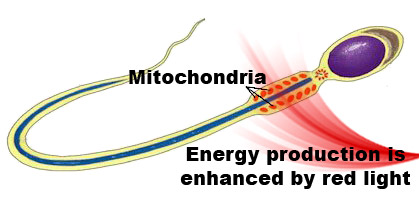
More so than other bodily processes, sperm production is highly dependent on ATP production. Given that red & infrared light both enhance ATP production in mitochondria, it should come as no surprise that red/infrared wavelengths have been shown to boost testicular sperm production and viability of the sperm.
Conversely, blue light and UV light, which both harm the mitochondria
(suppressing ATP production) also reduce sperm count/fertility.
Sperm have more energy to ‘swim’ after stimulation by red light
This applies not only to the sperm production in the testicles, but
also directly to the health of free sperm cells post-ejaculation. For
example studies have been done on in vitro fertilization (IVF), showing
superior outcomes under red light in both mammals and fish sperm. The
effect is especially profound when it comes to sperm motility, or
ability to ‘swim’, as the tail of sperm cells are powered by a row of
red light sensitive mitochondria.
Summary
In most cases, red light therapy on the testicle area shortly before
sexual intercourse would produce a greater chance of successful
fertilization.
Furthermore, consistent red light therapy over the days prior to
sexual intercourse would even further increase chances, not to mention
reduce chances of abnormal sperm production.
Testosterone Levels Potentially Tripled
It has been known scientifically since the 1930s that light in
general can help males to produce more of the androgen testosterone.
Initial studies back then examined how isolated light sources on the
skin and body affect hormone levels, showing a significant improvement
by using incandescent bulbs and artificial sunlight.
Some light, it seems, is good for our hormones. Conversion of skin
cholesterol into vitamin D3 sulfate is a direct link. Though perhaps
more importantly, the improvement in oxidative metabolism and ATP
production from red/infrared wavelengths has broad reaching, and often
underestimated, effects on the body. After all, cellular energy
production is the basis of all functions of life.
More recently, studies have been done on direct sunlight exposure,
firstly to the torso, which reliably increases male’s testosterone
levels by anywhere from 25% to 160% depending on the person. Sunlight
exposure directly to the testes though has an even more profound effect,
boosting testosterone production in Leydig cells by an average of 200% –
a large increase over baseline levels.
Studies linking light, particularly red light, to the testicular
function of animals have been performed for almost 100 years now.
Initial experiments focused on male birds and small mammals such as
mice, showing effects such as sexual activation and recrudescence. Testicular stimulation by red light has been researched for almost a century,
with studies linking it to healthy testicular growth and superior
reproductive outcomes in almost all cases. More recent human studies
support the same theory, showing potentially even more positive results
compared to birds/mice, with preliminary results showing a steady, dose-dependent jump in testosterone levels.
Why exactly does red light on testes have dramatic effects on testosterone?
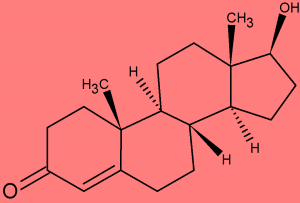
Testosterone molecule as produced by humans
Testicular function, as mentioned above, is dependent on energy
production. While this can be said about practically any tissue in the
body, there is evidence that it is especially true for the testes.
Explained in greater detail on our red light therapy
page, the mechanism that red wavelengths work is to stimulate ATP
production (which can be thought of as cellular energy currency) in our
mitochondria’s respiratory chain (look into cytochrome oxidase – a
photoreceptive enzyme – for more info), increasing the energy available
to the cell – this applies to Leydig cells (testosterone producing cells) just as much. Energy production and cellular function are commensurate, meaning more energy = more testosterone production.
More so than that, whole body energy production, as correlated with /
measured by active thyroid hormone levels, is known to stimulate
steroidogenesis (or testosterone production) directly in the Leydig
cells.
Another potential mechanism involves a seperate class of
photoreceptive proteins, known as ‘opsin proteins’. The human testes are
especially abundant with various of these highly specific
photoreceptors including OPN3, which are ‘activated’, much like
cytochrome, specifically by wavelengths of light. Stimulation of these
testicular proteins by red light induces cellular responses that may
ultimately lead to increased testosterone production, amongst other
things, although research is still in the preliminary stages regarding
these proteins and metabolic pathways. These type of photoreceptive
proteins are also found in the eyes and also, interestingly, the brain.
Summary
In most cases, red light therapy directly on the testicles for short, regular periods would raise testosterone levels over time.
Downstream this would lead to a holistic effect on the body, raising focus, improving mood, increasing muscle mass, bone strength andlowering excess body fat.
Type of light exposure is crucial
Red light can come from a variety of sources; it is contained in the
wider spectra of sunlight, most home/work lights, street lights and so
on. The problem with these light sources is that they also contain
contradictory wavelengths such as UV (in the case of sunlight) and blue
(in the case of most home/street lights). Additionally, the testicles
are especially sensitive to heat, more so than other parts of the body. There’s no point applying beneficial light if you are simultaneously cancelling the effects with harmful light or excess heat.
Blue & UV light’s effects
Metabolically, blue light can be thought of as the opposite of red light. While red light improves cellular energy production, blue light worsens it.
Blue light specifically damages the cytochrome enzyme in mitochondria,
preventing ATP and carbon dioxide production. This can be positive in certain situations such as acne
(where the problematic bacteria are killed), but over time in humans
this leads to an inefficient metabolic state similar to diabetes. UV or
ultraviolet light is even worse, having all of the negative aspects of
blue light magnified, and able to penetrate the skin deeper – exerting
damage on a more profound level.
Red Light vs. Sunlight on testicles
Sunlight has definite beneficial effects –
vitamin D production, improved mood, increased energy metabolism (in
small doses) and so on, but it is not without its downsides. Too much
exposure and you not only lose all benefits, but create inflammation and
damage in the form of sunburn, eventually contributing the skin cancer.
Sensitive areas of the body with thin skin are especially prone
to this damage and inflammation from sunlight – no area of the body
more so than the testes. Isolated sources of red light such as
LEDs are better, with none of the harmful blue & UV wavelengths and
so no risk of sunburn, cancer or testicular inflammation.
Don’t heat the testicles
Male testicles hang outside of the torso for a specific reason – they operate most efficiently at 35°C (95°F), which is a full two degrees below normal body temperature of 37°C (98.6°F). Many
types of lamps and bulbs used by some for light therapy (such as
incandescents, heat lamps, infrared lamps at 1000nm+) give off a
significant amount of heat and therefore are NOT suitable for use on the
testicles. Heating the testicles while attempting to apply
light would give negative results. The only ‘cold’/efficient sources of
red light are LEDs.
Bottom Line
Red or infrared light from an LED source (600-950nm) can be safely applied to the testes without risk of side effects or damage
while delivering all of the benefits as detailed above (improved fertility, improved testosterone production, etc.).
Sunlight can also be used on the testes but only for short periods and it is not without risks.
Avoid exposure to blue/UV.
Avoid any sort of heat lamp/incandescent bulb.
Stick to LED light therapy for maximum safety and benefits.
Visible red (600-700nm) LEDs are optimal. Session time from 2-20 minutes
depending on light strength/heat.
Recommended Light Devices
References Iurshin VV, Sergienko NF, Illarionov VE. Etiopathogenetic basis
for using magnetolaser therapy in the complex treatment of male
infertility. Urologiia. 2003 Mar-Apr;(2):23-5. Reza Salman Yazdi, Simin Bakhshi, Firooz Jannat Alipoor, Mohammad
Reza Akhoond. Effect of 830-nm diode laser irradiation on human sperm
motility. Lasers Med Sci (2014) 29:97–104 Ross S. Firestone, Navid Esfandiari, Sergey I. Moskovtsev et al.
The Effects of Low-Level Laser Light Exposure on Sperm Motion
Characteristics and DNA Damage. Journal of Andrology, Vol. 33, No. 3,
May/June 2012 Taha MF, Valojerdi MR. Quantitative and qualitative changes of
the seminiferous epithelium induced by Ga. Al. As. (830 nm) laser
irradiation. Lasers in surgery and medicine 2004; 34: 352-359. Jin-Chul Ahn, Young-Hoon Kim, Chung-Ku Rhee. The effects of low
level laser therapy (LLLT) on the testis in elevating serum testosterone
levels in rats. Biomedical Research 2013; 24 (1): 28-32 NM Biswas, R Biswas, NM Biswas and Late H Mandal. Effect of
continuous light on spermatogenesis and testicular steroidogenesis in
rats. Nepal Med Coll J 2013; 15(1): 62-64 Z. Abdel-Salam, M.A. Harith. Laser researches on livestock semen
and oocytes: A brief review. Journal of Advanced Research. Volume 6,
Issue 3, May 2015, Pages 311–317 Peterson, R, N., and Freund, M. (1970). ATP synthesis and oxidative metabolism in human spermatozoa. Biol. Reprod. 3, 47–54. Irani S, Monfared SSMS, Akbari-Kamrani M, Abdol-lahi M, Larijani
B. Effect of low-level laser irradiation on in vitro function of
pancreatic islets. Transplantation Proceedings 2009; 41: 4313-4315. Rajender S, Monica MG, Walter L, Agarwal A. Thyroid,
spermatogenesis, and male infertility. Front Biosci (Elite Ed). 2011 Jun
1;3:843-55. Mendis-Handagama SM1, Siril Ariyaratne HB. Leydig cells, thyroid
hormones and steroidogenesis. Indian J Exp Biol. 2005 Nov;43(11):939-62. Kolarova H, Ditrichova D, Waqner J. Penetration for the laser light into the skin in vitro. Lasers in surg Med 1999; 24: 231. Gildersleeve RP, Johnson WA. Effects of low intensity red light
on testicular recrudescence in Japanese quail. Poult Sci. 1981
Feb;60(2):453-61. Hance MW, Mason JI, Mendis-Handagama SM. Effect of
photostimulation and non-stimulation of golden hamster from birth to
early puberty on testis structure and function. Histol Histopathol 2009;
24: 1417-24. Thomas Hume Bissonnette. Inhibition of the stimulating effect of
red light on testis in sturnus vulgaris by a restricted diet. Inst of
animal nutrition, Cambridge. Biswas R, Sarkar M, Biswas NM. Protection of testicular activity
by continuous light in rats treated with lithium. Med Sci Res 1994; 24:
297-8. Harrison PC, Latshaw JD, Casey JM, McGinnis J. Influence of
decreased length of different spectral photoperiods on testis
development of domestic fowl. J Reprod Fertil. 1970 Jul;22(2):269-75. Graefes Arch Clin Exp Ophthalmol 1993 Jul;231(7):416-23.
Inhibition of cytochrome oxidase and blue-light damage in rat retina.
Chen E. St. Erik’s Eye Hospital, Karolinska Institute, Stockholm,
Sweden. Sandro La Vignera, Rosita A Condorelli. Does alcohol have any
effect on male reproductive function? A review of literature. Asian J
Androl. 2013 Mar; 15(2): 221–225. Huang YY, Chen ACH, Carroll JD, Hamblin MR. Bi-phasic dose response in low level light therapy. Dose-Response 2009; 7: 358-383. Rana Begum, Michael B. Powner, Natalie Hudson, et al. Treatment
with 670 nm Light Up Regulates Cytochrome C Oxidase Expression and
Reduces Inflammation in an Age-Related Macular Degeneration Model.
February 28, 2013. DOI: 10.1371/journal.pone.0057828 Azevedo LH, Aranha AC, Stolf SF, Eduardo CD, Vieira MM.
Evaluation of low intensity laser effects on the thyroid gland of male
mice. Photomedicine and laser surgery 2005; 23: 567-570.

No comments:
Post a Comment