By Dr. Mercola
"Let food be thy medicine and medicine be thy food." As with most
foundational truths, this saying by Hippocrates is as applicable today
as it ever was. I've been passionate about using food and nutrition to
optimize my own health for over 50 years.
The problem is that for many of those years I was fed misinformation
from the media and "experts" that advised a low-fat, high-carb diet. It
has taken decades to sift through this misinformation and determine
what plan best optimizes health.
For the last two decades I've been sharing what I learn through this
newsletter, and many of you have graciously given me important feedback
to let me know how this information has helped you improve your
health, fitness and general wellbeing.
Diet is clearly one of the foundational strategies for taking control
of your health, as you simply cannot out-exercise your mouth.
You can have an excellent exercise program, but if your diet is poor,
you will not be able to reap the full benefits of your efforts. It's
often been estimated that your diet accounts for about 80 percent of
the benefits you reap from a healthy lifestyle, and experience tells me
this is true.
Changes to Our Food Supply Necessitate Certain Dietary Modifications
Unfortunately, dietary advice can feel like a moving target. What's
considered healthy one day may be found to be harmful the next.
One classic example would be the advice to eat fish. Fish has been
one of the best sources of protein for most all of our ancestors, and a
critically important source of high-quality animal-based omega-3 fat.
Environmental pollution with heavy metals and other toxins has now
become so pervasive that eating large amounts of fish in the 21st
century may actually do more harm than good.
Satisfying nutritional requirements through fish consumption now
requires more knowledge of what to look for, such as which fish tend to
be the least contaminated and the highest in healthy fats and
nutrients.
If you choose your fish wisely, opting for anchovies, sardines, wild
Alaskan salmon or roe, for example, you can avoid virtually all the
toxins. Nearly every day I consume one or more of these foods, as having
a food-based DHA source is vital for your health.
Other significant changes to our food supply include the
introduction of genetically engineered (GE) foods and the massive
increase in pesticides used. Both of these factors have resulted in my
recommendation to buy organic foods whenever possible or, even better,
grow your own food.
A mere generation or two ago, the "organic" label was completely
unnecessary. Today, the organic label indicates that the food more
closely resembles the type of food that nourished your ancestors.
This shift emphasizes the fact that we need to be vigilant about the
evolving nature of the food supply and how it impacts our health, as
the food we eat has one of the most profound effects on any activity we
engage in to improve our health.
What Makes for a Healthy Diet?
What's worse, many of the recommendations issued by government
bodies such as the U.S. Dietary Guidelines Advisory Committee — which
updates dietary guidelines for Americans every five years — are often
influenced by industry interests and hence can be deeply flawed.
The recommendations to eat a low-fat diet and swap out saturated
fats for trans fats are just two examples where government-issued
dietary guidelines led the public astray for decades, resulting in a
virtual epidemic of heart disease and other chronic illness.
When it comes to eating "well," there are some foundational basics I
believe will likely never change to any significant degree, at least in
our lifetime. This includes the recommendations to avoid processed
foods and limit your sugar consumption.
One of the "master keys" to healthy eating is quite simply to EAT REAL FOOD.
This will help you avoid the most serious pitfalls. However, the devil
is in the details and that is what I hope to help you understand.
While everyone needs healthy fats, protein and carbohydrates, there are
"good" and "bad" versions in each of these categories. The closer you
stay to whole, unadulterated, unprocessed foods, the likelier you are
to be eating healthy fats, beneficial carbs and high-quality protein.
After that, it's a matter of determining the specific ratios needed for
your individual constitution and current level of health.
My Optimized Food Is Pyramid Based on Nutritional Science
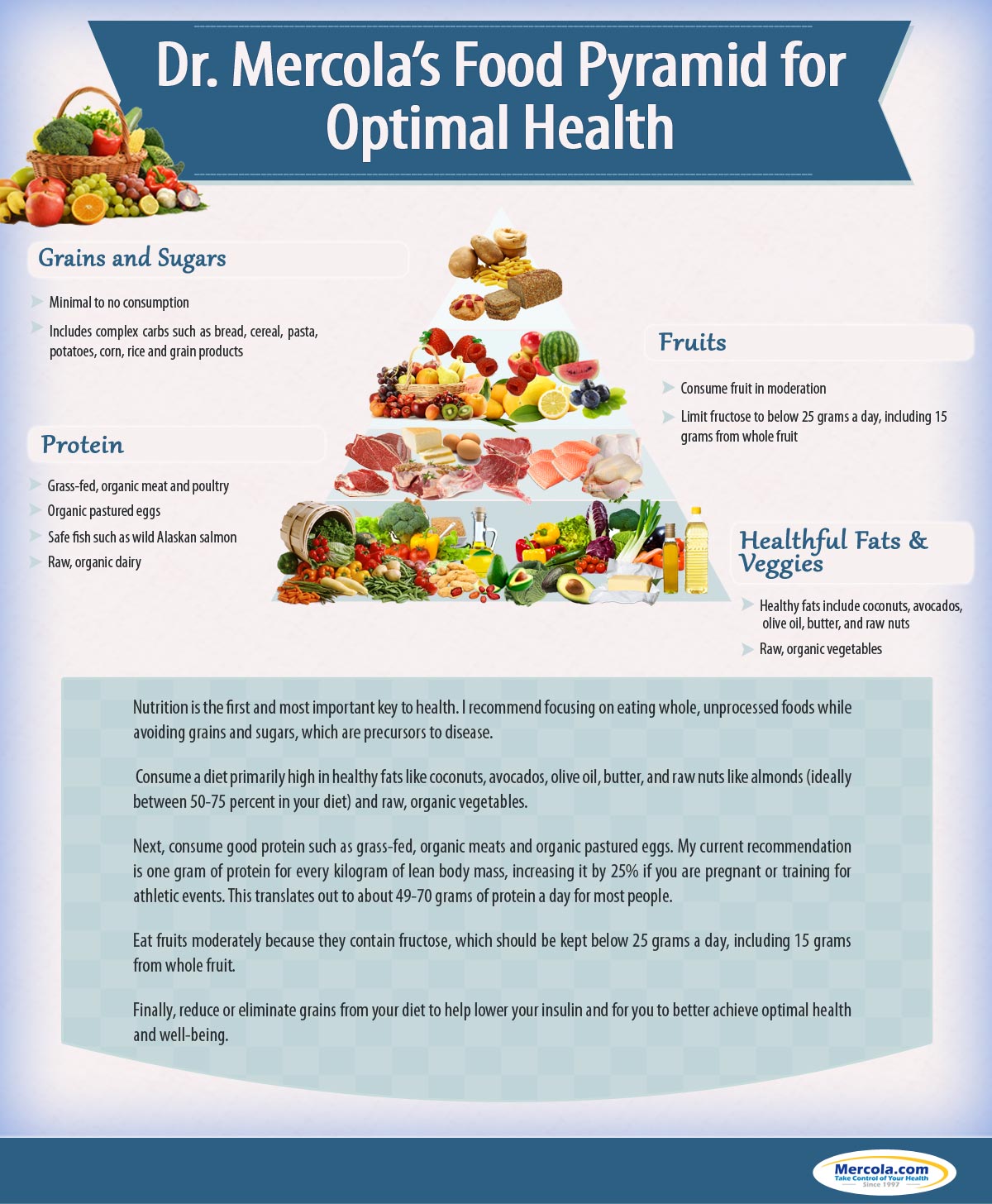
In an effort to remedy the situation, I've created my own food
pyramid for optimal health (below), which you can print out and share
with your friends and family.
My pyramid, which is based on nutritional science opposed to
agricultural subsidies and industry lobbying efforts, is almost the
inverse of the original USDA food pyramid, featuring healthful fats and
vegetables on the bottom.
Again, most people would benefit from getting at least 50 percent of
your daily calories from healthful fats, such as avocados, coconut oil,
nuts and raw organic butter.
In terms of bulk or quantity, vegetables should be the most
prominent feature on your plate. Veggies provide countless critical
nutrients, while being sparse on calories.
Next comes high quality proteins, followed by a moderate amount of
fruits, and lastly, at the very top, you'll find grains and sugars. This
last top tier of sugars and grains can be eliminated entirely, and your health just might become the envy of everyone around you.
While this may sound impossible to some, I can attest to the fact that quitting carbs is doable.
In fact, once you've successfully switched over from burning carbs to
burning fat as your body's primary fuel, carb cravings actually
disappear, as if by magic.
Take Control of Your Health With My Updated Nutrition Plan
I issued my first Optimized Nutrition Plan nearly a decade ago.
Since then, I've tweaked and updated it as needed based on changes in
our food environment and the weight of the scientific evidence.
It is now significantly improved and contains a number of updates.
One of the most important facets of eating for optimal health is to
understand how to nourish and support your mitochondria, the little
power stations in your cells.
The weight of the evidence strongly suggests that mitochondrial
dysfunction lies at the heart of virtually all disease — including
obesity — and your diet is a key component when it comes to maintaining
healthy mitochondrial functioning.
The recommendations in my Nutrition Plan significantly follow the
dietary portions in my optimized Food Pyramid. Healthy fats are
required, for example, and many would benefit from getting as much as
50 to 75 percent of your daily calories from healthy fats.
The recommendation to restrict your protein intake is also emphasized, as excessive protein
(especially low-quality protein) can activate your mTOR pathway, a
molecular signaling pathway responsible for either growth or repair,
depending on whether it is stimulated or inhibited. Stimulating mTOR
may contribute to the development of cancer and other degenerative
diseases.
Get Started Today!
There's an entire section that helps you evaluate your current
starting position. You'll find my Nutrition Plan is divided into Level 1
and 2. Level 1 is for beginners, such as those who are new to this website and are not yet fully familiar with my health recommendations.
If you've already implemented most of my health advice, then you can proceed to Level 2.
This is also recommended if you have a serious medical condition and
are looking for more extensive measures to promote healing and health.
You'll know you're ready to move on to Level 2 once the health
indicators listed are in their optimal ranges.
Even if you have previously read it, I would strongly recommend
reviewing the revised Nutritional Plan whenever your schedule allows.
It is a very detailed and comprehensive program — it's basically an
entire book, in multi-media format, and has many informative videos as
well.
What Else Will You Learn From My Updated Nutrition Plan?
Naturally, there are detailed instructions on how to determine your
ideal nutrient ratios, such as how much protein you may need based on
your lean body weight. I also review the importance of differentiating
between net carbohydrates and fiber. Both vegetables and table sugar
contain carbohydrates, for example, but veggies are loaded with healthy
fiber whereas sugar is not.
Net carbs are defined as total carbs minus fiber, and restricting
your net carbs is an important part of a healthy diet. Keep in mind
that this is NOT a low TOTAL carb diet, but a low NET carb diet,
because you do require large amounts of fiber-rich carbs. For starters,
fiber
is used as a prebiotic for your beneficial bacteria, and most of the
fiber is converted to short chain fats that can be used as fuel for
your cells in place of sugar.
The goal of this program is to slowly but surely get your net carbs
below 40 or 50 grams per day and to replace them with healthy fats and
moderate amounts of high-quality protein. Health indicators such as your
fasting insulin will help you determine how strict you may need to be.
All of this is explained in Level 1. Ultimately, this shift will
transition your body into primarily burning fat for fuel, and this not
may only help you normalize your weight without "dieting," but also may
radically reduce your risk for most chronic diseases.
I also review the role of dietary supplements, and the importance of
checking your iron levels — a health screen that is vastly underrated
and overlooked by most health professionals, considering the
devastating health effects elevated iron levels can cause.
Are You Ready to Take Your Health to the Next Level?
I've spent the last decade perfecting this Nutritional Plan and I
sincerely believe it has the power to improve and optimize your health.
Granted, no one plan will work flawlessly and optimally for every
single person, but by using the general principles I lay out in this
plan, you should be able to devise a program that suits you and that
you can live with over the long haul. Because, truly, "diets" don't
work. You need to relearn healthy habits that you can stick with for
life.
Eating food is a lifelong requirement, so you may as well figure out
how to eat for longevity and disease prevention. I've made it as easy
to follow as possible, guiding you step by step through the process.
Indeed, I urge you to take your time and implement this program in
successive steps. Trying to do it all at once may backfire, as it can
take time to create new habits. This is particularly true when it comes
to eating and food shopping habits.
So be kind to yourself and take it slow. Make one small change at a
time, and before you know it, you will have changed your life! Be sure
to bookmark the page so you can refer back to it often, and feel free
to share it with those you love and care about. Also please let me know
what you think in the comments below. Remember, this document is not
the final word and will continue to be revised, and your feedback is an
important part of that process. Thanks!
Spread the Word to
Friends And Family
By Sharing this Article.



 Email
Email

No comments:
Post a Comment