
Augustus Saint-Gaudens’ glorious William Tecumseh Sherman, known as
the Sherman Monument, 1902, on Fifth Avenue, Grand Army Plaza, New York
City, is one of the most important Beaux Arts sculptures in the country.
The plinth was designed by architect Charles Follen McKim of McKim,
Mead and White. Stanford White, of the same firm, was the architect of
the Metropolitan Club, 1893, one block up on the avenue. The nearby
landmarked Plaza Hotel dates from 1907, fronted with the picturesque
Pulitzer fountain, 1911. Bergdorf Goodman, 1928, sits adjacent to the
fountain. Until 1965, the lovely Savoy-Plaza Hotel, 1927, made up the
now missing piece of the historic square, along with the Sherry
Netherland, still existing, across Fifth Avenue from the Sherman
Monument.
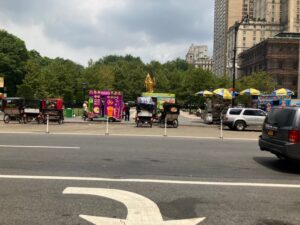
The slow degradation of Grand Army Plaza began in 1965 with the
destruction of the Savoy-Plaza Hotel. In its place the bland
International style Edward Durell Stone/Emery Roth General Motors (GM)
building was erected in 1968 and still stands. Today the Apple store
occupies the basement of the GM building, sometimes with several large
food trucks parked in front on the avenue.The valuable
equestrian
Sherman Monument is also currently surrounded by multiple large food
trucks, while others are on the nearby Park East Drive. Some of them are
blocking the view of the famous work of art. These food trucks give off
noxious fumes and smoke that are harmful to people and to the monument
itself, yet the NYC Department of Health hands out the permits for them.
A multitude of pedicabs swarm the area and also block the view. These
pedicabs are supposed to be have insurance, be licensed, have no motors
and only carry 3 people. Due to numerous accidents, many of the pedicabs
have had difficulty obtaining insurance and operate unlicensed. They
now also use unauthorized motors with impunity and cram in 5-6 people,
an obvious hazard.

Across 59th Street to the South at the Pulitzer Fountain and Plaza
Hotel, the hotel entrance is boxed in with an unattractive Citibank
festooned bike rack. Pedicabs storm the area pestering hotel guests for
rides. The doormen and chauffeurs all say that when there’s an event,
they don’t have enough space to safely drop off or pick up guests. Press
Secretary Vincent Barone, for the NYC Department of Transportation,
which oversees the bike rack, said on the phone June 23, 2023, “That
bike rack was already litigated in 2015 [which the Plaza Hotel lost
while saying it was an ‘eyesore and created traffic congestion.’]
Millions of New Yorkers and tourists use the Citi bikes for
transportation and just because you think it looks ugly doesn’t
mean we’re going to remove it.” What the DOT would like to hide is that
since they started to promote bikes for transportation, there has been
an increase in deaths from bike accidents. In 2021, 19 cyclists were
killed.
To complete the chaotic atmosphere at the Plaza Hotel, a food truck
sitting at the Pulitzer Fountain obscures the view of both the fountain
and the hotel entrance. None of these trucks or vehicles bring beauty to
the area. Instead, the area looks downtrodden.
The question is how did the Grand Army Plaza become such a jumbled
unsightly mess? The main answer is that the Central Park carriage horses
used to surround the Sherman Monument. They have been relegated to
spaces nearby, further in the Park Drives, that were never approved by
the Department of Health equine veterinarians. (This happened under
former Mayor De Blasio in a closed door meeting. They decided to move
the horses to spaces that were less safe in an effort to hide them and
reduce their business. He also removed the cobblestones in the dead of
night from 59th Street to 60th Street that surrounded the Sherman
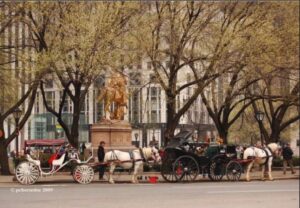
Monument and had given the plaza lots of atmosphere.) When the horses
and cobblestones were removed, the City allowed food trucks, bikes, and
pedicabs to invade the area. The horses looked far more beautiful and
were a better historical fit surrounding the Sherman Monument and at
Central Park South. They were safer and more comfortable in those areas
approved originally by the City equine veterinarians, and they didn’t
block the view of the monument. In addition, Olmsted designed Central
Park for horses on the bridal paths, horse carriages on the drives and
for pedestrians. Food trucks, bikes and pedicabs never figured into the
plan.
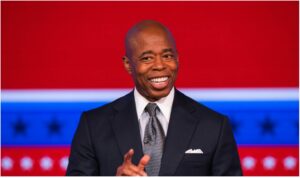
The question of how the Sheman Monument area became a mess along
with a list for suggestions to improve it, including removing the food
trucks, pedicabs and the bike rack, was put to City officials such as
Mayor Eric Adams for comment. He understands historic preservation, when
it suits him. The mayor recently went to bat to save the Richardson
Romanesque revival West-Park Presbyterian Church, 1890, at Amsterdam
Avenue and 86th St. He lent his voice on June 9, 2023, along with actors
Mark Ruffalo and Amy Schumer, for continued landmark preservation for
the church in order to foil developers. On the other hand, the mayor
unwisely decided that illegals could stay at taxpayer expense at the
superbly restored historic Roosevelt Hotel, 1924, even though illegals
have already trashed the luxury Row Hotel in the Times Square area. The
Roosevelt is even more posh, complete with chandeliers in the ballroom.
The hotel, which is owned by Pakistan International Airlines, was ready
for guests for many months but for an unexplained reason it never
opened. The hotel only opened recently, June 5, 2023, as a migrant
center, to much criticism, with a bloated $220 million contract with the
City at the mayor’s request. As to the awful mess at the Sherman
Monument, the mayor refuses to comment or get involved.
City Council member Gale Brewer has championed projects for
historic preservation and the Sherman Monument is in her Parks district.
Like the mayor, she spoke out for continued landmark status for the
West-Park Presbyterian Church. She also had given a speech in January
2023 to help secure $62.3 million to restore the crumbling Soldiers’ and
Sailors’ Monument, 1902, on Riverside Drive, a monument that honors
Union troops. As to the Grand Army Plaza area, Council member Brewer’s
office wrote, June 20, 2023, she “will look into Patty Saffran’s
concerns . . . [and that those responsible for its current state are]
the Department of Transportation and Parks Department.”
Council member Keith Powers has the Plaza Hotel and other parts of
the area in his district. His office wrote, June 16, 2023, “Council
Member Powers agrees that the historic areas around Grand Army
Plaza must be preserved for future generations to enjoy its beauty. If a
particular food truck is obstructing traffic or placed in a
prohibited location, please notify my office and we will work with the
appropriate city agencies to relocate them. However, as one of the most
visited areas in the city, bicycles, pedicabs, and food trucks are to be
expected – and allowed – as long as they are complying with all
relevant city regulations.” When questioned further if Council member
Powers actually plans to have the food trucks removed that are currently blocking the Sherman Monument, they had no answer.
When the Central Park Conservancy (CPC) was asked if they wanted to
remove the food trucks and clutter at the Grand Army Plaza area, Mary
Caricciollo, Chief Communications, wrote that City agencies, not the
Conservancy, oversaw the food trucks and other vehicles. She explained,
The Conservancy’s role in Grand Army Plaza South is daily, general
maintenance and upkeep. This includes picking up trash, tending to the
landscape, and preserving the Tecumseh monument. As a heavily used space
by millions of New Yorkers, we try to engage with all stakeholders to
ensure the best experience for visitors.” When asked further why the CPC
didn’t challenge the City agencies to return the Park area to one of
visual beauty, she provided no response.
When the NYC Parks Department was asked about the deplorable
condition of the area, they said unofficially on the phone – yes, we
know it’s a mess. Subsequently, Meghan Lalor, Director of Media
Relations, Parks, wrote on June 16, 2023, “We have your comments and
will pass them on.”
To improve the Grand Army Plaza, the Central Park carriage horses
should be restored to their places at the Sherman Monument, and on
Central Park South. The food trucks and pedicabs should stay clear of
the monument. The pedicabs also need to stop clogging the entrance to
the Park and stop obstructing the horses’ lanes and access to their
water. The monument area could be made more elegant by removing the
rotating contemporary sculptures nearby. The City has conspicuously
undermined the Sherman Monument’s majesty for many years by parking
modern sculptures behind the monument. The modern pieces in question are
almost always too massive and would be better displayed elsewhere. The
Grand Army Plaza needs to be returned to a green space. The City
professes to be interested in green ideas but doesn’t want to act on
them in this historic part of the Park.

No comments:
Post a Comment