John Bolton has gotten away with a dangerous deception. The national security adviser’s announcement Sunday that
the Pentagon has deployed air and naval forces to the Middle East,
which he combined with a threat to Iran, points to a new maneuver to
prepare the ground for an incident that could justify a retaliatory
attack against Iran.
Bolton presented his threat and the deployments as a response to
alleged intelligence about a possible Iranian attack on U.S. targets in
the Middle East. But what has emerged indicates that the alleged
intelligence does not actually reflect any dramatic new information or
analysis from the U.S. intelligence community. Instead, it has all the
hallmarks of a highly political case concocted by Bolton.
Further underscoring the deceptive character of Bolton’s maneuver is
evidence that senior Israeli national security officials played a key
role in creating the alleged intelligence rationale for the case.
The new initiative follows an audacious ruse carried out last fall by Bolton and Secretary of State Mike Pompeo, detailed in Truthdig in
February, to cast the firing of a few mortar rounds in the vicinity of
the U.S. embassy and a consulate in Iraq as evidence of an effort by
Tehran to harm U.S. diplomats. Bolton exploited that opportunity to
press Pentagon officials to provide retaliatory military options, which
they did, reluctantly.
Bolton and Pompeo thus established a policy that the Trump
administration would hold Iran responsible for any incident involving
forces supported by Iran that could be portrayed as an attack on either
U.S. personnel or “interests.”
Bolton’s one-paragraph statement on Sunday considerably broadened
that policy. It repeated the previously stated principle that the United
States will respond to any alleged attack, whether by Iranian forces or
by what the administration calls “proxy” forces. But it added yet
another major point to Trump administration policy: “a clear and
unmistakable message to the Iranian regime that any attack on United
States interests or on those of our allies will be met with unrelenting force [emphasis added].”
That language represents an obvious move by Bolton to create
potential options for U.S. retaliation against Iran for a real or
alleged attack by “proxy forces” on Israeli or Saudi forces or
“interests.” Such a commitment to go to war with Iran over incidents
related to Israeli or Saudi conflicts should be the subject of a major
debate in the press and in Congress. Thus far, it has somehow escaped
notice.
Significantly, on a flight to Finland on Sunday, Pompeo repeated the
threat he made last September to respond to any attack by “proxy forces”
on U.S. “interests.” He made no reference to possible attacks against
“allies.”
Bolton and his staff claimed to the news media that what he
characterizes as “troubling and escalatory indications and warnings” are
based on “intelligence.” Media reports about Bolton’s claim suggest,
however, that his dramatic warning is not based on either U.S.
intelligence reporting or analysis.
Citing “U.S. officials,” The Wall Street Journal reported Monday that
the alleged intelligence “showed that Iran drew up plans to target U.S.
forces in Iraq and possibly Syria, to orchestrate attacks in the Bab
el-Mandeb strait near Yemen through proxies and in the Personal Gulf
with its own armed drones.” UK General: No Signs of Increased Threats from Iran of its “Proxies” in the Middle East
But in the very next paragraph, the report quotes an official saying
it is “unclear whether the new intelligence indicated operations Tehran
planned to carry out imminently or contingency preparations in the case
U.S.-Iran tensions erupted into hostilities.”
A Defense Department source said the intelligence showed “a change in
behavior that could be interpreted to foreshadow an attack on American
forces or interests,” according to The New York Times’
story on the matter. But the source didn’t actually say that any
emerging intelligence had led to such a conclusion or even that any U.S.
intelligence official has come to that conclusion.
The timing of the alleged new intelligence also suggests that
Bolton’s claim is false. “As recently as last week there were no obvious
sign of a new threat,” The Wall Street Journal reported. The New York
Times similarly reported that “several Defense officials” said “as
recently as last Friday they have had not seen reason to change the
American military’s posture in the region.”
Normally, it would require intelligence from either a highly credible
source within the Iranian government or an intercept of a sensitive
communication from Iran to justify this kind of accusation. But no news
outlet has brought word that any such spectacular new intelligence has
found its way to the White House or the Pentagon.
The Journal’s report revealed, moreover, that Bolton has only a
“fresh intelligence assessment” rather than any new intelligence report.
That “assessment” is clearly not a product of the intelligence
community, which would have taken at least several days to arrive at
such a fundamental reinterpretation of Iranian intentions. The
mysterious new “assessment” was evidently unknown outside Bolton’s
office before Bolton swung into action last weekend.
We now know, in fact, that the sources behind Bolton’s claim were
Israel’s national security adviser and intelligence agency. Axios published a report Monday by leading Israeli journalist Barak Ravid, who covers national security for Israel’s Channel 13,
revealing that a delegation of senior Israeli officials had given
Bolton “information” about “possible Iranian plots against the U.S. or
its allies in the Gulf” two weeks earlier.
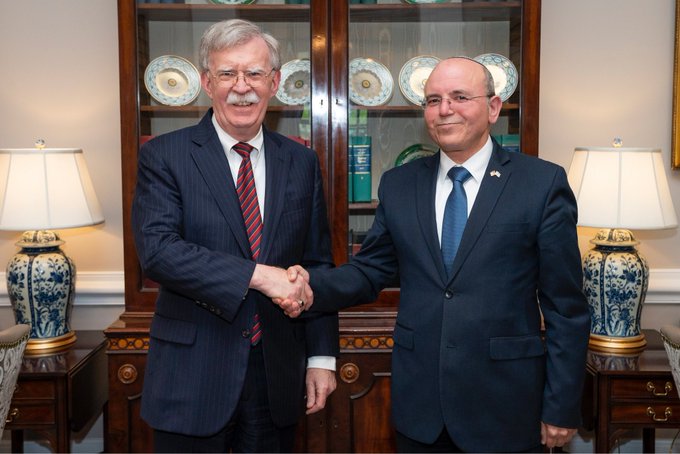
The Israeli delegation, led by national security adviser Meir Ben
Shabbat, met with Bolton and other unnamed officials in the White House,
according to Ravid, to discuss possible Iranian plans. Bolton himself
tweeted on April 15 about his meeting with Shabbat:
Great meeting
with Israeli National Security Advisor Meir Ben-Shabbat today. The close
United States-Israel strategic partnership reflects the tremendous
strength of the ties between our governments and the citizens of our two
allied countries.
Israeli officials told Ravid that they understood that “intelligence,
gathered by the Mossad intelligence agency, was part of the reason for
Bolton’s announcement.” What Ravid’s official sources told him reveals,
however, that what the Israelis provided to Bolton was not really new
intelligence at all.; it consisted of several scenarios for what the
Iranians might be planning, according to one Israeli official.
“It is still unclear to us what the Iranians are trying to do and how
they are planning to do it,” the Israeli official told Ravid, “but it
is clear to us that the Iranian temperature is on the rise as a result
of the growing U.S. pressure campaign against them, and that they are
considering retaliating against U.S. interests in the Gulf.”
That revelation explains the lack of evidence of either genuine U.S.
intelligence reporting or proper assessment to support Bolton’s
statement.
Bolton is an old hand at using allegedly damning intelligence on Iran to advance a plan of aggressive U.S. war. In 2003-04, he leaked satellite photographs of
specific sites in Iran’s Parchin military complex to the press,
claiming those images provided evidence of covert Iranian nuclear
weapons-related experiments—even though they showed nothing of the sort.
He then tried to pressure International Atomic Energy Agency Director
General Mohamed ElBaradei to insist on an inspection of the sites. When
ElBaradei finally relented, he found nothing in that inspection to
support Bolton’s claim.
Bolton’s deceptive maneuver has the effect of increasing the range of
contingencies that would trigger a U.S. strike on Iran and represent a
major advance toward his long-declared intention to attack it. More
alarmingly, however, some media outlets have reported his claims without
any serious questioning.
Given the violent struggles in Iraq, Yemen, Syria and Israel itself,
Bolton and the Netanyahu government will be able to portray an incident
as an attack by Shiite militias, the Houthis or Hamas on Israeli, Saudi
or U.S. “interests,” just as Bolton and Pompeo did last fall. That, in
turn, would offer an opportunity for urging Trump to approve a strike
against one or more Iranian military targets.
Even more alarming is that both acting Defense Secretary Patrick Shanahanand new CENTCOM commander Gen. Kenneth McKenzie have
signed up for the Bolton initiative. That means that the Pentagon and
military leaders can no longer be counted on to oppose such a war, as
they did in 2007, when Vice President Dick Cheney pushed unsuccessfully for a plan to retaliate against a future Iraqi militia attack on U.S. troops in Iraq.
The United States is in danger of falling for yet another war ruse as
malignant as those that led Congress and the mainstream media to accept
the invasion of Iraq or the Gulf of Tonkin resolution.
Gareth Porter is
an independent investigative journalist, historian and author who has
covered U.S. wars and interventions in Iraq, Pakistan, Afghanistan,
Iran, Yemen and Syria since 2004 and was the 2012…

@AmbJohnBolton


No comments:
Post a Comment