Just over 100
years ago, we began consuming industrial vegetable oils that never
existed before. These oils are primarily damaged omega-6 linoleic acid.
As a result, our omega-6 intake nearly tripled, while our intake of
plant- and marine-based omega-3 fat decreased tenfold
Damaged omega-6
fat is integrated into your cell membranes, including the mitochondrial
membrane, and once these membranes become dysfunctional, complications
follow
The fluidity of
the cell membrane is extremely important as it houses hormone
transporters. When you don’t get enough marine-based omega-3 fats,
especially docosahexaenoic acid (DHA), the membranes become very rigid
You only need
around 1 to 2 grams of omega-6 linoleic acid per day, ideally from plant
seeds and tree nuts, whereas optimal levels of marine omega-3 fats are
around 3 to 4 grams per day, which can be obtained from small fatty fish
such as anchovies, sardines, herring, wild-caught salmon or krill oil
Saturating your
cells with DHA makes their membranes very fluid, thereby raising your
basal metabolic rate by 15 percent, and increasing your fat burning
capacity during exercise by 30 percent. Even at rest, your fat burning
goes up by 20 percent
I've previously interviewedJames DiNicolantonio, Pharm.D., about his book, "The Salt Fix: Why
the Experts Got It All Wrong and How Eating More Might Save Your Life,"
where he exposes why we got it wrong about salt and promotes eating
healthy real salt.1
"The Salt Fix" is a fascinating book and I encourage you to go pick
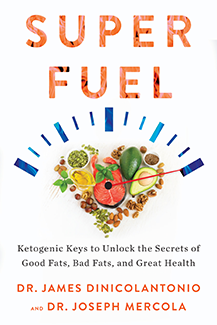
up a copy and read it. Here, we will focus on our new book, "Superfuel: Ketogenic Keys to Unlock the Secrets of Good Fats, Bad Fats, and Great Health," which covers the importance of dietary fats, and how to discriminate between healthy and harmful fats.
DiNicolantonio compiled most of the research for this book and
invited me to contribute to it, which I was happy to do. Healthy fats
are the foundation of my last book, "Fat for Fuel," and I thought it
would be useful to expand on the topic with this book.
"'Superfuel' is theketogenic diet 2.0," DiNicolantonio says.
"Everyone's doing keto diets now, where their diets are mostly 70 to 80
percent fat. But, 'How do we enhance that diet? What are the healthy
fats? What type of fat should people be eating since it's making up the
majority of their calories?'
I think a lot of people doing the ketogenic diet are doing some
things right, but they're doing a lot of things wrong … That really was
the motivation for this book."
What's Gone Wrong With Our Modern Diet
In a nutshell, "Superfuel" guides you back to a diet closer to what
was eaten during Paleolithic times. Just over 100 years ago, Procter
& Gamble introduced Crisco
as an alternative to butter and lard in 1911, and we began consuming
industrial vegetable oils or seed oils that never existed before.
These oils are primarily omega-6 linoleic acid, and damaged omega-6
at that, due to the processing involved. As a result, our omega-6 intake
nearly tripled, while our intake of plant- and marine-based omega-3 fat
DECREASED tenfold, causing a severe imbalance in our omega-3 to omega-6
ratio, which ideally should be between 1-to-1 and 1-to-5.
DiNicolantonio says:
"We've had these dramatic changes in our fat intake. They
actually changed us from the inside out. Omega-6 isn't bad as it is an
essential fat. It's only when you isolate it and adulterate and consume
it in excessive quantities that it becomes pernicious. We have these
bottles of omega-6 now that are … exposed to light, and then we cook
with them. That oxidizes the oil further.
Then we consume these isolated oils. They don't have the natural
vitamins and minerals and antioxidants in the coatings around seeds and
nuts that gives us omega-6 to protect them from oxidizing in our body.
When you consume these isolated oils, even if it's a cold-pressed
omega-6, the acid in your stomach will oxidize those oils and create
lipid hydroperoxides and aldehydes. We absorb these and they cause a ton
of damage."
How Damaged Omega-6 Fat Causes Cellular Damage
Indeed, one of the most significant dangers from consuming processed
vegetable oils is that the damaged fats are integrated into your cell
membranes, including the mitochondrial membrane, and once these
membranes become dysfunctional, complications are sure to follow.
Even if you do not cook with canola oil or some other vegetable oil,
there are many other stealth or hidden sources of damaged omega-6s. If
you frequent restaurants on a regular basis, for example, you're
virtually guaranteed to be eating a high-omega-6 diet, as most
restaurants use vegetable oils in their cooking and baking.
"Canola oil is one of the worst oils you can cook with," DiNicolantonio says.
"It causes a ton of oxidation products, because they're so susceptible
to heat due to the double bonds. They put these omega-6 seed oils in
bread and in condiments, cereals, pastries and desserts. It's really
everywhere … [and] it's literally transforming you from the inside-out,
because these long-chain omegas get integrated in the cell membrane.
The oxidation products oxidize those fatty acid tails. When you
damage those tails in the lipid bilayer, they start to curl upwards.
That actually creates a more permeable membrane. You get more things
that aren't supposed to get into the cell and damage the mitochondria,
damage the DNA. The fluidity of the cell membrane also goes down.
The fluidity of the cell membrane is extremely important, because
you have all these hormone transporters that sit in the cell membrane.
When you don't get enough omega-3s, especially docosahexaenoic acid
(DHA), the membranes become very rigid …
Instead of being able to come in and out very easily, because the
membrane isn't fluid, it starts … affecting how things flow into and
out of the cell. Your metabolic rate goes down, and you have damage in
the cell. It's a huge issue."
DHA Is Crucial for Cellular Health
With regards to your mitochondria,
these organelles have an inner membrane. Cardiolipin is an important
component of this membrane and it needs to be saturated in DHA, which
happens to be very susceptible to oxidation. Cardiolipin can be likened
to a cellular alarm system that triggers apoptosis (cell death) by
signaling caspase-3 when something goes wrong with the cell.
However, if the cardiolipin is not saturated with DHA, it cannot
signal caspase-3, and hence apoptosis does not occur. As a result,
dysfunctional cells are allowed to continue to grow, which can turn into
a cancerous cell. Similarly, in your brain, DHA is used as a signal to
stimulate NRF2, heme oxygenase 1 and to upregulate antioxidant enzymes.
"Omega-3s oxidizing in the body is bad, but our bodies kind of
know what to do with that signal, whereas omega-6, not so much, because
we didn't have as much during Paleolithic times," DiNicolantonio says.
Lowering your omega-6 intake is also important for the removal of
senescent cells, i.e., aged, damaged or crippled cells that have lost
the ability to reproduce. If senescent cells are not removed, they start
gunking up the machinery. Fasting is another method that will clear out
senescent cells.
Dietary Recommendations Are Way Off on Omega-6
When it comes to omega-6, you really only need 1 to 2 grams of
linoleic acid per day. I like my primary sources of omega-6 to be whole
foods such as nuts and seeds. With the exception of flax seeds, chia
seeds and hemp seeds, most other plant seeds have high amounts of
omega-6
Meanwhile, the American Heart Association (AHA) recommends you to
consume 5 to 10 percent of your calories as omega-6 from vegetable oils
or olive oil. DiNicolantonio explains:
"Instead of recommending whole foods, they recommend oils, which makes absolutely no sense. The Lyon Diet Heart Study2
lowered linoleic acid from over 5 percent to about 3.5 percent [and
found] a 70 percent reduction in cardiovascular [problems] and
mortality.
There's actually no evidence to support the AHA or the United
States dietary guidelines, [which] recommends consuming high amounts of
omega-6s from vegetable oils …
The problem with these industrial seed oils is the processing
that occurs to get [the oil] out of the seed. They have to use hexane
and deodorize the oil, because it's so toxic. By the time it makes it to
the shelf, you've got all these oxidation products, and then you
consume it and your body oxidizes it with the acid in your stomach.
These oxidation products are about a fiftyfold higher than the
eicosanoids made in your body. They are dramatically more harmful than
any of the most harmful eicosanoids, like thromboxane a2 … because they
form aldehydes. These aldehydes, like 4-hydroxynonenal … is what
actually causes oxidized low-density lipoprotein (LDL).
It binds to the apolipoprotein B (apoB) [and] all apoB-containing
lipoproteins. Now, these lipoproteins aren't recognized by the LDL
receptors. They hang out in the blood. It's really the linoleic acid
that gets integrated into high-density lipoprotein (HDL), LDL and very
low-density lipoprotein (VLDL), [which then] oxidizes and causes
atherosclerosis.
Linoleic acid itself also damages the endothelium and causes an
increase in penetration of LDL and VLDL particles into the
subendothelium … And then when you get these oxidation products, it's
dramatically more harmful.
This is what's causing neurodegenerative diseases. Aldehydes can
actually crosslink tau protein and create neurofibrillary tangles. It
has been shown in animal studies that these aldehydes can literally
create neurofibrillary tangles that you see in Alzheimer's disease.
This is what's called advanced lipoxidation end-products (ALEs).
Most people know about advanced glycation end-products (AGEs), but these
ALEs, by far, are much more harmful, and it's caused by consumption of
oxidized omega-6 seed oils."
Healthy Versus Damaging Omega-3 Fat
It may come as a surprise to learn that all omega-3 sources are not
healthy either. Not only is the ratio between omega-3 and omega-6 a
primary concern, but industrially processed omega-3 products can also
cause problems similar to those caused by too much, and damaged,
omega-6. This is a topic we delve deeper into in the book.
For example, about half of all fish oils
have problems with oxidation. So, when buying a fish oil supplement,
you really need to look for a product that tests the hydro peroxide
levels. The lower the level the better, but I would not accept anything
over 5 percent.
Many fish oils are also not sourced from wild fish, and that's
another consideration. Ideally, you really want a fish oil obtained from
wild-caught fish and not farmed. Also avoid farmed fish such as farmed
salmon if you're using that as a direct omega-3 source.
Many times, farmed salmon are raised on an unnatural diet that raises
their fat content to abnormal levels and skews their omega-3 to omega-6
ratio in favor of the latter. They're also chockfull of toxins. Along with wild-caught salmon, other healthy sources of omega-3 are sardines, anchovies and herring.
In addition to that, there's the issue of sustainability, where both
wild-caught and farmed fish fall short. That's one of the reasons I like
krill oil,
because it is the largest biomass in the world, and harvesting is
tightly regulated. If you're a vegan and refuse to eat any animal food
at all, your choices become very limited. Perhaps one of the best
sources of EPA and DHA for vegans is algal oil.
"Krill is great, because it is very sustainable and has so many
advantages compared to just regular fish oil, because the omega-3s are
bound to phospholipids," DiNicolantonio says. "Back in
Paleolithic times … we were scavengers. Sites have been discovered from
over 2 million years ago with dozens of animal skulls cracked open
around them.
The brain is higher in DHA than salmon — up to 30 percent more
concentrated. So, our ancient ancestors were able to access and scavenge
skulls in the African savanna and get tremendous amounts of DHA. To
give you an example, 4 ounces of brain can give you up to 1.5 grams of
DHA.
It's extremely saturated in cholesterol as well. This was a
phospholipid-bound DHA that we were getting. And your brain doesn't
absorb DHA without it being bound to phosphatidylcholine … When you're
consuming fish oil, you've got to esterify it. You've got to attach it
to choline, and then you absorb it.
But with krill oil, being bound to the phospholipids, you get
twice the absorption of DHA … And then, also, our consumption of ALA was
10 times what it was today. How we used to get omega-3s if we weren't
getting brain or seafood is we were consuming a tremendous amount of
plant material.
We were getting 10 to 15 grams of alpha-linolenic acid (ALA).
That's the parent omega-3 in plants. We only get about 2 grams nowadays.
If you look at a female of childbearing age, they could convert over 20
percent of their ALA to EPA …
[A woman of childbearing age] can convert almost 10 percent of
that ALA to DHA, which is a long-chain marine omega-3. They were getting
1 to 1.5 grams of DHA just from the conversion."
Bear in mind that these conversion rates are not typical. The
average, nonpregnant adult typically converts only 5 percent ALA to EPA
and 0.5 percent ALA to DHA.
What's more, when you go from 15 grams of omega-6 linoleic acid to 30
grams, which we're consuming nowadays, that reduces your conversion
rate of ALA to EPA and DHA by another 40 to 50 percent. Certain
nutrients, including magnesium and gamma-linolenic acid (GLA), are also
required, so certain nutritional deficiencies play a role in your
ability to convert ALA to EPA and DHA as well.
The Importance of Animal-Based Omega-3 in Fat Burning
In regard to the ketogenic diet, most people don't understand how
important omega-3s are to building muscle, improving fitness and burning
fat. To give you an example, if you replaced just 6 grams of visible
fat in your diet (such as steak) with 6 grams of high-quality fish oil,
research shows that in just three weeks you may lose 2 pounds of fat and
gain half a pound of muscle. The reason for this is because omega-3
fat, particularly DHA, is the pacemaker of the cell.
"The reason why hummingbirds can beat their wings 80 times a second is because they can saturate their wings with DHA," DiNicolantonio says.
"DHA makes the cell membrane so fluid that molecules, like amino acids,
glucose, sodium, potassium, they fly in and out of the cell.
The same thing happens in humans. When you consume a high amount
of omega-3s, about 3 to 4 grams, you create a cell membrane that is
super saturated DHA, very fluid. Now, your basal metabolic rate goes up
15 percent. Your beta-oxidation in the liver during exercise, your fat
burning during exercise goes up by 30 percent. Even at rest, your
beta-oxidation goes up by 20 percent.
Long-chain omega-3s are important for ketogenic diets, because
you become a better fat-burning machine. It's affecting the machinery,
the beta-oxidation in the liver. It's improving that by activating
genes. And then the other omega-3, the plant omega-3, ALA, is a
ketogenic substrate, so it doesn't get stored like the marine omega-3s.
It can be converted into ketones …
Medium-chain triglycerides (MCT) oil is great too for fat loss. Meta-analyses or randomized studies show that MCT oil,
compared to long-chain saturated fats — we're talking about heavy cream
and butter —significantly reduces waist circumference and visceral
adiposity, because it doesn't get stored. It gets burned for ketones.
The reason why [marine-based] omega-3s are good for fuel is
because it suppresses inflammation in the brain. What happens in a
cognitive-declining brain is you're not able to utilize glucose well,
because of the inflammation. DHA helps squelch the inflammation.
Your brain is able to utilize glucose better when you're
consuming more omega-3s. You're actually able to produce more ketone
bodies when you're consuming both parent omega-3 and the long-chain EPA
and DHA. You become a better ketogenic machine when you're consuming
high amounts of omega-3s."
Mechanisms Behind Omega-3s Ability to Optimize Fat Burning and Build Strength
The mechanism behind these effects is an upregulation of genes that
activate beta-oxidation in your liver, allowing you to burn fat more
efficiently when you have enough omega-3s in your system. Overall, your
basal metabolic rate goes up, because your cell membranes are so fluid,
which allows amino acids and glucose to flow into and out of the cells
better.
Your inflammation also goes down, and all of this helps optimize your
ability to burn fat for fuel. On top of that, omega-3s help synthesize
protein, so muscle protein synthesis dramatically increases when you
consume 3 to 4 grams of animal-based omega-3 per day — again, because
amino acids are able to circulate through the cell very easily when its
saturated with DHA.
"Studies have shown in middle-aged adults, as well as in the
elderly, consuming 3 grams of DHA [per day] increases muscle strength,
increases your maximum amount that you're able to rep. Your grip
strength is improved. This is an important fat to help prevent
sarcopenia.
This is a very big issue, where elderly people are not even able
to carry a milk carton. Really, the omega-3s are what's going to
hopefully help prevent a lot of the muscle loss during aging."
Recent Study Supports Our New Book — 'Superfuel'
After taping this interview, the drug company Amarin issued a press release3
about a new study with fish oil that was just recently completed. They
used a new proprietary prescription formulation of fish oil called
Vascepa. This is a highly-processed form of EPA.
The drug trial was called REDUCE-IT and it was done for five years.
The really unusual result of this trial is that they used high doses — 4
grams per day — which is two to four times as much EPA as is typically
done in these types of studies.
What did they find? They found a 25 percent reduction in
cardiovascular risks, which far exceeded their expectations and results
that are seen with statins. The study only looked at cardiovascular
disease but my guess is other degenerative diseases, like Alzheimer's,
diabetes and arthritis, also likely improved. We won't be able to
review the study until it is presented at the American Heart
Association's annual meeting on November 10, 2018.
This study confirmed what we wrote and predicted in our book that
will be published on November 13. BUT here is the real kicker, the drug
costs $2,500 per year or over $200 per month. Krill and clean fish are
far less expensive but you need to approach the 4 grams per day dose to
achieve these results, which is the key.

No comments:
Post a Comment