This
bill was heard June 2, 2025, by the Joint Committee on Consumer
Protection and Professional Licensure, but it has not yet been sent to
study. This means that there is still time to send in written testimony
and email the Committee members!
Under
this licensing bill, virtually anyone playing music for another person,
even to soothe them, would be practicing music therapy. Under the bill,
no one without a license can “practice music therapy.” The bill states
that:
Music
therapy interventions may include: (i) music improvisation; (ii)
receptive music listening; (iii) songwriting; (iv) lyric discussion; (v)
music and imagery; (vi) singing;
(vii) music performance; (viii)
learning through music; (ix) music combined with other arts; (x)
music-assisted relaxation; (xi) music- based patient education; (xii)
electronic music technology; (xiii) adapted music intervention; and
(xiv) movement to music.
There
is no constitutional basis for licensing music therapy! A state can
license an occupation to protect the health, safety, and welfare of the
public. Music therapy does not pose an imminent risk of harm to the
public and therefore should not be licensed.
This
bill, if it became law, would place music therapy under a Board, which
would decide who was “determined to be qualified as music therapists.”
The Board would create rules and regulations, establish standards and
ethical conduct, set continuing education standards, and more. Those who
did not fit into the licensing framework would be forced out of using
music as a part of their practice. It would impose unnecessary
regulatory burdens and adversely impact healers and consumers. It would
increase fees and therefore how much the consumer would pay. Licensing
creates monopolies for those with a license. This sort of over broad
and unnecessary licensing hurts our economy, workers, small businesses,
and consumers.
Under
this restrictive licensing bill, practices and the use of certain
titles would be prohibited and banned from the public domain. Under
H3939, these restricted titles include “music therapist, licensed
professional music therapist or any similar title.” Certainly it would
be difficult for a person (or unlicensed healing practitioner!) to use
any title with music in it. These titles should not be taken out of the
public domain and should not be restricted to an exclusive group of
people.
Massachusetts needs a broad Safe Harbor law similar
to laws in eleven other states that will protect complementary and
alternative practitioners in a more feasible and practical manner, that
is good for both consumers and practitioners, and that gives clear
guidance to government. Massachusetts now has two Safe Harbor bills
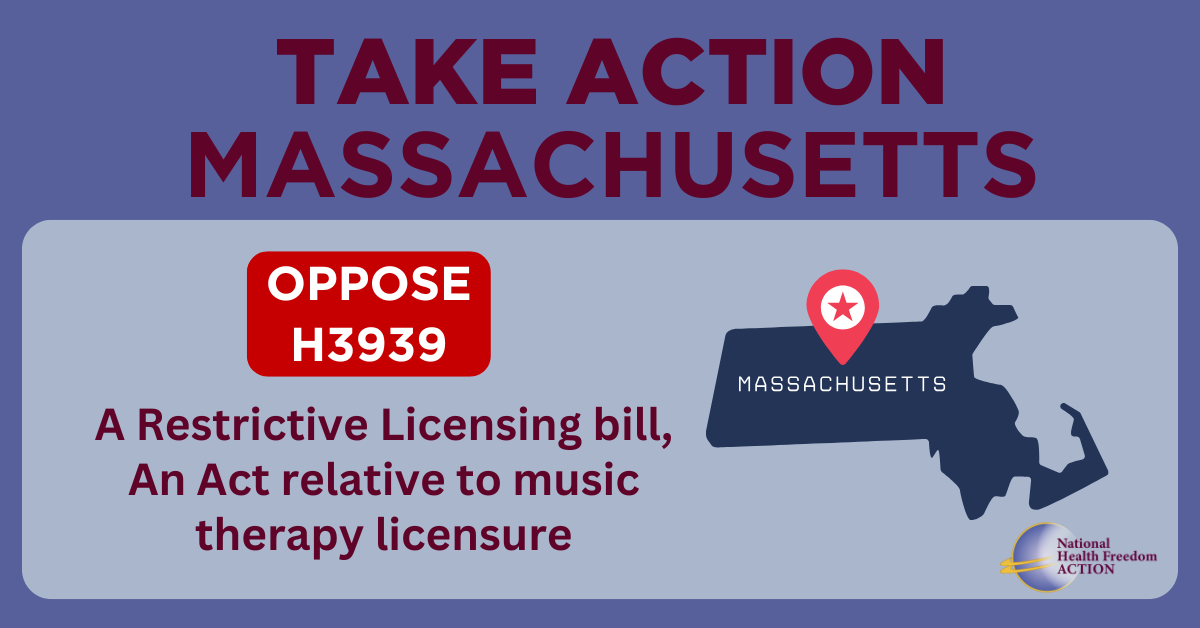
currently in the legislature: Massachusetts H. 2504 / S.1481,
An Act providing for consumer access to and the right to practice
complementary and alternative health care services, and have been sent
to the Joint Public Health Committee.
Take Action Steps:
CLICK HERE NOW TO EMAIL the
committee members to OPPOSE MA H.3939, a restrictive licensing bill,
because it hurts alternative healing practitioners and the clients they
serve. We have a letter ready for you to send. We recommend
personalizing it if you can.
TO SUBMIT WRITTEN TESTIMONY– The
subject line of your email should be: “Testimony in Opposition to
H.3939, An Act relative to music therapy licensure”. Please submit your
written testimony via email to: jointcmte-consumerprotection@malegislature.gov
If you have any questions, you may email Marissa Dakin (Marissa.Dakin@mahouse.gov) or Tom Mahoney (Thomas.Mahoney@masenate.gov)



No comments:
Post a Comment