Earthing (Grounding) the Human Body Reduces Blood Viscosity—a Major Factor in Cardiovascular Disease
I
found this article on the relationship of grounding on blood viscosity.
After I had spoken with Dr Pedro Chavez who mentioned to me that the
MAC addresses emission of vaccinated patients was interrupted when
walking barefoot I looked into grounding shoes. I have told the story
that I did testing on Birkenstock shoes which have a cork and rubber
sole - it really makes a difference, and that is all I wear anymore for
me personally. I was so excited about this simple method I got
Birkenstock’s for all my staff ( I have no affiliation with them, any
other grounding shoes can be used) . I definitely have seen in my
clinical practice significant improvement with telling my patients to
ground. Some with extreme EMF sensitivity and autonomic dysfunction go
outside, lay on the ground and can control their symptoms. Understanding
now from the document yesterday of how we resonate with the Earth for
healing purposes, this makes sense.
CIA Gateway paper human consciousness
1.
Role of Resonance. However, brain coherence through entrainment to
"beat" frequencies introduced via stereo headphones is only part of the
reason why the Gateway system works. It is also designed to achieve the
physical quietude characteristic of deep transcendental meditative
states which brings about a complete alteration of the fundamental
resonance pattern associated with the sound frequencies produced by the
human body. Yoga, zen or transcendental meditation, if practiced long
enough, will produce a change in the sound frequency with which the
human heart resonates throughout the entire body. According to Bentov,
this change in resonance results from elimination of what the medical
profession calls "the bifurcation echo" so that the sound of the
heartbeat can move synchronously up and down the circulatory system in
harmonious resonance approximately seven times a second. Bentov
describes the roll played by the bifurcation echo as follows: "When the
left ventricle of the heart ejects blood, the aorta, being elastic,
balloons out just beyond the valve and causes a pressure pulse to travel
down along the aorta. When the pressure pulse reaches the bifurcation
in the lower abdomen (which is where the aorta forks in two to go into
the legs), part of the pressure pulse rebounds and starts traveling up
the aorta. If in the meantime the heart ejects more blood, and a new
pressure pulse is traveling down, these two pressure points will
eventually collide somewhere along the aorta and produce an interference
pattern." By placing the body in a sleeplike state, the Gateway tapes achieve the same goal as meditation in that
it places the body in such a profoundly relaxed state that the
bifurcation echo slowly fades away as the heart lessens the force and
frequency with which it pushes blood into the aorta. The result is a
regular, rhythmic sinewave pattern of sound which echoes throughout the
body and rises up into the head in sustained
resonance. The amplitude of this sinewave pattern, when measured with a
sensitive, seismograph type instrument is about three times the average
of the sound volume produced by the heart when it is operating normally.
I specifically wanted to mention again on how the body like a tuning fork attunes to the vibratory frequency of the earth.
1.
Also, the brain is contained in a tight membrane called the dura which
is, in turn, cushioned by a thin layer of fluid located between it and
the skull. As the cohere t resonance produced by the human heart in a
state of profound relaxation reaches the fluid layer surrounding the
brain, it sets up a rhythmic pattern in which the brain moves up and
down approximately 0.005 to 0.010 millimeters in a continuous pattern.
The self reinforcing character of resonant behavior accounts for the
body's ability to sustain this movement despite the minimal level of
energy involved. In this way, the entire body, based on its own
micromotion, functions as a tuned vibrational system which transfers
energy in a range of between 6.8 and 7.5 Hertz into the earth's
ionospheric cavity, which itself resonates at about 7-7.5 Hertz. Of this
process, Bentov states:
"This
is occurring at a very long wavelength of about 40,000 Km, or just
about the perimeter of the planet. In other words, the signal from the
movement of our bodies will travel around the world in about one seventh
of a second through the electrostatic field in which we are imbedded.
such a long wavelength knows no obstacles, and its strength does not
attenuate much over large distances. Naturally it will go through just
about anything: metal, concrete, water, and the fields making up our
bodies. It is the ideal medium for conveying a telepathic signal."
With this in mind, lets go back to the Grounding article:
From
the perspective of the health care practitioner, it is essential to
have a better understanding of the relationships between other
well-documented factors in CVD, including blood viscosity, blood
pressure (BP), peripheral resistance, coagulation, left-ventricular
hypertrophy, and inflammation.
Blood
is a complex fluid containing a variety of formed elements (cells),
proteins, nutrients, and metabolic waste products, along with dozens of
clotting factors. In spite of this complexity, measurement of the
electrophoretic mobility or zeta potential of red blood cells (RBCs) is a
simple method for measuring blood viscosity.4–8
This is because blood viscosity is strongly influenced by the RBC
surface charge that governs the spacing between erythrocytes. A higher
repulsive surface charge increases spacing between erythrocytes, reduces
clumping, lowers viscosity, and lowers peripheral resistance to flow.9
Conditions that reduce RBC surface charge correlate with occlusive
arterial disease because of a higher incidence of RBC aggregation.5
It is accepted that blood viscosity and resistance to blood flow are
related and are elevated in patients who have hypertension.10–12
Total resistance is the product of vascular resistance and viscosity.
Small changes in viscosity produce large differences in total
resistance,13
especially in peripheral vessels <30 μm in diameter, in which the
relative effective viscosity can increase six- to sevenfold.14
These results confirm the existence of a blood hyperviscosity syndrome
in hypertension. Positive correlations in rheologic variables with
arterial pressure and with indices of left-ventricular hypertrophy
suggest that these changes may be involved in the pathophysiology of
hypertension and its serious complications
The
electrophoretic mobility or zeta potential can be measured by
determining the mobility of RBCs in an imposed electric field. The
classic text on zeta potential is Control of Colloid Stability Through Zeta Potential (with a closing chapter on its relationship to CVD by Riddick).4
Riddick's perspectives on CVD are important but have not been widely
recognized, probably because rheology is a highly specialized and
interdisciplinary subject. Moreover, blood is a very complex material,
and many variables affect its ability to carry oxygen, nutrients, and
metabolic waste products.
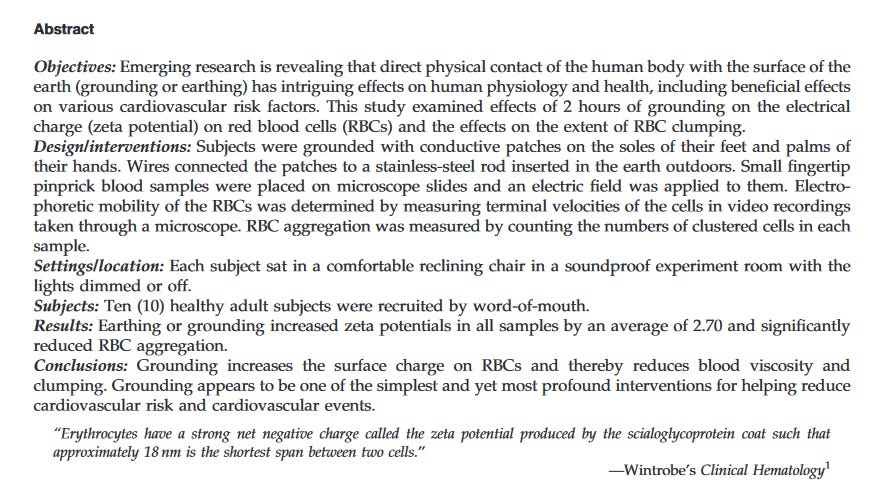
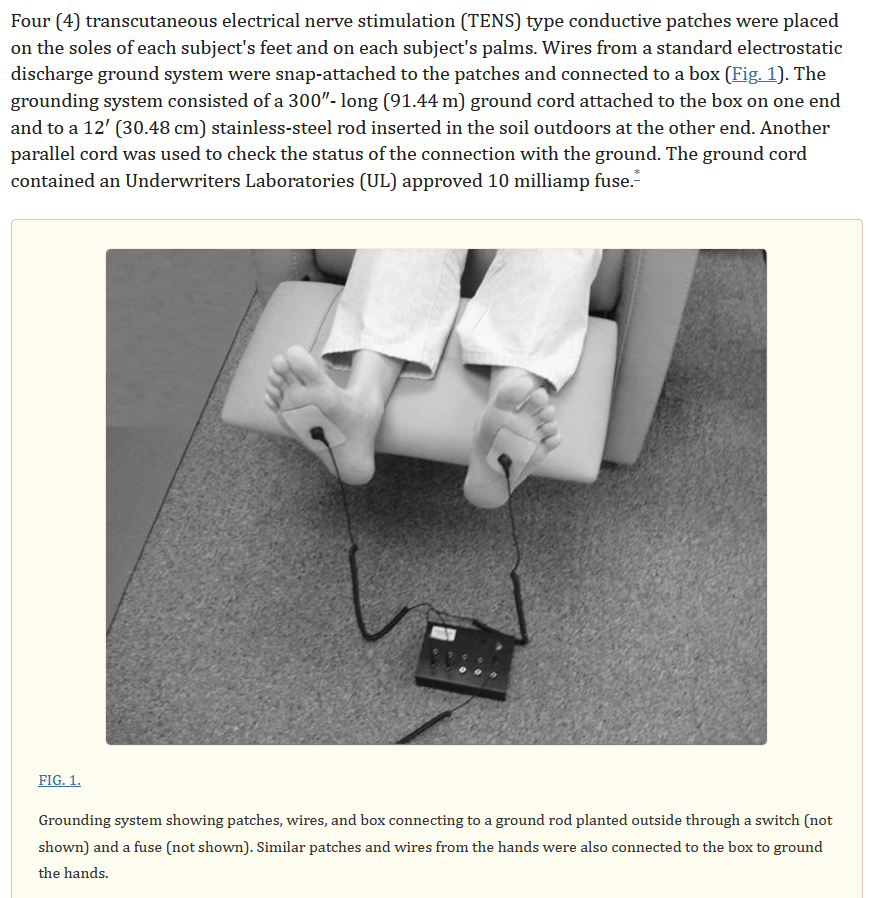
In this report the terms earthing and grounding
are used interchangeably. The branch of physics known as electrostatics
teaches that, when two conductive objects with different electrical
potential touch each other, there is a virtually instantaneous transfer
of charge so that the two objects equilibrate to the same electrical
potential. The human body is a conductor of electricity17
and so is earth (soil), except in very dry areas such as deserts.
Consequently, grounding leads to rapid equalization of the electrical
potential of the body with the potential of the Earth (planet) through
an almost instantaneous transfer of electrons from soil to the body.18,19
This has been the natural bioelectrical environment of the human body
and of other organisms throughout most of evolutionary history.
Given that earthing or grounding alters many electrical properties of the body,18–21
it was logical to evaluate an electrical property of the blood. The
goal was to find if grounding affects RBC zeta potential and RBC
aggregation in an ordinary office environment. The results show that
grounding the body to soil increases the zeta potential and thereby
decreases aggregation of RBCs.
Table 3
shows RBC velocity and zeta potential (ζ) before and after grounding
(earthing) for each of the 10 subjects. As explained previously, for
each blood draw, RBC velocity was measured 9 times. Given that there
were 2 blood draws before and 2 blood draws after a session (for a total
of 4 blood draws per subject per session), each RBC velocity presented
in Table 3
represents the average of 18 measurements. The average, SD and standard
error of the mean (SEM) were computed between subjects. Thus, these
statistical parameters reflected the distribution of velocities among
subjects (which were consistent with a normal distribution according to
the Lillifors test for normality). The zeta potentials in this table
were computed using the Smoluchowski equation from the corresponding
velocities (as previously explained). All subjects had an increase in
the absolute value of zeta potential after 2 hours of grounding. The
smallest absolute increase was by a factor of 1.27 and the largest was
by a factor of 5.63. On average, the absolute value of zeta potential
increased by a factor of 2.70 (a highly statistically significant
result, as can be seen from the one-tailed t-test;
this statistical test was used because an increase in the absolute
value of zeta potential of ∼ 20%–30% was expected after grounding). This
increase effectively brought the average zeta potential from a very
small average value of −5.28 mV into a normal value (–14.3 mV). It seems
that the healthier a subject was, the less significant the increase was
RBC aggregation
With
respect to RBC aggregation results for the 10 subjects, there were
significantly more aggregates or (clusters) during grounding (after 2
hours of grounding while still grounded) than before grounding (p=0.0000153). This is because there were significantly more clusters with 1 or 2 cells after 2 hours of grounding (p=0.0000269 and p=0.000354, respectively), simultaneously significantly fewer clusters of 3 cells (p=0.0451),
and far fewer clusters with 4+ cells (although no statistical
evaluation was done for clusters with 4+ cells, the last column of Table 4
shows that the average number of cells during earthing, which was 15.0,
was less than half the average number of cells before earthing which
was 34.7, a ratio of 34.7/15.0=2.3>2.0). There was clearly less
clumping after 2 hours of grounding than before grounding.
Discussion
A
number of clinical studies on the physiologic effects of grounding the
human body have indicated improvements in various cardiovascular and
heart-related parameters. One of the first investigations reported
normalization of the day–night cortisol rhythms in subjects who were
grounded by sleeping on a conductive mattress pad connected via a wire
to a rod inserted into soil.31
It is known that chronic elevation of cortisol can result in disruption
of circadian rhythms and chronic activation of the sympathetic nervous
system, both of which can contribute to insomnia and its many
well-documented health effects, including hypertension, CVD, stroke and
other disorders.32,33
Subsequent
research has repeatedly confirmed the positive effects of grounding on
the autonomic nervous system (ANS), including increases in
parasympathetic activity18,34 and, most recently, increases in heart rate variability (HRV).35
The significance of the latter study is that HRV is an important
indicator of the status of autonomic balance and stress on the
cardiovascular system. A decrease in HRV indicates autonomic dysfunction
and is a predictor of the severity of progression of coronary artery
disease.36,37
The positive effects of grounding on HRV suggest that simple grounding
techniques can be utilized as a basic strategy for supporting the
cardiovascular system, especially during situations of heightened
autonomic tone and/or hypertension.35 The present study demonstrated a profound increase in zeta potential and a corresponding decrease in blood viscosity.
Magnets
repel each other when the same poles come sufficiently close to one
another. Similarly, electric charges of the same sign repel each other
when they are in proximity to one another. The surface of RBCs has
negative electrical charges that maintain spacing of the cells in the
bloodstream by electrostatic repulsion. The electrophoretic mobility of
RBCs is a function of net negative charge (zeta potential), provided
that the viscosity of the suspending medium does not change during the
measurement. In a study of 50 patients with occlusive arterial disease
and 50 control counterparts (N=100), the migration
time of red cells (seconds) was longer and the electrophoretic mobility
(μsec/V/cm) was less in the patients with occlusive disease than in the
healthy controls.5
This study on electrophoretic mobility suggested differences in RBC
surface charge (zeta potential). The researchers concluded that patients
with occlusive arterial disease have one or more factors in their
plasma and RBCs that reduce the net negative charge (zeta potential) of
the cells, thereby facilitating RBC aggregation.5
This finding supports the notion that there are definitely many factors
that can reduce zeta potential, and thereby increase blood viscosity
and increase RBC aggregation, both of which play a major role in the
pathogenesis of arteriosclerosis.5
A meta-analysis evaluating the connection between blood viscosity and
CVD demonstrates clearly that the risk of major cardiovascular events
increase with higher blood-viscosity levels.38
In the Edinburgh Artery Study, a population of 4860 men 45–59 years of
age was observed for 5 years. The 20% of the men with the highest blood
viscosity had a 3.2 times greater risk for cardiac events, compared with
the 20% of men with the lowest blood viscosity. Fifty-five percent
(55%) of major cardiovascular events occurred in the highest
blood-viscosity group versus only 4% in the lowest blood-viscosity
group.39
Summary:
Earthing
has significantly beneficial effects on blood viscosity, improves zeta
potential, reduces blood clumping, heart rate variability, autonomic
function, decreases pain and walking barefoot or with grounding shoes of
your preference is a cheap and simple method to help the body recover
from this assault. Other options like earthing mats can also be explored
for health benefits. Also considering how our body is like a
vibrational tuning fork connected with the vibratory frequency of the
earth, other effects on spiritual clarity, and calming down the nervous
system could also be considered. All around - it works.






No comments:
Post a Comment