Continental Congresses
Essay
At the conclusion of the Seven Years’ War in 1763, independence from the British Crown was an outlandish thought in the minds of many American colonists. They enjoyed the protections of one of the world’s most powerful empires and rights and freedoms granted to its subjects. Little more than a decade later, delegates from these same colonies assembled in Philadelphia, risking their “lives, fortunes, and sacred honor” as they declared independence from Great Britain. The First and Second Continental Congresses, held in Philadelphia in 1774 and 1775-81, engaged in the complex politics surrounding independence and heightened the city’s role in a world-changing moment in history.
Tensions between the British Crown and the American colonies had simmered since the passage of the Stamp Act in 1765. The Coercive Acts, passed by the British Parliament in 1774 to punish the city of Boston for the Boston Tea Party, put the Massachusetts government under direct British control, closed the port of Boston, and increased British troops there. While the Acts were designed to bring only the Massachusetts colony under tight control, the highly punitive legislation drew concern from all thirteen colonies. Many outside of Massachusetts viewed the acts as a violation of their valued rights under the English constitution; the outrage demanded a unified response from the colonies.
But what response? Only the most radical among the colonists advocated for independence. Many others, including Pennsylvania political leaders John Dickinson (1732-1808) and Joseph Galloway (1731-1803), acknowledged the need for political unity but also encouraged caution, non-violent action, and a desire to reconcile their differences with the British government.
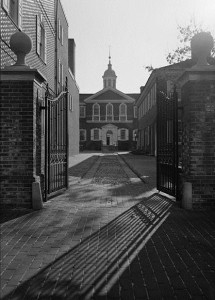
Representatives of twelve colonies assembled in Philadelphia in September 1774 at Carpenters’ Hall, then and since the meeting hall for the Carpenters’ Company of the City and County of Philadelphia. (Georgia, in dire need of the services of British regulars to fend off incursions of Creek Indians on its borders, did not send a delegation.) The choice of Carpenters’ Hall, rather than the Pennsylvania State House, reflected the complex politics surrounding the independence movement. The State House was the seat of the Pennsylvania Provincial Assembly, which in the fall of 1774 was not only against independence but was viewed by many in Philadelphia as highly sympathetic to the British Crown. Galloway had served as Speaker of the Assembly since 1766, and he was clear in his belief that the colonies needed to reconcile their differences with Britain (later, in 1788, he moved to England). Carpenters’ Hall also housed the collections of the Library Company of Philadelphia, established in 1731 by Pennsylvania delegate Benjamin Franklin (1706-1790), of which the delegates were made subscribing members.
Largest Port City
Then the largest port city in the colonies, Philadelphia was well situated to play a critical role in the slow march to independence. Its strategic location, wealth, population, industrial and commercial capacity, and professional and business classes were unsurpassed in America. On a more practical level, the city’s public buildings—including the State House, the “British Barracks” in Northern Liberties, the Pennsylvania Hospital, and Walnut Street Prison—could accommodate any of the needs of both Congresses.
Philadelphia also contained more than enough diversions to entertain its distinguished visitors. Massachusetts’ John Adams (1735-1826) and Connecticut’s Silas Deane (1737-1789) both noted the nearly unparalleled luxury found in the Second Street home of John Cadwalader (1742-1786), with whom they both dined. Delegates also were entertained in the many exclusive clubs of Philadelphia’s elite, including the Schuylkill Fishing Company, which was founded in 1732 and still exists as State on Schuylkill, one of the oldest private clubs in the United States.
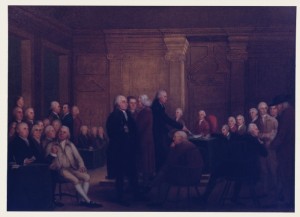
At the First Continental Congress, little consensus existed as whether to declare independence. When Galloway proposed a “plan of union” with Great Britain, the delegates voted it down, but narrowly. After seven weeks of debate, the first Congress ended with the delegates agreeing only to form an “Association” to boycott British goods and to meet again in May 1775. By the time the Second Continental Congress assembled, this time in the Pennsylvania State House (later Independence Hall), events had moved forward rapidly. The delegates were not dealing solely with philosophical and political questions related to their rights as Englishmen, but were responding to the hostilities that began between British regulars and Massachusetts militiamen at the Battle of Lexington and Concord on April 19, 1775. This Congress, now joined by Franklin and Thomas Jefferson (1743-1826) and presided over by John Hancock (1737-1793), appointed George Washington (1732-1799) as commander of the Continental forces, managed the loosely organized colonial war effort, and debated whether to declare independence.
Initially, many of the delegates favored Dickinson’s long-held position—reconciliation with Great Britain. Jefferson, later the primary author of the Declaration of Independence, also wrote the first version of the Olive Branch Petition, which in July 1775 affirmed the colonists’ loyalty to the British king in an attempt to avoid further bloodshed. When the petition was rejected by King George III (1738-1820), who viewed the Second Congress as an illegal assembly and insincere in its intentions, members of the Congress who favored independence saw their opportunity and pushed for independence.
Congress Flees Philadelphia
After formally declaring independence on July 2, 1776, the Second Continental Congress became the government of the United States, and Philadelphia became the nation’s capital city. This location did not last long as the British army took control of Philadelphia in the fall of 1777, forcing the Congress to flee and conduct its business from a variety of locations, including York, Pennsylvania; Princeton, New Jersey; Baltimore, Maryland; and New York City. When the British army left Philadelphia after nine months of occupation, the national government returned its capital to Philadelphia, where it remained until 1781.
Regardless of its location, the weak powers of this first national government nearly caused its failure. To fight the American Revolution, the thirteen American colonies cautiously entered the “firm league of friendship” established by the Articles of Confederation. Indicating its weakness as a frame of a unified national government, the document was not fully ratified by all of the colonies until 1781—four years after its initial creation in 1777. Fighting the war with borrowed money and little power to collect revenue from the states through taxes, the Continental Congress was bankrupt at the conclusion of the War for Independence. When the states, addressing this and other problems facing the new nation, ratified a new United States Constitution in September 1788, the Continental Congress began its slow fade into history. The end came on March 2, 1789, in New York when the Congress was adjourned by its lone member, New York’s Philip Pell (1753-1811), for the last time.
Michael Karpyn teaches History, Economics, and Advanced Placement U.S. Government and Politics at Marple Newtown Senior High School in Newtown Square, Pennsylvania. He has served as a Summer Teaching Fellow at the Historical Society of Pennsylvania, where he is a member of the Teacher Advisory Group. (Author information current at time of publication.)
Copyright 2012, Rutgers University
Timeline
- 1774
- September 5: First Continental Congress convenes at Philadelphia's Carpenter's Hall
- October 14: Declaration and Resolves of the First Continental Congress is adopted
- October 18: Continental Association is adopted
- October 25: First Petition to the King is signed
- October 26: Congress adjourns, resolving to reconvene the following May if grievances were not redressed
- 1775
- April 19: War begins at the Battles of Lexington and Concord
- May 10: Second Continental Congress convenes at Philadelphia's State House
- June 14: Congress establishes the Continental Army
- June 15: Congress appoints one of its members, George Washington, as commander of the Continental Army
- July 1: King George III addresses Parliament, stating they will "put a speedy end" to the rebellion
- July 6: Declaration of the Causes and Necessity of Taking Up Arms is approved
- July 8: Second petition to the king (the Olive Branch Petition) is signed and sent to London
- August 23: In his Proclamation of Rebellion (officially titled "A Proclamation for Suppressing Rebellion and Sedition"), King George III declares elements of the American colonies in "open and avowed rebellion" and orders officials of the British Empire "to use their utmost endeavours to withstand and suppress such rebellion"
- October 13: Congress establishes the Continental Navy
- November 10: Congress establishes the Continental Marines
- 1776
- January 10: Thomas Paine publishes Common Sense
- June 7: Richard Henry Lee of Virginia presents a three-part resolution to Congress, calling on Congress to declare independence, form foreign alliances, and prepare a plan of colonial confederation
- June 10: Congress votes on June 10 to postpone further discussion of Lee's resolution for three weeks to allow time for the delegates to confer with their state assemblies
- June 11: Congress appoints a "Committee of Five", Thomas Jefferson of Virginia, John Adams of Massachusetts, Benjamin Franklin of Pennsylvania, Roger Sherman of Connecticut and Robert R. Livingston of New York, to draft a declaration justifying independence.
- June 12: Congress appoints a Committee of Thirteen to draft of a constitution for a union of the states
- July 2: Lee Resolution (also known as "The Resolution for Independence"), asserting the independence of the 13 colonies from Great Britain, is adopted
- July 4: Final text of the Declaration of Independence is adopted
- July 12: John Dickinson presents the Committee of Thirteen's draft constitution to Congress
- August 2: Delegates sign an engrossed copy of the Declaration of Independence
- December 12: Congress adjourns to move to Baltimore, Maryland
- December 20: Congress convenes in Baltimore at the Henry Fite House
- 1777
- February 27: Congress adjourns to return to Philadelphia
- March 4: Congress reconvenes at Philadelphia's State House
- June 14: Flag Resolution, defining the design of the flag of the United States of America, is adopted
- September 18: Congress adjourns in order to move to Lancaster, Pennsylvania
- September 27: Congress convenes for one day in Lancaster, at the Court House
- September 30: Congress reconvenes at York, Pennsylvania at the Court House
- November 15: Final text of the Articles of Confederation is approved and sent to the states for ratification
- 1778
- June 27: Congress adjourns to return to Philadelphia
- July 2: Congress reconvenes in Philadelphia, first at College Hall, then at the State House
- 1780
- January 15: Congress establishes the Court of Appeals in Cases of Capture
- 1781
- March 1: Having been ratified by all 13 states, the Articles of Confederation becomes effective; Continental Congress becomes the Congress of the Confederation
- May 26: Proposed plan from Robert Morris to establish Bank of North America approved by Congress
- October 17: Surrender of Cornwallis at Yorktown, Virginia
- December 31: Bank of North America chartered by Congress
- 1783
- June 21: The Pennsylvania Mutiny of 1783 forces congress to flee Philadelphia.
- June 30: Congress reconvenes in Princeton, New Jersey, first at a house named "Prospect," then Nassau Hall
- November 4: Congress adjourns to move to Annapolis, Maryland
- November 26: Congress reconvenes at Annapolis, in the State House
- December 23: George Washington resigns from the Army
- 1784
- January 14: The Treaty of Paris is ratified
- May 7: Thomas Jefferson is appointed as a minister to France
- August 19: Congress adjourns to move to Trenton, New Jersey
- November 1: Congress reconvenes at Trenton, at the French Arms Tavern
- December 24: Congress adjourns to move to New York City
- 1785
- January 11: Congress reconvenes in New York City, first at City Hall, then at Fraunces Tavern
- March 25–28: Maryland–Virginia Conference held at Mount Vernon
- March 28: Mount Vernon Compact is signed between Maryland and Virginia covering the use of the Potomac River
- 1786
- August 29: Shays' Rebellion begins
- September 11–14: 1786 Annapolis Convention held; delegates issues a report calling for another meeting in the spring with delegates from all states
- 1787
- February 21: Congress calls a constitutional convention "for the sole and express purpose of revising the Articles of Confederation and reporting to Congress and the several legislatures such alterations and provisions therein and when agreed to in Congress and confirmed by the States render the Federal Constitution adequate to the exigencies of Government and the preservation of the Union"
- May 25: Constitutional Convention convenes in Philadelphia; every state except for Rhode Island sends delegates
- July 13: Congress passes the Northwest Ordinance
- September 17: Constitutional Convention adjourns after completing work on the United States Constitution
- September 28: Congress votes to transmit the proposed Constitution to the 13 states for ratification
- 1788
- July 2: Congress President Cyrus Griffin informs Congress that New Hampshire has ratified the Constitution and notes that it is the ninth ratification, thereby allowing for the establishment of the new government [30]
- July 8: A committee is formed to examine all ratifications received and to develop a plan for putting the new Constitution into operation. [30]
- September 13: Congress certifies that the new constitution has been duly ratified and sets date for first meeting of the new federal government and the presidential election [31]
- October 10: The last session during which the Continental Congress succeeded in achieving a quorum; and passes its last ordinance [32]
- November 15: Cyrus Griffin, the 10th president of Congress under the Articles of Confederation, resigns
- 1789
- March 2: Last meeting of the Continental Congress, held at Fraunces Tavern, is adjourned sine die; Philip Pell is the only member in attendance
- March 4: First session of the 1st United States Congress begins at Federal Hall
- April 30: George Washington inaugurated as first President of the United States
- July 23: Charles Thomson transmits to President Washington his resignation of the office of Secretary of Congress
- July 25: In accordance with President Washington's directions, "the books, records, and papers of the late Congress, the Great Seal of the Federal Union, and the Seal of the Admiralty" are delivered over to Roger Alden, deputy secretary of the new Congress, who had been designated by President Washington as custodian for the time being [33]

No comments:
Post a Comment