Even though the
COVID-19 curve has been flattened, mainstream media outlets continue to
push doomsday predictions of an impending explosion of deaths
According to
Stanford University's disease prevention chairman Dr. John Ioannidis,
the COVID-19 fatality rate for those under the age of 45 is “almost
zero,” and between the ages of 45 and 70, it’s somewhere between 0.05%
and 0.3%
So, the fact
that young and middle-aged adults are testing positive in droves is not a
warning sign of an impending onslaught of deaths, as the risk of death
in these age groups is minuscule
According to
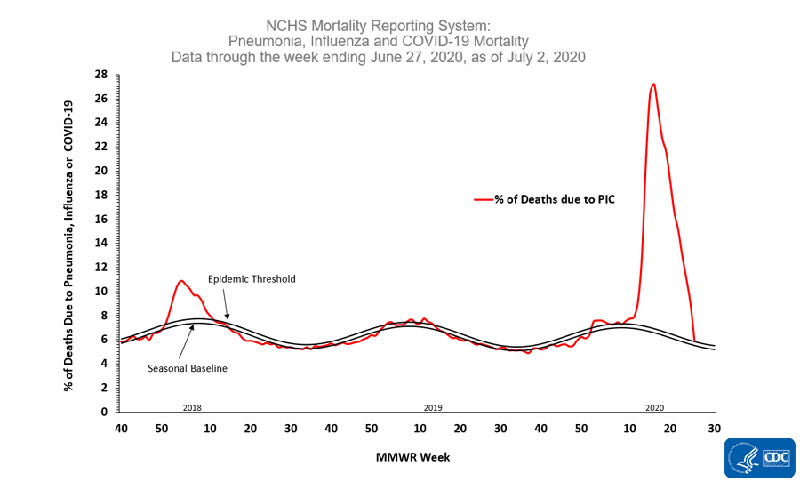
the Centers for Disease Control and Prevention, the COVID-19 mortality —
which had declined for the last 10 weeks straight — “is currently at
the epidemic threshold,” meaning if it declines just a little more,
COVID-19 will no longer be considered an epidemic
The sharp increases in “cases” are not proof of disease spread but, rather, the spread of testing
Even though the COVID-19 mortality
curve has been flattened, mainstream media outlets continue to push
doomsday predictions of an impending explosion of deaths. The New York
Times, for example, published articles July 21,2 and July 3,3,4 2020, basically warning everyone to not get excited about plummeting mortality rates, as the trend could change at any moment.
"Why Virus Deaths Are Down but May Soon Rise," its July 2 headline
states. The article goes on to claim "coronavirus trends in the United
States are pretty dark right now" — based on surging case numbers,
meaning positive test results, not hospitalizations or people
exhibiting actual symptoms.
The article attributes the steady and relatively rapid drop-off in
deaths to improved medical treatment and older people being more
cautious, but warns that "Deaths may be on the verge of rising again,"
because "middle-aged and younger people are acting as if they're
invulnerable" and have increased their social activities.
"Their increased social activity has fueled an explosion in
cases over the last three weeks, which in turn could lead to a rise in
deaths soon," The New York Times states,5,6 adding:
"With testing now more widespread, it's possible that
the death data will lag the case data by closer to a month. (In a
typical fatal case, the death comes three to five weeks after
contraction of the virus.) If that's correct, coronavirus deaths may
start rising again any day."
This, however, completely ignores data showing that the COVID-19
fatality rate for those under the age of 45 is “almost zero,” and
between the ages of 45 and 70, it’s somewhere between 0.05% and 0.3%.7,8,9
In other words, the fact that young and middle-aged adults are
testing positive in droves is not a warning sign of an impending
onslaught of deaths, as the risk of death in these age groups is
minuscule. If anything, it seems to show herd immunity is building which, ultimately, will help protect the most vulnerable among us.
Why Did They Want to Flatten the Curve?
The primary justification for the tyrannical governmental
interventions of COVID-19 was to slow the spread of the infection so
that hospital resources would not be overwhelmed, causing people to die
due to lack of medical care. These interventions were not about
stopping the spread or reducing the number of people that would
eventually get infected.
It was only intended to slow it down so, eventually,
naturally-acquired herd immunity — the best kind — would prevent its
spread. Well guess what? They have changed the narrative. That is why
you now do not hear anything about flattening the curve. Instead they
transitioned the fear-mongering to alarm the public that the number of
“cases” are increasing.
Bear in mind that you do NOT need any test to be classified as a
COVID case. All you need is a simple upper respiratory infection and
you can legally be classified as a COVID-19 case to artificially
inflate the totals.
Advertisement
Fatality Rate No Longer Cause for Hysteria
The fatality rate data given above were cited by Stanford
University's disease prevention chairman Dr. John Ioannidis — an
epidemiologist who has made a name for himself by exposing bad science —
in a June 27, 2020, interview with Greek Reporter,10,11,12 in which he criticized global lockdown measures, saying they were implemented based on flawed modeling and grossly unreliable data.
"0.05% to 1% is a reasonable range for what the data
tell us now for the infection fatality rate, with a median of about
0.25%," Ioannidis told Greek Reporter.13
"The death rate in a given country depends a lot on the
age-structure, who are the people infected, and how they are managed.
For people younger than 45, the infection fatality rate is almost 0%.
For 45 to 70, it is probably about 0.05-0.3%.
For those above 70, it escalates substantially, to 1% or higher
for those over 85. For frail, debilitated elderly people with multiple
health problems who are infected in nursing homes, it can go up to 25%
during major outbreaks in these facilities."
When asked whether the curve had indeed been flattened in the U.S.,
seeing how no health care system had been completely overwhelmed,
Ioannidis answered:14
"The predictions of most mathematical models in terms of how
many beds and how many ICU beds would be required were astronomically
wrong. Indeed, the health system was not overrun in any location in the
USA, although several hospitals were stressed. Conversely, the health
care system was severely damaged in many places because of the measures
taken …
Major consequences on the economy, society and mental health
have already occurred. I hope they are reversible, and this depends to a
large extent on whether we can avoid prolonging the draconian
lockdowns and manage to deal with COVID-19 in a smart, precision-risk
targeted approach, rather than blindly shutting down everything …
I hope that policymakers look at the big picture of all the
potential problems and not only on the very important, but relatively
thin slice of evidence that is COVID-19."
COVID-19 Close to Epidemic Threshold
The fear-mongers also ignore recent Centers for Disease Control and Prevention statements15
saying the COVID-19 mortality — which had declined for the last 10
weeks straight — "is currently at the epidemic threshold," meaning if
it slides down just a little more, COVID-19 will no longer meet the
CDC's criteria for "epidemic" status.
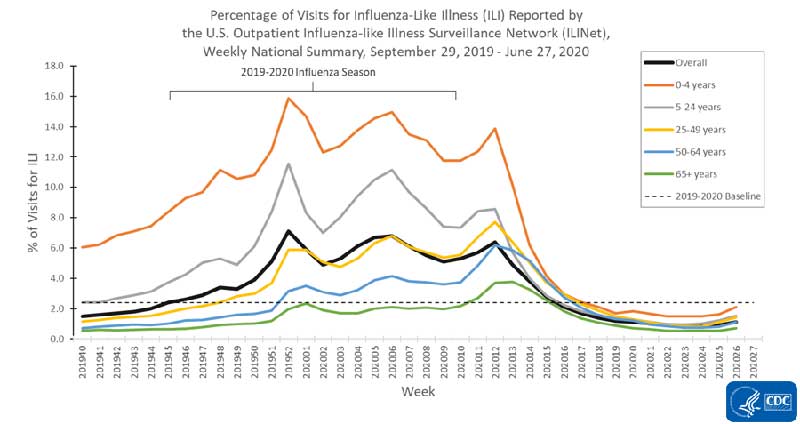
The percentage of doctors' visits for influenza-like illness (ILI)
for all age groups has also dropped below the 2019-2020 baseline, as
seen in the CDC graph below, published July 3, 2020.16
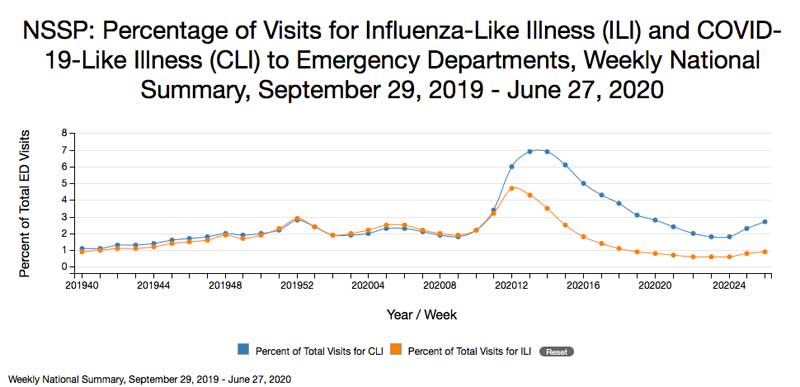
The graph below shows the percentage of visits to emergency
departments, specifically, related to suspected ILI and COVID-19-like
illness (CLI). While ER visits for suspected COVID-19 have seen a
slight uptick, it's not an extreme increase.
The Truth About Increasing COVID-19 Cases
The video above reviews why the rise in COVID-19 "cases" is
misleading at best, and not a viable measure of a public health threat.
It presents a historical overview of what happened during the 2009
swine flu pandemic, and how it parallels the current COVID-19 pandemic.
In summary, fear of a novel illness — pandemic swine flu — led to a
dramatic spike in testing, making it seem like a significant threat as
many tested positive. Yet the death toll was insignificant. We're
seeing the same thing happening now. Two things are driving the numbers
of positive tests skyward: The sudden availability of tests, and
widespread testing of asymptomatic people.
Put another way. The sharp increases in "cases" are not proof of
disease spread but rather the spread of testing. When you don't have a
test for the infection, you cannot tally positive cases. Hence it
looked like there were virtually no COVID-19 cases in January 2020.
The sudden jump in cases in February correlates with the emergence
of test kits sent out by the CDC. Once those test kits were used up,
the number of "cases" again dried up. Then, once test kits became
readily available again in early April, the number of cases skyrocketed
— as you'd expect. But again, this doesn't mean the disease was
spreading like wildfire.
It was probably in circulation throughout and countless people were
already walking around with it, feeling no worse than normal. The only
difference is that test kits became available and massive amounts of
people — whether they had symptoms or not — were being tested.
Increased Testing = Increased 'Cases'
In short, the graphs showing "cases" in large part simply illustrate
the availability of testing. Granted, even this is an
oversimplification and is not going to be exact, and there's more than
one reason for this. For example, during the third week of May, the CDC
admitted it had combined the results from viral and antibody tests in
its national results.17
This provides a really inaccurate picture, since the two tests
describe very different things. The viral test is supposed to identify
active infections (regardless of whether you have symptoms or not),
whereas the antibody test tells you if you've been exposed to the virus
in the past and fought it off by developing antibodies. Hence, an
antibody test should not be counted as an active infection or active
"case."
Some data18
also suggest positive test results have declined even as testing has
increased. The question is, could this be an indication that people who
are being tested for active infection have already fought off the
virus and have antibodies? Could it be a sign of rising herd immunity?
Unfortunately, COVID-19 test data has been so mishandled and the way
the data is compiled has changed enough times that it's virtually
impossible to make sense of it at this point. The quality and
reliability of the tests themselves, both viral and antibody, also
appear to be less than stellar.
The CDC has admitted that prior exposure to coronaviruses
responsible for the common cold can result in a positive COVID-19
antibody test,19
and during an April White House Coronavirus Task Force briefing, Dr.
Birx explained that COVID-19 tests are "not 100% sensitive or
specific," and that when prevalence is low in the community, the false
positive rate will be high.
"If you have 1% of your population infected, and you have a test
that's only 99% specific, that means that when you find a positive,
50% of the time will be a real positive and 50% of the time it won't
be," Birx said. In other words, if the prevalence of infection in the
community is 1%, about half of all positive tests will be false
positives.
Only as the overall infection rate gets higher does the viral test
become increasingly reliable. Who knows, perhaps this is why some of
the data suggest the number of positive tests is actually decreasing
even as testing continues to increase?
What Happened to the Death Toll Reporting?
As you may recall, early on, the media focused on the death toll and
hospitalizations. We had daily news ticker tapes providing us with the
numbers of severe and critical cases, and the number of deaths.
These statistics were used to justify draconian lockdown orders to
prevent hospitals from becoming overwhelmed. Now you hear virtually
nothing about hospitalizations or deaths.
It's all about the rising number of "cases," meaning infected
individuals, which is to be expected when you test a population in
which the virus has already infected the majority. But that doesn't
mean it poses a threat, since deaths continue to drop.
It seems many are simply unwilling to accept the good news and allow
the population to return to normal living. Instead, "rising cases" —
especially among previous low-risk age groups — is now being used to
justify continued stay-at-home orders, even though hospitals are at no
risk of being overwhelmed since a vast majority of these cases are
asymptomatic and need nothing in terms of health care.
In its April 13, 2020, issue, the German magazine Blauer Bote20,21 lists a collection of 75 expert opinions about the COVID-19 threat. Among them is a statement from Gerd Bosbach,22
professor emeritus of statistics, mathematics and empirical economic
and social research, and author of the book, "Lying With Numbers," who
said (translated from German to English using TranslationLookup.com23):24
"The tripling of the tests resulted in a little more than
tripling the number of those who tested positive. This tripling was
presented to the citizens as a tripling of the infected …
Far-reaching decisions require secure foundations. This is
exactly what has been neglected so far. The repeated equation of the
number of positively tested people with the number of infected clouded
the view …
The government's standard of when measures should be weakened is
based on an apparent number of infected people, which has nothing to do
with reality …
So we have a muddle of terms, which is ultimately explained by
the fact that we keep talking about infected people instead of positive
people. The high numbers remain in memory, such as the mortality rate
of 3.4% stated by the WHO. And that creates fear …
We should ensure that the media do not use the power of images
to generate emotions that influence our judgment. If you get pictures
of coffins and death departments from Italy or pictures of completely
empty shelves, then their effects exceed the facts mentioned."
Herd Immunity Likely Much Higher Than Suspected
In related news, several recent studies suggest a majority of the
population may already have immunity against COVID-19, via one
mechanism or another. According to a Swiss study,25,26
SARS-CoV-2-specific antibodies are only found in the most severe cases
— about 1 in 5. That suggests COVID-19 may in fact be five times more
prevalent than suspected. This also means it may be five times less
deadly than predicted. According to the authors:
"When symptomatic, COVID-19 can range from a mild flu-like
illness in about 81% to a severe and critical disease in about 14% and
5% of affected patients, respectively."
They also found that even though people who had been exposed to
COVID-19 had SARS-CoV-2-specific immunoglobulin A (IgA) antibodies in
their mucosa, there were no virus-specific antibodies in their blood.
IgA is an antibody that plays a crucial role in the immune function of
your mucous membranes, while IgG is the most common antibody that
protects against bacterial and viral infections and is found in blood
and other bodily fluids. As explained by the authors:27
"As with other coronaviruses, symptomatic SARS-CoV-2 disease causes
an acute infection with activation of the innate and adaptive immune
systems. The former leads to the release of several pro-inflammatory
cytokines, including interleukin-6 …
Subsequently, B and T cells become activated, resulting in the
production of SARS-CoV-2-specific antibodies, comprising immunoglobulin
M (IgM), immunoglobulin A (IgA), and immunoglobulin G (IgG).
Whereas coronavirus-specific IgM production is transient and
leads to isotype switch to IgA and IgG, these latter antibody subtypes
can persist for extended periods in the serum and in nasal fluids.
Whether SARS-CoV-2-specific IgG antibodies correlate with virus control
is a matter of intense discussions."
Majority of People Appear Resistant to COVID-19
Another study28,29
published in the journal Cell found 70% of samples from patients who
had recovered from mild cases of COVID-19 had resistance to SARS-CoV-2
on the T-cell level. Curiously, 40% to 60% of people who had not been
exposed to SARS-CoV-2 also had resistance to the virus on the T-cell
level.
According to the authors, this suggests there's "cross-reactive T
cell recognition between circulating 'common cold' coronaviruses and
SARS-CoV-2." In other words, if you've recovered from a common cold
caused by a particular coronavirus, your humoral immune system may
activate when you encounter SARS-CoV-2, thus rendering you resistant to
COVID-19.
May 14, 2020, Science magazine reported30 these Cell findings, drawing parallels to another earlier paper31 by German investigators that had come to a similar conclusion. That German paper,32
the preprint of which was posted April 22, 2020, on Medrxiv, found
helper T cells that targeted the SARS-CoV-2 spike protein in 15 of 18
patients hospitalized with COVID-19.
Yet another study,33,34,35
this one by researchers in Singapore, found common colds caused by the
betacoronaviruses OC43 and HKU1 might make you more resistant to
SARS-CoV-2 infection, and that the resulting immunity might last as
long as 17 years.
The authors suggest that if you've beat a common cold caused by a
OC43 or HKU1 betacoronavirus in the past, you may have a 50/50 chance
of having defensive T-cells that can recognize and help defend against
SARS-CoV-2.
81% of Unexposed Individuals May Be Resistant to SARS-CoV-2
Two additional studies suggesting herd immunity is near were reported36 by Reason, July 1, 2020. These include a Swedish study,37,38
which found "SARS-CoV-2 elicits robust memory T cell responses akin
to those observed in the context of successful vaccines, suggesting
that natural exposure or infection may prevent recurrent episodes of
severe COVID-19 also in seronegative individual." Similarly, a German
study39 concluded:
"SARS-CoV-2-specific T-cell epitopes enabled detection of
post-infectious T-cell immunity, even in seronegative convalescents.
Cross-reactive SARS-CoV-2 T-cell epitopes revealed preexisting T-cell
responses in 81% of unexposed individuals, and validation of similarity
to common cold human coronaviruses provided a functional basis for
postulated heterologous immunity in SARS-CoV-2 infection."
Flattening the Curve Was a Fool's Errand
So far, many efforts to curb COVID-19 infection have proven to be
ill advised. Evidence shows the illness spreads mostly indoors,40,41,42
for example, casting doubt on the sanity of closing parks and beaches,
especially during the summer. As reported by The Baltimore Sun,43 scientists are now considering using ultraviolet light to eradicate SARS-CoV-2 in indoor air. Step outside, and you get that effect for free.
The total all-cause mortality is not significantly different than in
previous years as discussed by my interview with Denis Rancourt. Many
other deaths have been shifted to COVID-19, bringing a high spike in
deaths, but when you look at the area under the curve for total deaths,
it really doesn't differ from previous years.
This was also echoed by the American Institute for Economic Research.44
Back in April 2020 they referred to the COVID-19 pandemic as "An
egregious statistical horror story" that resulted in "a vandalistic
lockdown on the economy," which:
"… would have been an outrage even if the assumptions were not
wildly astronomically wrong. Flattening the curve was always a fool's
errand that widened the damage …
The latest figures on overall death rates from all causes show
no increase at all. Deaths are lower than in 2019, 2018, 2017 and 2015,
slightly higher than in 2016. Any upward bias is imparted by
population growth.
Now writing a book on the crisis with bestselling author Jay
Richards, [statistician William] Briggs concludes: 'Since pneumonia
deaths are up, yet all deaths are down, it must mean people are being
recorded as dying from other things at smaller rates than usual.'
Deaths from other causes are simply being ascribed to the coronavirus.
As usual every year, deaths began trending downward in January.
It's an annual pattern. Look it up. Since the lockdown began in
mid-March, the politicians cannot claim that their policies had
anything to do with the declining death rate.
A global study45
published in Israel by Professor Isaac Ben-Israel, chairman of the
Israeli Space Agency and Council on Research and Development, shows
that 'the spread of the coronavirus declines to almost zero after 70
days — no matter where it strikes, and no matter what measures
governments impose to try to thwart it.'
In fact, by impeding herd immunity, particularly among students
and other non-susceptible young people, the lockdown in the U.S. has
prolonged and exacerbated the medical problem. As Briggs concludes,
'People need to get out into virus-killing sunshine and germicidal
air.'"


No comments:
Post a Comment