Not a single
randomized controlled trial with verified outcome has been able to
detect a statistically significant advantage of wearing a mask versus
not wearing a mask, when it comes to preventing infectious viral illness
If there were
any significant advantage to wearing a mask to reduce infection risk to
either the wearer or others in the vicinity, then it would have been
detected in at least one of these trials, yet there's no sign of such a
benefit
There is no
evidence that masks are of any utility for preventing infection by
either stopping the aerosol particles from coming out, or from going in.
You're not helping the people around you by wearing a mask, and you're
not helping yourself avoid the disease by wearing a mask
Infectious
viral respiratory diseases primarily spread via very fine aerosol
particles that are in suspension in the air. Any mask that allows you to
breathe therefore allows for transmission of aerosolized viruses
All-cause
mortality data are not affected by reporting bias. A detailed study of
the current data of all-cause mortality shows the all-cause mortality
this past winter was no different, statistically, from previous decades.
COVID-19 is not a killer disease, and this pandemic has not brought
anything out of the ordinary in terms of death toll
Denis Rancourt, Ph.D., a former full
professor of physics, is a researcher with the Ontario Civil Liberties
Association in Canada. He’s held that volunteer position since 2014,
which has given him the opportunity to dig into scientific issues that
impact civil rights. He also did postdoctoral work in chemistry.
Here, we discuss the controversial topic of face masks.
Should you wear one? When and where? Does it protect you or not?
There’s a wide range of opinions on this even within the natural health
community.
Early on in the COVID-19 pandemic,
I endorsed the use of face masks based on the experience of some of
the Eastern European countries. The rationale of it seemed to make sense
at the time. Since then, however, I’ve started to question their use.
Unfortunately, the mainstream propaganda and government orders in
many states in recent weeks have reverted back toward mask wearing just
about everywhere. You’re not allowed into stores; you cannot fly or
take a cab, Uber or Lyft without one; you must wear one everywhere you
go, even outdoors, and if you don’t you’re vilified, sometimes
aggressively attacked.
There’s No Scientific Support for Mask-Wearing
Rancourt’s investigation into mask wearing was part of his research
for the Ontario Civil Liberties Association. He did a thorough study of
the scientific literature on masks, concentrating on evidence showing
masks can reduce infection risk, especially viral respiratory diseases.
“What I found when I looked at all the randomized controlled
trials with verified outcome, meaning you actually measure whether or
not the person was infected … NONE of these well-designed studies that
are intended to remove observational bias … found there was a
statistically significant advantage of wearing a mask versus not
wearing a mask.
Likewise, there was no detectable difference between respirators
and surgical masks. That to me was a clear sign that the science was
telling us they could not detect a positive utility of masks in this
application.
We're talking many really [high-]quality trials. What this means —
and this is very important — is that if there was any significant
advantage to wearing a mask to reduce this [infection] risk, then you
would have detected that in at least one of these trials, [yet] there's
no sign of it.
That to me is a firm scientific conclusion: There is no evidence
that masks are of any utility either preventing the aerosol particles
from coming out or from going in. You're not helping the people around
you by wearing a mask, and you're not helping yourself preventing the
disease by wearing a mask.
This science is unambiguous in that such a positive effect cannot
be detected. So, that was the first thing I publicized. I wrote a
large review1,2 of the scientific literature about that.
But then I asked myself, as a physicist and as a scientist, why
would that be? Why would masks not work at all? And so, I looked into
the biology and physics of how these diseases are transmitted.”
Advertisement
The Importance of All-Cause Mortality Statistics
When trying to tease out whether an intervention works against
COVID-19 or not, it’s important to look at death statistics. The number
of deaths is really what’s important, not the number of infected
individuals, as many may not even exhibit symptoms.
The problem is that assigning the cause of death in a situation
where a viral infection taxes the immune system and is confounded by
comorbidities is tricky business. As noted by Rancourt, epidemiologists
have long known that you cannot reliably assign cause of death during a
viral pandemic such as this. There’s tremendous bias involved.
To get around those problems, you have to look at all-cause
mortality. The reason for this is because all-cause mortality data are
not affected by reporting bias.
So, Rancourt did a detailed study of the current data of all-cause
mortality, showing that the all-cause mortality this past winter was no
different, statistically, from previous decades. In other words,
COVID-19 is not a killer disease, and this pandemic has not brought
anything out of the ordinary in terms of death toll.
Government Lockdown Orders Fueled Death Toll
He published this data in the paper,3
“All-Cause Mortality During COVID-19: No Plague and a Likely Signature
of Mass Homicide by Government Response.” Rancourt explains:
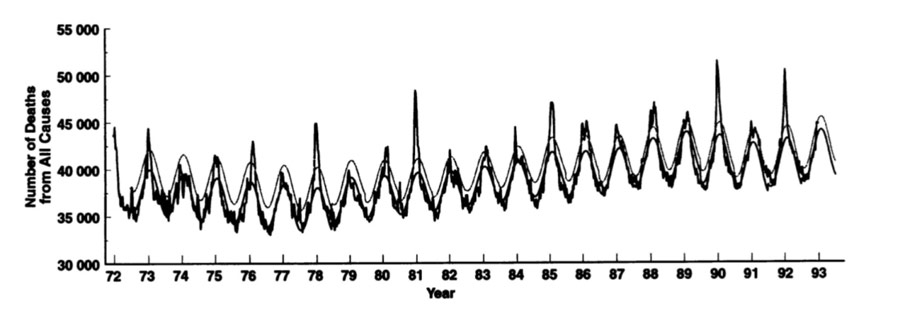
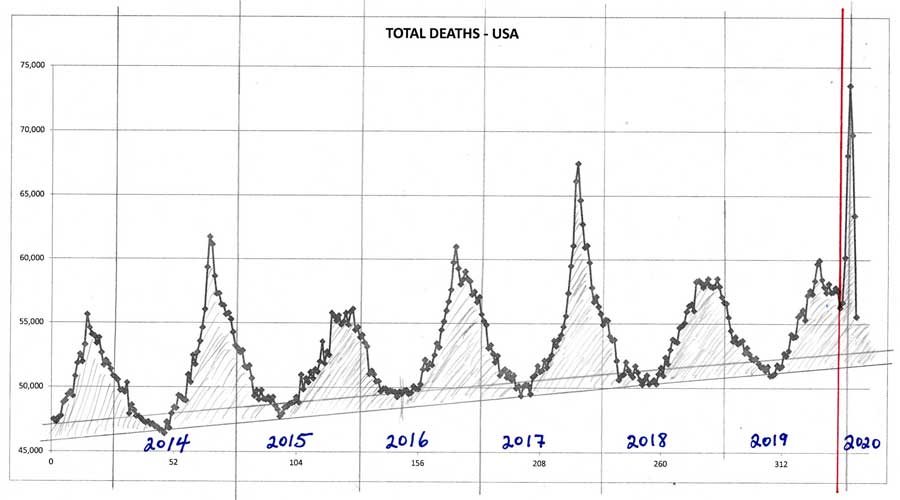
“It turns out that these curves, which show the winter burden
deaths as humps every winter, some of them, in some jurisdictions, have
an additional very sharp peak. It doesn't represent a … huge amount of
deaths by comparison to the total winter burden because it's a very
sharp peak, but it's an anomalous peak. It's not a natural peak.
And it happened in exact coincidence and time everywhere. In
every jurisdiction that sees this anomalous, unnatural peak ... the
peak started exactly when the pandemic was declared by the World Health
Organization. And the World Health Organization at that time
recommended states prepare their hospitals for a huge influx of people
with critical conditions.
So, the government response to that World Health Organization
recommendation is what killed people, what accelerated the deaths. You
can see that in the data, and you can also understand it in terms of
how immune-vulnerable people are affected by these kinds of diseases.
What they did is they closed people into their institutional
places of residence, they didn't allow visitors. So, they isolated the
most vulnerable parts of society that already had comorbidity
conditions who were in a fragile state.
So, they ensured that many people that were locked into these
institutions would die from this particular seasonal virus that causes
the respiratory disease.
But the virus itself is not more virulent than other viruses. The
total winter burden deaths is not greater, but there is a signature of
a sharp feature that lasts the full width at half maximum. This
feature is three or four or five weeks, which is extraordinarily rapid,
never been seen before. And it happens very late in the winter burdens
season.
A sharp peak like this has never been seen this late in the
season before, and it's happening [synchronistically] everywhere, on
every continent, at the same time in direct immediacy after the
declaration of the pandemic. To my eye, there is no doubt that there
was an acceleration of deaths of vulnerable people due to government
responses ...
What really matters is the hard data, and the hard data is
all-cause mortality in any jurisdiction that you want to look at. And
it has not been anomalous, statistically speaking, no matter how you
slice it.”
The two graphs below show the number of deaths from all causes from 1972 until 1993, and 2014 until present time in 2020.
Why Government Response Was Ill Advised
Rancourt goes on to qualify some of this data based on the mechanism
of viral transmission, which also helps explain why government
responses have been ill advised, as they actually worsen transmission
rather than inhibit it. Infectious respiratory diseases primarily
spread via very fine aerosol particles that are in suspension in the
air.
“We're talking about the small size fraction of aerosols, so typically smaller than 2 micrometers,” Rancourt explains.
“There are water droplets that bear these virions, the virus
particles, and there can be dozens or hundreds of these virions per
very small droplet of this size.
Those are the droplets we're talking about. When you get down to
those sizes, gravitational outtake is very inefficient and they
basically stay in suspension. And, as soon as you have currents or flow
of air, [the particles] are carried.”
The aerosol particles stay in suspension when the absolute humidity
is low. This is why influenza outbreaks occur during the winter. Once
absolute humidity rises, the aerosol particles become unstable. They
agglomerate, drop out of suspension and cease to be transmissible. “This
is well known,” Rancourt says. “It's been known for a decade. It's
been extraordinarily well-demonstrated by top scientists.”
The mid-latitude band is where you find the dry weather and the
temperature ideal for transmitting viral respiratory diseases. Viral
infections typically spread during the winter in the northern
hemisphere, and in the summer in the southern hemisphere.
“You see it in both hemispheres, but inverted,” Rancourt says. “That is why, when you move down towards the equator, transmission drops. You don't get transmission.
Likewise, if you go too far North, it also does not transmit, and
that is not well understood. I'm an expert in environmental
nanoparticles and how they charge and what they do, so I have some
ideas about why that is, but it hasn't been studied in detail.
The point is the transmission band is very narrow. It's across
Europe and North America where you have temperatures between about zero
and 10 degrees Celsius, and you have low absolute humidity. That's
where these aerosol particles that are the vector of transmission are
completely suspended as part of the fluid air.
They're really part of the fluid air, so any air that gets
through, [the viral particles are also] going to come through. That's
why masks don't work. And these particles are in suspension in the air
and get trapped indoors.
That's why centers where you have sick people and you're not
controlling the air environment are centers of transmission. We're
talking about old folks’ homes, hospitals, even people's homes. This
entire class of diseases, this is how they're transmitted.”
Why Masks Are Used During Surgery
Many firmly believe wearing a mask in public will protect themselves
and/or others, and one of the reasons for this is because they appear
to work in some circumstances, such as operating rooms. If they don’t
work, why do surgical staff and many health care workers use them on a
regular basis?
As explained by Rancourt, the reason surgical masks are worn in the
operating room is to prevent spittle from accidentally falling into an
open wound, which could lead to infection. Surgical masks have been
shown to be important in that respect.
Preventing microbes and bacteria from falling into an open wound is
very different from preventing the spread of viral particles, however.
Not only are viruses much smaller than bacteria and many other microbes
found in saliva, they are, again, airborne. They’re aerosolized and
part of the fluid air. Therefore, if air can penetrate the mask, these
aerosol particles can also get through.
“The best randomized controlled trials with verified outcome — in
other words, the only scientifically designed studies that remove
observational bias and that are valid and rigorous — are [done] in
clinical environments.
So, they're looking at health care workers treating people that
potentially have a viral respiratory infection, or treating people they
know have such an infection and they're doing something that will
potentially generate a lot of aerosol particles by the treatment. Many,
many trials have been done in that environment and none of them find
any advantage to the health care workers,” Rancourt says.
Mask Wearing Does Not Protect Others Either
The video below is from Patrick Bet David, who has a very popular
YouTube channel that I enjoy watching. His message below is broken down
into very simple terms and he presents valid arguments and good
questions. I encourage you to view it if you believe in wearing masks.
Now, one view is that, even though a mask may not protect the wearer
against contracting an infection, it will still protect others that
the mask-wearer comes into contact with. But that’s not what the
science shows. The measured outcome in most rigorous studies on this is
the infection rate. Did anyone involved get infected?
Comparisons are made between health care workers wearing masks,
respirators or nothing at all. While this does not allow you to discern
who is being protected — the mask wearer or others — the studies show
mask wearing does neither.
Since everyone is in close proximity to each other, and no
differences in infection rates are found regardless of what type of
mask is worn, or none at all, it tells us that mask wearing protects no
one from viral infections.
“It makes no difference if everybody in your team is wearing a mask; it makes no difference if one is and others aren't,” Rancourt says.
“Wearing a mask or being in an environment where masks are being worn
or not worn, there's no difference in terms of your risk of being
infected by the viral respiratory disease.
There's no reduction, period. There are no exceptions. All the
studies that have been tabulated, looked at, published, I was not able
to find any exceptions, if you constrain yourself to verified
outcomes.”
What’s more, the results are the same for both N95 respirators and surgical masks. Respirators offer no protective advantage when it comes to viral infections.
“In one of the randomized control trials, a big one that compared
masks and N95 respirators among health care workers, the only
statistically significant outcome they discovered and reported on was
that the health care workers who wore the N95 respirators were much
more likely to suffer from headaches,” Rancourt says. “Now, if you've got a bunch of health care workers, which you're
forcing to get headaches, how good is the healthcare going to be?”
Why Masks Don’t Prevent Viral Infections
As noted by Rancourt, it’s important to separate scientific
findings from possible mechanics that might explain a certain outcome.
Studies have conclusively proven masks do not prevent viral infections.
Why, is another question.
“I think it's important to recognize that no matter how clever your
explanation is, it may not be right,” he says. That said, one
commonsense explanation put forth by Rancourt is that masks don’t work
for this application for the simple fact that they allow airflow:
“I've come to the conclusion that the most prominent vector of
transmission is these fine aerosol particles. Those fine aerosol
particles will follow the fluid air. In a surgical mask, there is no
way you're blocking the fluid air. When you breathe wearing a surgical
mask, the lowest impedance of airflow is through the sides and tops and
bottoms of the mask.
In other words, very little of the airflow is going to be through
the actual mask. The mask is only designed and intended to stop your
spitballs from coming out and hitting someone … If the flow of air is
through the sides, whatever molecules or small particles are carried in
the air, are going to flow that way as well, and that's how you get
infected.
If you're not stopping [the viral particles] coming in, you're
not stopping them from coming out either. They follow the flow, period.
That's the way it is. So that's why there's an equivalence between ‘It
doesn't protect you and it doesn't protect anyone else either.’”
Ironically, some masks are even designed with out-vents, to
facilitate breathing, which completely negate the claim that
mask-wearers are protecting others.
Why Masks Have No Impact on Viral Load
Rancourt also dismisses the argument that masks can reduce the total
viral load by catching your spit. The theory is that by minimizing the
viral load someone is exposed to, their chances of the infection
taking hold are minimized.
“The large droplets drop to the floor immediately and are not
breathed in. So, they're not part of the transmission mechanism. You can
do a scientific study that demonstrates that viruses survive a fairly
long time on a surface … These are called fomites, these surfaces where
viruses can live and stay active.
That does not mean that transmission occurs through surfaces. It
only means that a scientist was able to establish that a virus can
survive a long time on a surface. It doesn't tell you anything about
the likely transmission mechanism of the disease. So, there are a lot
of studies like this that are basically irrelevant in terms of
transmission mechanism.
[Infectious respiratory diseases] are transmitted by these fine
aerosol particles that are in suspension in the air. In a case like
that, will a mask, will something that is preventing spitballs from
coming out, protect you or protect others? And the answer is no, it
makes no measurable difference.
There are many studies that show how difficult it is to actually
infect someone when you're just trying to put something like a fluid or
something you know is bearing the virus into their eye or into their
nose. It's hard to do this. That's what the studies show.
But if you take a fine aerosol and you breathe it in deeply,
that's where the infection starts and that's where the virus has evolved
to be most effective. So, by breathing in aerosols laden with these
viruses, you're going to be infected. Try to do anything else, and it's
going to be difficult [to spread infection].
The most recent randomized controlled trial [published] this year
basically concluded they could find no evidence that masks,
hand-washing and distancing, in terms of reducing the risk of these
types of diseases, were of any use. [They] didn't help.
So, there's this dissonance between what the science actually
tells you when you measure correctly, and what the health authorities
tell you to do. They want you to be convinced that you're in this
dangerous environment and that if you follow their directives, you’ll
be safe.
Their purpose is to control your life and to give you directives,
and you're going to accept that. That's part of how they convince you
that you absolutely need the state to save your life. I think that's
what's going on.”
Mask-Wearing Is Not Without Its Risks
We’ve already mentioned that certain masks can increase your
likelihood of headaches. Others believe masks can cause lower partial
pressure of oxygen, which could cause serious health problems. In the
video above, Peggy Hall with TheHealthyAmerican.org claims certain masks
can result in low oxygen levels, thus violating OSHA rules on oxygen
requirements.
“There are many admitted dangers to wearing masks,” Rancourt says. “The World Health Organization in its June 5 memo,4
where they reversed their position and decided that it was a good idea
to recommend mask use in the general population, in that document, they
actually say you have to consider the potential harms, and they list
what they consider are all the potential harms.
They missed a lot. But one of the top ones is you're
concentrating the pathogen laden material onto this material near your
face, nose, eyes and so on. And you're touching the mask all the time,
you're touching yourself, you're touching others.
It's not a controlled clinical environment, so there's potential
for transmission in that way. You might wear the mask more than once,
you might store it at home and then wear it again. You might do all
kinds of things …
What I find extraordinary is that they also have a list of what
they call potential advantages. And when I compare the two lists, the
potential dangers far outweigh the potential advantages. So, you have
to ask yourself, what the heck are you doing?
How can you make these two columns and compare the advantages and
disadvantages and have one clearly outweigh the other and then
conclude that therefore we recommend masks? This is just nonsense. It's
irrational. So, my association added our list5 of things that they weren't even considering.
We went into the civil liberties aspect of it as well, because I
think this is very important. One of the fundamental aspects of a free
and democratic society is that the individual is entitled to evaluate
the personal risk to themselves when they act in the world.”
As noted by Rancourt, risk evaluation is a very personal thing. It
involves your personality, your judgment, your knowledge, your
experience and your culture. It's a very personal thing that you're
entitled to do for yourself. If the state is forcing you to accept their
evaluation of risk, then this fundamental precept is violated. What’s
worse, they’re currently forcing you to accept an evaluation of risk
that cannot be scientifically justified.
Mask Mandates Are Indicative of Rising Totalitarianism
In its letter6
to the WHO, the Ontario Civil Liberties Association also addressed the
issue of mask mandates as an instrument of totalitarianism.
“In our letter, we put it this way. There's a recent scientific study7
that came out in 2019. The first author is the executive director of
the Ontario Civil Liberties Association that I do research for, and
he's a physicist also. He wrote an article with another physicist.
They looked at the conditions under which a society will
gradually degrade towards a more totalitarian state. What they found
was that there were two major control parameters that characterize the
society that will tell you if that is likely to happen or not.
One of those control parameters is authoritarianism in the
society. What they mean by that is, how successful can an individual be
to refuse something, like to refuse to wear a mask if they protest?
What is the chance that they'll succeed if they refuse? That would be
related to the degree of authoritarianism.
The other important parameter is the degree of violence in the
society. How violent is the repression if you disobey? So how big is the
fine? Can you go to jail? How much punishment will you be subjected to
if you disobey a particular rule, for example, wearing of a mask?
Those two parameters, they were able to establish what we call a
phase diagram of societies … And what they found is that in present
society, if you would estimate the average value of those two
parameters for United States or Canada, we're in a state right now
where the society is very gradually evolving towards totalitarianism.
The way to slow that and prevent it is for people to object and
to scale it back. As soon as you agree with an irrational order, an
irrational command that is not science-based, then you are doing
nothing to bring back society towards the free and democratic society
that we should have. You are allowing this slow march towards
totalitarianism. That's how I would explain the importance of objecting
to this.”
Mask Mandates Allow Government to Shirk Responsibility
Rancourt also points out that when government and health
institutions convince people that masks are the solution, they are
effectively removing their duty of care toward you, because they're
saying all you need to do is wear a mask. This allows them to avoid the
responsibility of actually preventing transmission in the primary
centers of transmission, such as hospitals, nursing homes and
elsewhere.8
“We don't have to manage the air in such a way that
immune-vulnerable in this establishment will not be at risk of dying
and so on. They remove their duty of care responsibilities by saying,
‘Well, we're just not going to allow visitors, and we're going to force
everyone to wear masks.’
You need to look at, scientifically, what is happening here. Why
are people at risk? What is immune-vulnerability due to? What can you
do about it? And then you have to do something about it if you're
serious about your duty of care towards these people. So it has that
side effect of letting them get away with not taking care of the people
that they're responsible for.”
Calls for Peaceful Civil Disobedience Are Growing
The Ontario Civil Liberties Association has issued a press release9 calling for peaceful civil disobedience against mandatory masking. The U.S. nonprofit Stand for Health Freedom
is also calling for civil disobedience, and has a widget you can use
to contact your government representatives to let them know wearing a
mask must be a personal choice.
“In the memo that was put out, we explain how best to perform
that civil disobedience. We explain that you should be calm and
confident and not get into arguments and not try to convince the
authorities.
Just express your disobedience regarding this rule. And then we
explain that they may want to trespass you, they may want to give you a
fine, that you can anticipate fighting that fine in court. We go
through the steps so that people can visualize how to do this.
We explain that some of their core shoppers or core citizens will
be angry and aggressive, and to not get into a fight and not to get
into a war of words. Do not try to convince them. Just stick to that
you are not going to comply. Be very calm. This kind of civil
disobedience has been successful at various times in North American
history.
There are risks involved, but it's often worth it to the
individual to have that civil disobedience because there are many
individuals that don't know what to do that are very angry because
they're being forced to wear masks and they see it as absurd and a
constraint. So, we try to give them a view of a venue on how to resist
this …
We also recommend when people are practicing this kind of civil
disobedience that they not be isolated, that they try to form a
grassroots group of support and that they don't do it alone. Try to
bring at least one person, one supporter, with them. Record the
interaction with the authorities and report back on social media and to
their groups with details of what happened and so on.
We hope to create kind of a smoother messaging that a lot of
people, or at least some people, do not believe this mask story and do
not believe that they are at risk and are willing to practice civil
disobedience to make that point.”


No comments:
Post a Comment