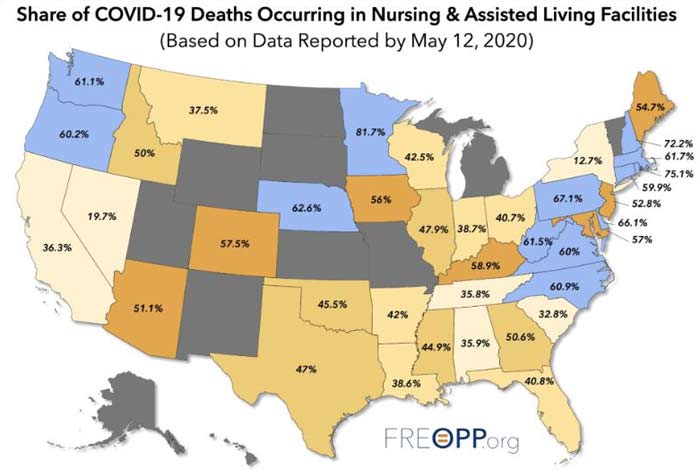
On average, 42%
of all COVID-19 deaths in the U.S. have occurred in nursing homes,
assisted living and other long-term care facilities. This is
extraordinary considering this group accounts for just 0.62% of the
population
Some states
have nursing home mortality rates that are significantly higher than the
national average. In Minnesota, over 81% of all COVID-19 deaths have
occurred in nursing homes and assisted living facilities
In
Massachusetts and Connecticut, COVID deaths per 10,000 nursing home and
assisted living facility residents were 703 and 827 respectively. In New
Jersey, nearly 10% of all long-term care facility residents have died
of COVID-19
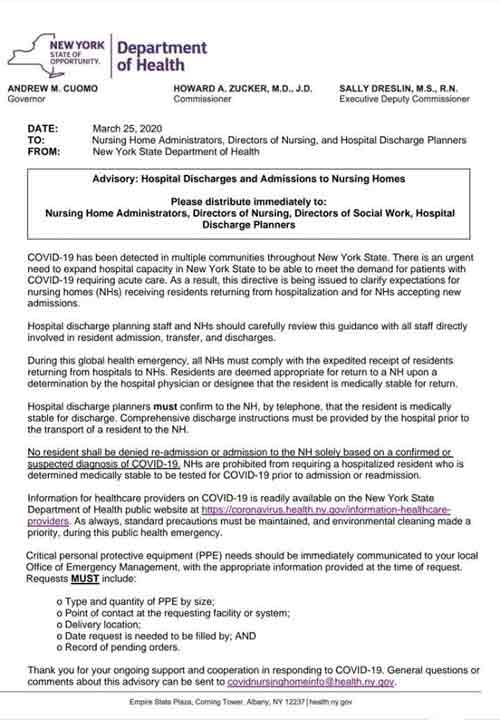
March 25, 2020,
instructions from the New York Department of Health stated nursing
homes were not allowed to deny admission or readmission of a
COVID-19-positive patient. Nursing homes were even “prohibited from
requiring a hospitalized resident who is determined medically stable to
be tested for COVID-19 prior to admission or readmission”
New York’s
directives seem particularly questionable, considering the Navy hospital
ship USNS Comfort was docked in New York City harbor, yet treated only
182 patients, and the temporary hospital facility at the Javits
Convention Center, which had a capacity of 2,500, closed after treating
just over 1,000 patients
Early on in the pandemic it became
clear that older individuals were at disproportionate risk of severe
COVID-19 infection and death.
According to an analysis1
conducted by the Foundation for Research on Equal Opportunity, which
included data reported by May 22, 2020, an average of 42% of all
COVID-19 deaths in the U.S. had occurred in nursing homes, assisted
living and other long-term care facilities. This is beyond
extraordinary, considering this group accounts for just 0.62% of the
population.
Avik Roy, president of the Foundation for Research on Equal Opportunity, wrote an article2
about their findings in Forbes, pointing out that “42% could be an
undercount,” since “states like New York exclude from their nursing
home death tallies those who die in a hospital, even if they were
originally infected in a long-term care facility.” Roy also testified
before Congress June 17, 2020, about racial disparities in COVID-19 and
the health care system.3
Why Do Some States Have Exaggerated Nursing Home Death Rates?
Disturbingly, some states have nursing home mortality rates that are
significantly higher than the national average of 42%. Minnesota4
tops the list in this regard, with 81.4% of all COVID-19 deaths having
occurred in nursing homes and assisted living facilities. Ohio comes in
second, with a rate of 70%.
As reported by Roy:5
“Another way to cut the data is to look at nursing home and
assisted living facility deaths as a share of the population that lives
in those facilities. On that basis, three states stand out in the
negative direction: New Jersey, Massachusetts, and Connecticut.
In Massachusetts and Connecticut, COVID deaths per 10,000
nursing home and assisted living facility residents were 703 and 827,
respectively. In New Jersey, nearly 10 percent of all long-term care
facility residents — 954 in 10,000 — have died from the novel
coronavirus.”
Thousands Have Died Unnecessarily
By and large, nursing homes are ill equipped to care for COVID-19 infected patients.6
They’re set up to care for elderly patients, whether they are generally
healthy or have chronic health problems, but they’re not typically
equipped to quarantine and care for people with highly infectious
disease.
It’s logical to assume that comingling infected patients with
noninfected ones in a nursing home would result in exaggerated death
rates, as the elderly are far more prone to die from any infection,
including the common cold.
March 17, 2020, Stanford epidemiologist John Ioannidis wrote an op-ed in STAT news,7
stating that “even some so-called mild or common-cold-type
coronaviruses have been known for decades [to] have case fatality rates
as high as 8% when they infect people in nursing homes.”
In other words, we should not be surprised that COVID-19
disproportionally affects older people. Most elderly are frail and have
underlying health problems that make them more prone to death from any
infection whatsoever. Since this is common knowledge, why did some
states decide to violate federal guidelines and send COVID-19 patients
back into nursing homes?
Advertisement
New York Governor in the Hot Seat
Democratic governor of New York, Andrew Cuomo, appears to have been
among the most negligent in this regard. March 25, 2020, instructions
from the New York Department of Health stated nursing homes were not
allowed to deny admission or readmission of a COVID-19-positive
patient.
Nursing homes were even “prohibited from requiring a hospitalized
resident who is determined medically stable to be tested for COVID-19
prior to admission or readmission.” As reported by Roy:8
“As recently as April 23, Cuomo declared9 that nursing
homes ‘don’t have a right to object’ to accepting elderly patients
with active COVID infections. ‘That is the rule and that is the
regulation and they have to comply with that.’
Only on May 10 — after the deaths of nearly 3,000 New York
residents of nursing homes and assisted living facilities — did Cuomo
stand down and partially rescind his order.”
Cuomo’s order seems particularly dubious considering the Navy
hospital ship USNS Comfort was docked in New York City harbor. The
ship, which had a 1,000-bed capacity, was barely used.10 It departed NYC on April 30, having treated just 182 patients.11
A temporary hospital facility at the Javits Convention Center was
also erected to deal with predicted hospital overflow. It had a
capacity of 2,500, and closed May 1, 2020, having treated just over
1,000 patients.12
With all that available surplus space equipped for infectious disease
control, why were COVID-19 patients forced back into nursing homes
where they would pose a clear infection risk to other high-risk
patients?
Several Governors Violated Federal Guidelines
June 22, 2020, Centers for Medicare and Medicaid Services
administrator Seema Verma condemned the actions of Cuomo and “other
Democrat governors” — including Pennsylvania Gov. Tom Wolf, New Jersey
Gov. Phil Murphy, Michigan Gov. Gretchen Whitmer and California Gov.
Gavin Newsom — who contradicted federal guidelines for nursing homes in
their own state guidance.
“Our guidance was absolutely crystal clear,” Verma said in an
exclusive interview with Breitbart reporter Matthew Boyle, adding:13
“Any insinuation to the contrary is woefully mistaken at best
and dishonest at worst. We put out our guidance on March 13 … It says …
‘When should a nursing home accept a resident who is diagnosed with
COVID-19? …
A nursing home can accept a resident diagnosed with COVID-19 and
still under transmission-based precautions,’ which means if this
person is infectious you have to take precautions.
It says ‘as long as the facility can follow CDC guidance for
transmission-based precautions.’ It says: ‘If a nursing home cannot, it
must wait until these precautions are discontinued,’ meaning if you
are not able to care for this patient — somebody is still positive and
you’re not equipped to care for the patient, then you shouldn’t accept
the patient into your care.
That’s really important because longstanding discharge — when
you’re discharging a patient from the hospital, longstanding guidelines
require when you transfer them somewhere you transfer them to a place
that can take care of their needs whether they’re going home or they’re
going to a nursing home or some other facility …
I just don’t think we should ever put a nursing home in a
situation or a patient where we force them to take a patient they are
not prepared to care for. That not only jeopardizes the patient but it
jeopardizes the health and safety of every single resident in that
nursing home.”
Stark Differences Between Nursing Homes
While Cuomo has tried to deflect criticism for his devastating
nursing home directive, the facts seem to speak for themselves.
ProPublica published an investigation14
June 16, 2020, comparing a New York nursing home that followed Cuomo’s
order with one that refused, opting to follow the federal guidelines
instead. The difference is stark.
According to ProPublica,15
by June 18, the Diamond Hill nursing home — which followed Cuomo’s
directive — had lost 18 residents to COVID-19, thanks to lack of
isolation and inadequate infection control. Half of the staff (about 50
people) and 58 patients were also sickened.
In comparison, Van Rensselaer Manor, a 320-bed nursing home located
in the same county as Diamond Hill, which refused to follow the state’s
directive and did not admit any patient suspected of having COVID-19,
did not have a single COVID-19 death. A similar trend has been observed
in other areas. As reported by ProPublica:16
“New York was the only state in the nation that barred testing
of those being placed or returning to nursing homes. In the weeks that
followed the March 25 order, COVID-19 tore through New York state’s
nursing facilities, killing more than 6,000 people — about 6% of its
more than 100,000 nursing home residents …
In Florida, where such transfers were barred, just 1.6% of
73,000 nursing home residents died of the virus. California, after
initially moving toward a policy like New York’s, quickly revised it. So
far, it has lost 2% of its 103,000 nursing home residents.”
Florida Republican Gov. Ron DeSantis actually took the opposite
position with regard to nursing homes. Not only were hospitals not
permitted to discharge COVID-19 patients into nursing homes, but all
nursing home workers were also required to be screened for symptoms
before entering facilities each day, and ensuring availability of
personal protective equipment was prioritized.
In California, Los Angeles County nursing homes are such a hotspot,
and local leaders describe the situation as a “pandemic within a
pandemic.”17 There, the fact that many of the facilities are unusually large appears to be part of the problem.
They also have a higher percentage of people of color — another
high-risk group — both working and residing in these facilities. Low
pay, poor quality of care and inferior infection control add to the
problem.
COVID-19 Primarily Spread in Health Care Settings
Overall, COVID-19 transmission appears to be rampant within our
health care system in general, not just in nursing homes. As noted in “20% of COVID Patients Caught Disease at Hospital,”
British data suggests 1 in 5 COVID-19 patients actually contracted the
disease at the hospital, while being treated for something else.
SARS-CoV-2 is being transmitted not only between patients but also
from health care workers to patients. When you add it all together,
nursing homes and nosocomial infections (i.e., infections originating
in or acquired from a hospital18), plus the spread from workers to family members, likely account for a vast majority of all COVID-19 deaths.
Without doubt, if nursing homes don’t start getting this right, they
eventually won’t have enough patients to stay in business.
Unfortunately, rather than tackle the problem head-on and implement
sensible safety measures across the board, the nursing home industry is
instead seeking immunity from COVID-19 related lawsuits. I discussed
this in “COVID-19 and Nursing Homes: The No. 1 Place Not to Be.” According to NBC News:19
"So far at least six states have provided explicit immunity from
coronavirus lawsuits for nursing homes, and six more have granted some
form of immunity to health care providers, which legal experts say
could likely be interpreted to include nursing homes …
Of the states that have addressed nursing home liability as a
response to the outbreak, two — Massachusetts and New York — have
passed laws that explicitly immunize the facilities. Governors in
Connecticut, Georgia, Michigan and New Jersey have issued executive
orders that immunize facilities."
In other words, New York not only issued rules requiring COVID-19
infected patients to be admitted into nursing homes, and barred them
from testing, it also granted nursing homes immunity against lawsuits.
Talk about triple injury. Clearly, New York nursing home patients
have gotten ill and died due to willfully negligent directives. On top
of that, families have been deprived of due process and any legal
recourse for these beyond-reprehensible criminal actions.
Congressional Members Demand Answers
While several states have failed to protect their most vulnerable,
New York’s actions stand out as being particularly egregious and, so
far, no sound justifications have been forthcoming.
June 15, 2020, House Minority Whip Steve Scalise, R-La., and four
Republican members of the Select Subcommittee on the Coronavirus sent
letters20 to the governors of New York, Michigan, California, New Jersey and Pennsylvania, demanding answers:21
“Why did they give those orders? Why did they go against the
safety guidelines that were issued from CMS? And why won't they give us
all the disclosure of the patient information that they were giving
and then all of a sudden when we started discovering this they clammed
up and they’re not letting the public see what these numbers really
are?” Scalise said.
Curiously, Select Subcommittee Democrats not only declined to join
Republicans in the proposed nursing home oversight effort, they also
refused Scalise’s call to “get to the bottom of what motivated these
decisions” in New York, Michigan, California, New Jersey and
Pennsylvania, and they did not sign the letters to the governors of
those states.22
In a press release by Scalise, Select Subcommittee member Jackie Walorski (R-Ind.) is quoted saying:23
“Just about the worst possible thing to do is knowingly
introduce coronavirus to the most vulnerable populations, yet that's
exactly what several states did by mandating nursing homes accept
infected patients.
These misguided policies deserve close scrutiny, and the leaders
who put them in place have a lot of tough questions to answer. Now is
not the time to look the other way while placing blame for this crisis
on states that are taking a measured, responsible approach to reopening
our economy and protecting our communities.”
Take Action NOW!
While the death toll from COVID-19 in the U.S. has sharply declined
since its peak in mid-April — declining from 2,666 deaths the week of
June 13, 2020, to 906 deaths for the week of June 20, 2020,24 — authorities predict a reemergence this fall.
We can significantly blunt any reemergence by optimizing our vitamin
D levels, and making sure this information reaches nursing homes and
other long-term care facilities.
For more information, see “Your Vitamin D Level Must Reach 60ng/mL Before the Second Wave.”
To facilitate the public information campaign, I’ve created two
vitamin D reports — one comprehensive science report and one summary
review — both of which can be downloaded below.
I urge everyone to share this information with friends, family and
community at large, so that we can minimize a second outbreak. If you
have a family member or know anyone that is an assisted living
facility, you could meet with the director of the program, share these
reports and encourage them to get everyone tested or at least start
them on vitamin D.
Additionally, you could speak to pastors in churches with large
congregations of people of color — who are also at disproportionate risk
— and help them start a program getting people on vitamin D. Doing so
could help save many lives, far more than any vaccine program.



No comments:
Post a Comment