People with COVID-19 will shed the virus in their stool; the testing of sewage sludge can help predict local outbreaks
Sewage sludge
is a concentration of the solid waste found in raw wastewater;
scientists studying public health patterns test it for opiates to gauge
community use
One city is using this type of testing to help make public health decisions and guide policy
Your stool
offers valuable insights into your overall health; use the Bristol stool
chart to determine if diet and hydration changes are necessary
Wastewater treatment has been a focus of
environmental protection groups for years since the plants are not
equipped to treat wastewater containing products of modern life,
including toxic chemicals, drugs and cosmetics. It wasn't until 1972
when the Clean Water Act1 was passed that pollution discharged into U.S. waterways began to be regulated.
The Act is supposed to ensure clean water, but after nearly five
decades the waterways are in serious trouble. Sources of pollution range
from agricultural runoff and industrial release to worn out pipes and firefighting foam.2
Even the chemicals used during treatment can pollute the waterways.
Fish and other wildlife suffer the ramifications of out-of-control water
pollution.3,4
Chemical pollution has also reached tap water; in many places tap water
has tested positive for heavy metals and disinfection byproducts.5
Sewage sludge masses pulled from raw wastewater can be “treated” and are then called biosolids,6
which are allowed to be sprayed across farm fields on vegetables that
end up on your plate. After decades of poor control, the sludge may
offer researchers more information about the spread of viruses,
including SARS-CoV-2.
Sewage Sludge Offers Epidemiological Insight
The virus that triggers COVID-19 is spread through respiratory
droplets. However, researchers have found that the virus can also be
detected in human waste. In other words, what's flushed down the toilet
may also contain SARS-CoV-2. In the race to test, some scientists have
begun taking samples from sewage sludge.
In a recently published paper by a team from Yale University,7 data were shared after evaluation of sewage sludge from an abatement facility in New Haven, Connecticut. The facility manages waste from 200,000 residents.
Samples were collected from March 19, 2020, to May 1, 2020, and
compared to local hospital admission data as well as COVID-19 test
results in the community. The researchers wrote:8
"We report a time course of SARS-CoV-2 RNA concentrations in
primary sewage sludge during the Spring COVID-19 outbreak in a
northeastern U.S. metropolitan area. SARS-CoV-2 RNA was detected in all
environmental samples and, when adjusted for the time lag, the virus RNA
concentrations were highly correlated with the COVID-19 epidemiological
curve (R2=0.99) and local hospital admissions (R2=0.99).
SARS-CoV-2 RNA concentrations were a seven-day leading indicator
ahead of compiled COVID-19 testing data and led local hospital
admissions data by three days.”
The data showed that testing of sewage sludge could predict, with
reasonable accuracy, when there would be a rise in the number who have
COVID-19 within the following seven days, and that would lead to a
higher number of hospital admissions over the next three days.
One graph from the study was shared on social media.9 It illustrated the lag time between sewage sludge testing and the rise in community-confirmed tests of the virus.
Results from the study were similar to those from one performed by
researchers in Massachusetts, published in April. The biotech company
Biobot Analytics10
evaluated wastewater from a major urban treatment facility, which they
did not identify. Data were collected from March 18, 2020, to March 25,
2020. In a preprint release of the study abstract, the researchers
wrote:
“Viral titers observed were significantly higher than expected
based on clinically confirmed cases in Massachusetts as of March 25.” The researchers do not know why there is a discrepancy, though.
Advertisement
Differences Between Sewage Sludge and Raw Wastewater
The material that researchers were testing was not pulled directly
from raw wastewater. Raw sewage goes through multiple stages of
treatment before the solid waste becomes sewage sludge. When wastewater first enters a treatment plant it often contains additional items including wood, rocks and dead animals from time to time.11
This material is filtered to remove large impediments, which are then
sent to a landfill. Most of the wastewater system uses gravity, so once
the water enters the plant it needs to be pumped into aeration tanks.
This is one of the first steps during which wastewater is exposed to
air, causing some of the dissolved gases to be released.
Raw waste runs through a series of concrete tanks during which oxygen
is bubbled through the water to suspend organic material while other
smaller parts are settled out, including things like coffee grounds and
sand. In the next tank, the organic part of sewage from your home — the
sludge — settles and water is then pumped out of the tanks.
In the process of the sludge settling to the bottom, smaller, lighter
material floats to the surface and gets skimmed off. The resulting
thick material at the bottom is called sewage sludge. This is the
material researchers tested on consecutive days to determine the density
of viral material.
To create biosolids,12
the sludge may be treated with lime to eliminate odors. Then, it is
processed to control pathogens and other organisms known to trigger
infection. Unfortunately, as has been demonstrated in the past, this
system is not consistently successful.13
The practice of using biosolids began when it became clear that dumping
sludge directly into the waterways was damaging the environment.
The EPA describes the use of biosolids as completing a “natural cycle.”14
If human waste were the only product being returned to the soil on
farmlands, it might be the final step in a system of regenerative
agriculture. However, industrial waste is also included because the
treatment process concentrates toxins, and the waste is then spread as
fertilizer.
In an investigation by the Office of Inspector General,15 the agency identified 352 chemical pollutants coming out of wastewater treatment plants and treated biosolids; these included pesticides, pharmaceuticals and solvents. Of these, 61 are listed as hazardous materials with known human health effects.
Sewage Used to Track Other Public Health Epidemics
For decades, microbiologists have been studying sewage to evaluate
and analyze pathogens. Using the sampling for public health
surveillance, however, is relatively new. For example, researchers are
using the sludge to detect the polio virus since it can also be shed in
human waste.16
Another public health concern that sent researchers to the sewers is
the fight against opioid misuse. Biobot Analytics was involved in a
competition to measure the concentration of opioids and sewage in order
to offer an estimate of local drug use.17
The testing is generalized and doesn’t identify specific homes or
individuals, but it does give governments a strong indication of where
drug use may be at its highest. The goal was for agencies to be supplied
with information that would allow them to proactively address the issue
and potentially stem the rise in overdoses and deaths. The mayor of
Fort Worth, Texas, who was on the panel of judges, said:18
“It’s a very creative way to use a source of untapped data. Who
thinks about measuring wastewater? This is another way to use city
assets that we don’t think about to hit a problem like opioids or public
health in general.”
The city of Tempe, Arizona, and Arizona State University have
partnered up to study the city’s wastewater and use it as a source of
public health information.19
Specifically, the city is looking to measure narcotic consumption as
they seek a way to reduce the challenges associated with addiction.
Samples are collected over a 24-hour period at the treatment plant
and pulled from the sewer line; these can provide a single snapshot of a
specific place and time. Researchers have found natural fluctuations
from day-to-day information that produce valuable insights on long-term
trends.
Arizona State University processes wastewater from more than 300
cities around the world. Tempe is the first to incorporate the data with
other tactics to help guide the development of public health policy.
What to Watch for in Your Toilet
Your stool says a lot about your overall health, as its composition
is a direct reflection of your gut microbiome. There's a strong
connection between your gut health, mental health and immune system.20
The size, shape and color of your stool give clues as to the state of
your overall health and that of your intestinal tract, specifically.
It's normal for the shape and consistency of your stool to fluctuate
from day to day, particularly when your diet changes.
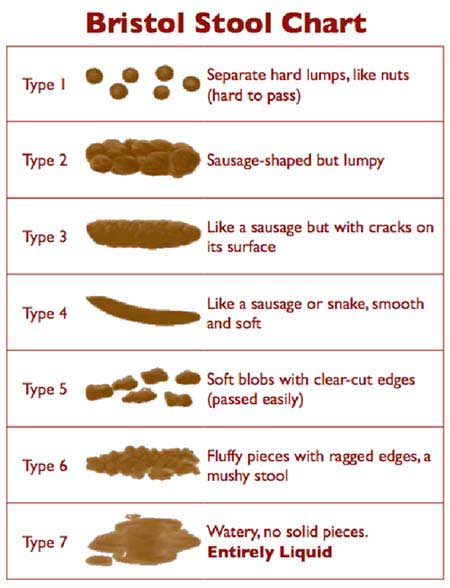
In 1997, Dr. Ken Heaton from the University of Bristol developed a
chart as a way for his patients to report the form and consistency of
their stool.21
The Bristol chart is now widely used and involves a 7-point scale
ranging from Type 1, indicating constipation, to Type 7, indicating
diarrhea. Types 3 and 4 are considered normal and ideal, while Types 6
and 7 point to inflammation.
The shape, color, diameter and texture of your stool are factors you
can use to gauge what’s going on. If it’s not ideal, pay attention to
the food you eat and how much water you're drinking. Good options for
increasing your fiber intake include organic psyllium, freshly ground
organic flaxseed and fruits and vegetables.
I recommend you shoot for 25 to 50 grams of fiber for every 1,000 calories you eat each day. You can also support the health of your intestinal microbiome by adding naturally fermented foods and/or a probiotic supplement. At the same time, you should avoid sugar, artificial sweeteners and processed foods.


No comments:
Post a Comment