Part of what
makes COVID-19 such a dangerous disease in severe cases is because it
can trigger a cytokine storm reaction leading to sepsis, organ failure
and death
Astaxanthin, a
potent antioxidant supplement derived from microalgae, has many health
effects that render it an ideal candidate as an adjunct therapy against
COVID-19
Astaxanthin is a
powerful antioxidant, immune booster, anti-inflammatory, neuroprotector
and immunomodulatory with antibacterial and anti-apoptotic effects
Astaxanthin
blocks oxidative DNA damage, lowers C-reactive protein and other
inflammation biomarkers, inhibits cell death in alveolar epithelial
cells, modulates the immune response and much more
Studies have
shown it alleviates cytokine storms, acute lung injury, acute
respiratory syndrome and sepsis, all of which are common in cases of
serious COVID-19 infection
Part of what makes COVID-19 such a
dangerous disease in severe cases is because it can trigger a cytokine
storm reaction leading to sepsis, organ failure and death.
I’ve written a number of articles discussing a variety of natural
supplements known to inactivate viruses, quell inflammation and
regulate the inflammatory process. Examples include vitamin C, melatonin and licorice root. You can find them all on my Coronavirus Resource Page.
Blocking Cytokine Storm Is Crucial
Most recently, the paper1
“COVID-19: Potential of Microalgae Derived Natural Astaxanthin as
Adjunctive Supplement in Alleviating Cytokine Storm,” published April
21, 2020, on the research library website SSRN, addresses the use of
astaxanthin, a potent antioxidant supplement derived from microalgae.
According to the authors:
“There is rationale, pre-clinical evidences of effectiveness and
evidence of safety from long-time use for other indications to justify
possible inclusion of natural astaxanthin as adjunctive in combination
with primary anti-viral drugs therapy will hugely benefit COVID-19
patients by improving their health and reducing recovery time …
Clinically, natural astaxanthin has shown diverse benefits with
excellent safety and reported to block oxidative DNA damage, lowered
C-reactive protein (CRP) and other inflammation biomarkers. Previous
studies reported that natural astaxanthin exert positive effects in
alleviating cytokine storm, acute lung injury, acute respiratory
syndrome, etc …
Current understandings based on accumulated evidences suggest
that SARS-CoV-2 induces a potential amplified inflammatory response to
sequential consequences of ALI [acute lung injury], ARDS [acute
respiratory distress syndrome] to a life-threatening dire consequence
of potential septic shock with elevated expression of inflammatory
related genes along with inevitable secondary infections, rather than
increased viral load …
The attenuation of the cytokine storm by targeting key steps in
the process may deliver improved outcomes … Shi et al. suggested a
two-phase approach for potential treatments of COVID-19 patients: the
first immune defense-based protective phase for non-severe COVID-19
cases and the second, inflammation-driven damaging phase for severe
COVID-19 patients.
Zhang et al. presented a critical review … stating that
blocking the cytokine storm at right time followed by initiation of
anti-inflammation therapy is very critical for reducing the rate of
fatalities. … A range of antioxidants as supplements will offer a window
of quick recovery of patients by reducing post treatment
side-effects.”
Rationale for Using Astaxanthin
The astaxanthin paper cites research showing astaxanthin “can play
major roles in regulating immunity and disease etiology” thanks to its
multifaceted activity. Not only is it a powerful antioxidant, but it’s
also an immune booster, anti-inflammatory, neuroprotector,
immunomodulator, antibacterial and anti-apoptotic. In terms of
antioxidant power, it’s thought to be the most potent available. As
noted in the astaxanthin paper:2
“The antioxidant activity of astaxanthin is reported to far
exceed the existing antioxidants with ROS- scavenging capacity of 6,000
times that of vitamin C, 800 times that of coenzyme Q10, 550 times
that of vitamin E, 200 times that of polyphenols, 150 times that of
anthocyanins, and 75 times that of α-Lipoic acid.”
Importantly, as explained in this paper, astaxanthin has a very
unique molecular structure that allows it to penetrate the bilayer
membrane of cells. The ability to quench reactive oxygen species (ROS)
and free radicals in both the inner and outer layers of the cellular
membrane allows it to provide superior protection against oxidative
stress, compared to other antioxidants. Vitamin E and beta-carotene, for example, only work in the inner side of the membrane, and vitamin C only works on the outer side.3 What’s more:
“The anti-oxidative effect of astaxanthin cooperates with its
anti-inflammatory actions by up-regulating anti- oxidative enzymes
(e.g. superoxide dismutase) and down-regulating pro-oxidative enzymes
(e.g. nitric oxide synthetase).
Astaxanthin is also known to protect pancreatic beta cells by
reducing oxidative stress and sugar toxicity, improve the levels
adiponectin and HDL, and enhances blood flow and circulation,” the authors state, adding:
“Increasing evidences indicate that dysregulation of cytokines
in acute inflammation is the most important step in mediating,
amplifying and perpetuating the process of sepsis or ALI …
The excessive release of various pro-inflammatory cytokines
mainly including TNF-α, IL-6, IL-1β, IL-12 and IL-8 rapidly initiate a
systemic inflammatory response leading to simulation of adaptive immune
response and cytokine storm resulting the acute cellular injury to
form sepsis or ALI.
These observations along with currently accumulating evidences
related to COVID-19, strongly suggest that the inflammatory process
involve in association with ARDS related ALI and sepsis.
This warrants that effective anti-oxidant and anti-inflammatory
treatments must be given strategically to treat COVID-19 patients ...
Anti-inflammatory / anti-oxidants candidates to intervene the
excessive production of cytokines, including IL6 and TNF-α can be a
promising strategy for the prevention and treatment of COVID-19 induced
ARDS related ALI and sepsis.”
According to the authors, astaxanthin may be uniquely suited for
this task. Astaxanthin, “with its proven anti-inflammatory and
anti-oxidant activity backed by multiple preclinical and human trials
and with its extraordinary safety profile can be one of the most
promising candidates to be tried against COVID-19,” they say.
Advertisement
How Astaxanthin May Inhibit SARS-CoV-2 Damage
The authors believe astaxanthin may help minimize the impact of SARS-CoV-2 infection by:4
Inhibiting nuclear factor kappa-B (NF-kB), a
transcription signaling pathway involved in the innate immune response.
This reduces the M1/M2 macrophage phenotype ratio, which is an important
part of lowering levels of inflammatory cytokines.
NF-kB is also a mediator of inflammation in acute lung injury, and
according to the authors, “Previous studies reported that the
anti-inflammatory effect of [astaxanthin] involves the suppression of
NFkB activation in ARDS”
Inhibiting production of IL6, a key culprit in sepsis, acute lung injury and ARDS
Inhibiting production of TNF-alpha, which decreases the levels of several proinflammatory cytokines
Inhibiting apoptosis (cell death) in alveolar epithelial cells
Increasing Sirtuin 1 (SIRT1), which according to the
authors “can play a vital role in proper regulation of SIRT1 to
attenuate lung injury and inflammation” in sepsis-induced acute lung
injury
Inhibiting the Toll-like receptor 4 (TLR 4)
signaling pathway, which reduces the pro-inflammatory response. As noted
by the authors, “TLRs are a group of pattern recognition receptors that
play a critical role in the innate immune system”
Decreasing alveolar wall swelling
Significantly inhibiting bronchial alveolar lavage fluid in acute lung injury and suppressing lung edema
Reducing the decline in pulmonary alveoli in lung tissue
Modulating the immune response by stimulating
lymphocyte proliferation (a type of white blood cell involved in
fighting infections), increasing natural killer cell cytotoxicity and
increasing the number of T cells and B cells (two major components of
your adaptive immune response)
Down-regulating NOD-like receptor 3 (NLRP3)
inflammasome — which is part of your innate immune response during lung
infection — and its downstream apoptosis and inflammatory response
Reducing C-reactive protein, a marker of inflammation
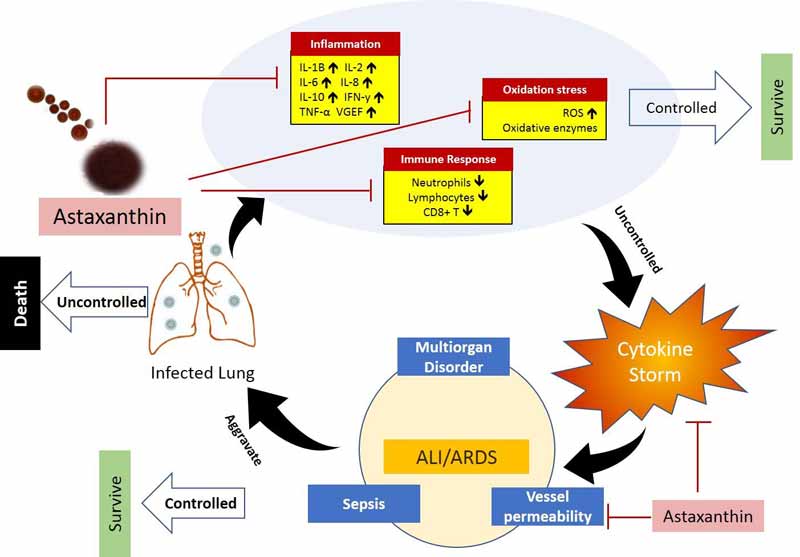
The following graph illustrates and summarizes the beneficial effects
of astaxanthin and how it can help quench the cytokine storm response
responsible for the sepsis, acute lung injury, ARDS and multiorgan
disorders often seen in patients with severe COVID-19 disease.
According to the authors:
“Taken together, we speculate that implications of astaxanthin
as adjunctive countermeasure in the treatment of COVID-19 may exert
dual purpose of both as antioxidant and anti-inflammatory compound with
beneficial outcome of reduce fatality and rapid recovery …"
Astaxanthin, One of Nature’s Most Powerful Antioxidants
In short, astaxanthin ticks many important boxes when it comes to
ameliorating COVID-19, including immune response regulation and the
enhancement of both cell-mediated and humoral immune responses, as well
as the simultaneous protection against oxidative damage and
inflammation.
Aside from being potentially useful against COVID-19 and other
respiratory illnesses, astaxanthin has also been shown to provide
broad-spectrum, systemwide health benefits, protecting against
radiation and promoting skin, eye, brain and heart health. To learn
more about this powerful antioxidant, see “Research on Astaxanthin Demonstrates Significant Whole Body Benefits.”


No comments:
Post a Comment