Facing an estimated 2,000 lawsuits, Purdue Pharma has announced the company is considering filing for bankruptcy protection
In an expanded
lawsuit against Purdue, the state of New York alleges Purdue has
fraudulently transferred funds into trusts and offshore accounts owned
by members of the Sackler family to shield assets from litigation
The New York
complaint, which names eight Sackler members as defendants, seeks to
return fraudulently transferred assets to the company to pay for its
liabilities
The complaint also alleges pharmaceutical distributors colluded with pharmacies to get around monthly opioid distribution limits
In March 2018,
Purdue Pharma reached a $270 million settlement with Oklahoma, about
$122.5 million of which are earmarked for the funding of a drug
addiction treatment center at Oklahoma State University that will study
opioid addiction and its treatment
In November 2016 then-U.S. Surgeon
General Dr. Vivek Murthy reported that 78 Americans were dying every
day from opioid overdoses — four times as many as in 1999.1
Requesting a nationwide call to action, Murthy asked the country to
shift away from current policies and approach the problem as a clinical
or public health issue, rather than a criminal one.2
As of June 2017, opioids had become the leading cause of death among Americans under the age of 50.3
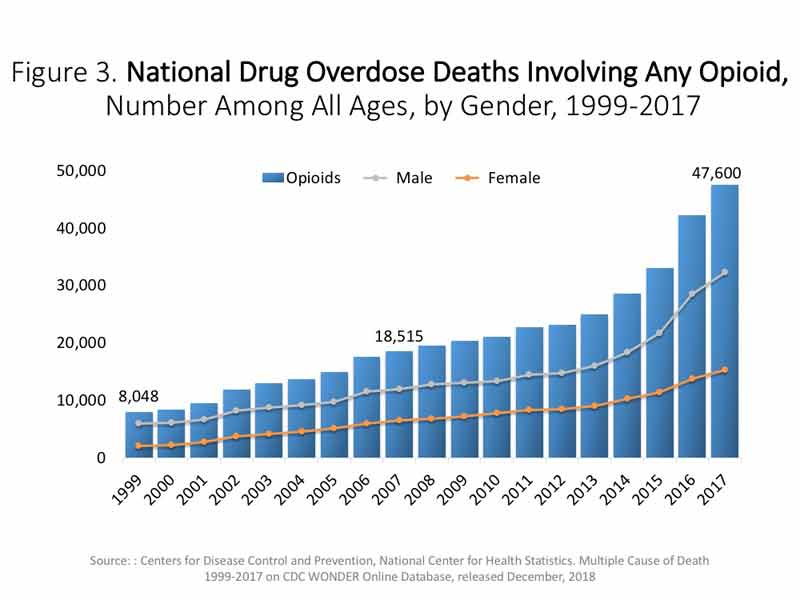
The following graph by the National Institute on Drug Abuse shows the
progressive incline in overdose deaths related to opioid pain
relievers between 1999 and 2017.4
This does not include deaths from heroin addiction, which we now
know is a common side effect of getting hooked on these powerful
prescription narcotics. Indeed, prescription opioids have become the
primary gateway drug to heroin5
and other illicit drug use, and prescription painkillers — not illicit
drugs — are among the most commonly misused drugs in the U.S.6,7
False Advertising Created the Opioid Crisis
In previous articles, I’ve discussed the role false advertising
played in the creation of this national disaster. To recap, a single
paragraph in a 1980 letter to the editor (not a study) in the New
England Journal of Medicine — which stated that narcotic addiction in
patients with no history of addiction was very rare — became the basis
of a drug marketing campaign that has since led to the death of hundreds of thousands of people.
In reality, opioids have a very high rate of addiction and have not been proven effective for long term use.8 According to The New England Journal of Medicine, opioids
have not been proven safe or effective beyond six weeks of treatment,
as most of the clinical trials with them have been less than that.9
“In fact, several studies have shown that use of opioids for chronic
pain may actually worsen pain and functioning, possibly by potentiating
pain perception,” the NEJM states.
The massive increase in opioid sales has been repeatedly blamed on
an orchestrated marketing plan aimed at misinforming doctors about the
addictive potential of these drugs. Purdue Pharma, owned by the Sackler family,
was one of the most successful in this regard, driving sales of
OxyContin up from $48 million in 1996 to $1.5 billion in 2002.10
Purdue’s sales representatives were extensively coached on how to
downplay the drug’s addictive potential, claiming addiction occurred in
less than 1 percent of patients being treated for pain.
Meanwhile, research11
shows addiction affects as many as 26 percent of those using opioids
for chronic noncancer pain, and 1 in 550 patients on opioid therapy
dies from opioid-related causes within 2.6 years of their first
prescription.
In 2007, Purdue Pharma paid $634.5 million in fines for fraudulently misbranding Oxycontin and suggesting it was less addictive and less abused than other painkillers.
The company was charged with using misleading sales tactics,
minimizing risks and promoting it for uses for which it was not
appropriately studied. More than a decade later, it’s become clear the
company did not learn its lesson or change its deceptive and dangerous
behavior.
Advertisement
Will Justice Catch Up With the Sackler Family?
In recent years, a number of states and municipalities have sued
Purdue Pharma over the role it played in the opioid crisis. In March
2018, the company reached a $270 million settlement with Oklahoma,
about $122.5 million of which are earmarked for the funding of a drug
addiction treatment center at Oklahoma State University12 that will study opioid addiction and its treatment.13
About $12.5 million will be dispersed to local governments to
address the opioid epidemic, while $60 million will cover the legal
fees incurred, Reuters reported. As part of the deal, Purdue has also
agreed to stricter limitations on how they market and sell opioids in
Oklahoma.14
When you consider Purdue has made an estimated $35 billion from
sales of OxyContin since its release in 1996, settlements of a few
hundred million dollars is still akin to a slap on the wrist.
Originally, Oklahoma had sought damages in excess of $20 billion.
According to Reuters, Purdue Pharma still faces some 2,000 other lawsuits,15
and in the face of this flood of legal action, Purdue’s chief executive
has announced the company is considering filing for bankruptcy
protection — a common tactic aimed at stemming the flow of lawsuits —
and according to news reports, the possibility of bankruptcy was a
significant factor in the company’s negotiations with Oklahoma.
The state wanted to strike a deal to ensure some form of
compensation, even if it meant agreeing to a much lower amount.
However, mere days later, Purdue was struck by another legal twist;
this time by the state of New York, which alleges the company has
fraudulently transferred funds into trusts and offshore accounts owned
by members of the Sackler family in an effort to shield assets from
litigation.16,17,18
Eight Sacklers Named in Expanded New York Lawsuit
As reported by Reuters:19
“New York Attorney General Letitia James made the claims in a
revised lawsuit already pending against Purdue over its role in the
opioid epidemic that added members of the Sackler family and other drug
manufacturers and distributors as defendants …
In her lawsuit, James accused Purdue of seeking to ‘intimidate’
states pursuing lawsuits against it by threatening bankruptcy, which
would hinder their cases and limit their ability to recover damages.
Yet James said Purdue, which is fighting lawsuits by 34 other
states and hundreds of localities, has continued in the face of its
liabilities to pay millions of dollars to the Sacklers. The lawsuit
argued Purdue was either insolvent or near insolvency when it
transferred those funds, making the transfers illegal under New York
law.”
In all, eight Sackler members are now named as defendants in New
York’s expanded lawsuit: Richard, Jonathan, Mortimer, Kathe, David,
Beverly, Theresa and Ilene Sackler Lefcourt. 20
The lawsuit seeks to return fraudulently transferred assets to the
company and prevent the Sacklers from transferring assets to other
entities so they don’t lose them in their eventual bankruptcy. It also
seeks to strip all listed defendants of their drug licenses and bar
them from marketing and distributing painkillers in New York until or
unless they agree to abide by stricter rules.21
According to the complaint, pharmaceutical distributors, including
Cardinal Health, McKesson, Amerisource Bergen and Rochester Drug,
colluded with pharmacies to avoid raising red flags indicating drug
misuse by warning the pharmacies when they were nearing their monthly
opioid limit, and then manipulating the timing and volume of orders to
get around the limits.
The complaint also charges Purdue with secretly setting up a new
company, Rhodes Pharma, in 2007 while the company was being
investigated by federal prosecutors, as a way to protect the Sacklers
from the mounting OxyContin crisis and continue their profit scheme.22
Rhodes Pharma makes generic opioids, allowing the Sacklers to
benefit from the opioid epidemic both in terms of brand name sales and
generic sales.23 Between 2009 and 2016, Rhodes’ market share of opioid sales exceeded that of Purdue itself.24
Massachusetts Lawsuit Reveals Inner Workings of Purdue’s Efforts to Maintain Profits
Rhodes Pharma and Richard Sackler also hold the patent to a new,
faster-dissolving form of buprenorphine, a mild opioid drug used in the
treatment of opioid addiction,25
allowing the Sacklers to further profit from the addiction crisis they
helped instigate, the economic burden of which is costing the U.S. an
estimated $504 billion a year.26
Indeed, according to a lawsuit filed in Massachusetts,27
Purdue Pharma and the Sacklers sought to increase opioid prescriptions
while simultaneously developing overdose treatment to boost its
profits.
The complaint quotes emails and internal documents alleging Kathe
Sackler concluded opioid addicts were their next big business
opportunity. Purdue identified eight ways the company's experience in
getting patients on opioids could now be used to sell treatment for
addiction.28
Released unredacted files reveal Kathe Sackler's involvement in
“Project Tango” — a secret plan to shift the blame of addiction from
opioid makers and distributors to the patients themselves.29
A recent article30
in The New York Times discusses Project Tango, noting that together,
the two lawsuits by Massachusetts and New York “lay out the extensive
involvement of a family that has largely escaped personal legal
consequences for Purdue Pharma’s role in an epidemic that has led to
hundreds of thousands of overdose deaths in the past two decades.”
Internal documents unearthed during these legal proceedings include
charts and diagrams illustrating “the business potential of adding
addiction treatment to the mix,” The New York Times writes. Such
documents have led to members of the Sackler family being added to
lawsuits against the company not only in New York and Massachusetts,
but also in Connecticut, Rhode Island and Utah. As noted by The New
York Times:31
“The suits are not only an effort to get at the Sacklers’
personal fortunes — estimated by Forbes to be $13 billion — but to
expose the extent to which the Sacklers themselves have been calling the
shots.
‘If these allegations against the Sacklers are proven to be
correct, that could dramatically change the potential reach of where
the litigation goes to collect funds on behalf of the cities and states
that are so desperately trying to get money to deal with the opioid
crisis,’ said Adam Zimmerman, an expert on complex litigation at Loyola
Law School in Los Angeles …
Purdue temporarily abandoned plans to pursue Project Tango in
2014, but revived the idea two years later, this time pursuing a plan
to sell naloxone, an overdose-reversing drug, according to the
Massachusetts filing. A few months later, in December 2016, Richard,
Jonathan and Mortimer Sackler discussed buying a company that used
implantable drug pumps to treat opioid addiction.
In recent years, the Sacklers and their companies have been
developing products for opioid and overdose treatment on various
tracks.”
One of those tracks is Rhodes’ buprenorphine. In March 2019, the
FDA granted fast-track status to injectable nalmefene hydrochloride
developed by Purdue32
— a drug used for the emergency treatment of known or suspected opioid
overdose said to have a longer duration of effect than naloxone. Purdue
Pharma has also contributed $3.4 million to a company working on the
production of a low-cost naloxone nasal spray as a cheaper opioid
overdose antidote.33
Purdue Has Recklessly Ignored Harm to Patients
The Massachusetts complaint goes on to allege the Sackler family
discussed threats to their finances as data from long-term opioid use
indicated danger to patients. Sales dropped and the staff recommended
increasing the number of sales visits to doctors.
The company hired global consulting firm McKinsey & Company to
recommend strategies to boost sales and polish the image of the
company, in order to offset emotional messages from mothers whose
children had overdosed.34
McKinsey allegedly urged Purdue to direct sales reps at the most
prolific opioid prescribers, “because prescribers in the most prolific
group wrote 25 times more OxyContin scripts than the less prolific
prescribers.”35
This group of physicians were classified as “Super Core.” Purdue
allegedly ordered sales reps to make visits to these prescribers every
week.
The complaint claims that within the notes of the sales reps are
recorded more than 1,000 visits to providers, in which the reps
recommended pitching opioids to elderly patients with ailments such as
arthritis. The complaint goes on to describe how the consulting firm
recommended sales reps convince doctors to prescribe opioids:36
“McKinsey had reported to Purdue on opportunities to increase
prescriptions by convincing doctors that opioids provide ‘freedom’ and
‘peace of mind’ and give patients ‘the best possible chance to live a
full and active life.’ McKinsey also suggested sales ‘drivers’ based on
the ideas that opioids reduce stress and make patients more optimistic
and less isolated.”
In other words, Purdue appears to still be filling doctors’ heads
with misinformation about opioids in order to drive sales, even as
people are dying from overdoses in droves. I guess a shift to killing
the elderly could help hide the massacre taking place, but just because
someone is old does not make shortening their life any less heinous.
Struggling With Opioid Addiction? Please Seek Help
Regardless of the brand of opioid, it's vitally important to realize
they are extremely addictive drugs and not meant for long-term use for
nonfatal conditions. Chemically, opioids are similar to heroin.
If you wouldn't consider shooting up heroin for a toothache or
backache, seriously reconsider taking an opioid to relieve this type of
pain.
The misconception that opioids are harmless pain relievers has
killed hundreds of thousands, and destroyed the lives of countless
more. In many cases you’ll be able to control pain without using
medications.
In my previous article, “Billionaire Opioid Executive Stands to Make Millions More on Patent for Addiction Treatment,”
I discuss several approaches — including nondrug remedies, dietary
changes and bodywork interventions — that can be used separately or in
combination to control pain, both acute and chronic.
If you've been on an opioid for more than two months, or if you find
yourself taking a higher dosage, or taking the drug more often, you
may already be addicted. Resources where you can find help include the
following. You can also learn more in “How to Wean Off Opioids.”


No comments:
Post a Comment