On the Brink with Russia in Syria Again, 5 Years Later
By Ray McGovern
Consortiumnews.com
Consortiumnews.com
September 13, 2018
The New York Times,
on September 11, 2013, accommodated Russian President Vladimir V.
Putin’s desire “to speak directly to the American people and their
political leaders” about “recent events surrounding Syria.”
Putin’s op-ed in the Times appeared under the title: “A Plea for Caution From Russia.” In
it, he warned that a military “strike by the United States against
Syria will result in more innocent victims and escalation, potentially
spreading the conflict far beyond Syria’s borders … and unleash a new
wave of terrorism. … It could throw the entire system of international
law and order out of balance.”
Three weeks before Putin’s piece, on August 21, there
had been a chemical attack in the Damascus suburb of Ghouta and Syrian
President Bashar al-Assad was immediately blamed. There soon emerged,
however, ample evidence that the incident was a provocation to bring
direct U.S. military involvement against Assad, lest Syrian government
forces retain their momentum and defeat the jihadist rebels.
In a Memorandum for President Barack Obama five days
before Putin’s article on September 6, the Veteran Intelligence
Professionals for Sanity (VIPS) had warned President Barack Obama of the likelihood that the incident in Ghouta was a false-flag attack.
 War is a Racket: The A...
Best Price: $6.45
Buy New $2.53
(as of 02:45 EDT - Details)
War is a Racket: The A...
Best Price: $6.45
Buy New $2.53
(as of 02:45 EDT - Details)

Despite his concern of a U.S. Attack, Putin’s main message in his Op-Ed was positive, talking of a growing mutual trust:
War is a Racket: The A...
Best Price: $6.45
Buy New $2.53
(as of 02:45 EDT - Details)
“A new opportunity to avoid military action has emerged in the past few days. The United States, Russia and all members of the international community must take advantage of the Syrian government’s willingness to place its chemical arsenal under international control for subsequent destruction. Judging by the statements of President Obama, the United States sees this as an alternative to military action. [Syria’s chemical weapons were in fact destroyed under UN supervision the following year.]
“I welcome the president’s interest in continuing the dialogue with Russia on Syria. We must work together to keep this hope alive … and steer the discussion back toward negotiations. If we can avoid force against Syria, this will improve the atmosphere in international affairs and strengthen mutual trust … and open the door to cooperation on other critical issues.”
Obama Refuses to Strike
In a lengthy interview with journalist Jeffrey Goldberg published in The Atlantic much
later, in March 2016, Obama showed considerable pride in having refused
to act according to what he called the “Washington playbook.”
He added a telling vignette that escaped appropriate
attention in Establishment media. Obama confided to Goldberg that,
during the crucial last week of August 2013, National Intelligence
Director James Clapper paid the President an unannounced visit to
caution him that the allegation that Assad was responsible for the
chemical attack in Ghouta was “not a slam dunk.”
Clapper’s reference was to the very words used by
former CIA Director George Tenet when he characterized, falsely, the
nature of the evidence on WMD in Iraq while briefing President George W.
Bush and Vice President Dick Cheney in December 2002. Additional
evidence that Ghouta was a false flag came in December of 2016
parliamentary testimony in Turkey.
In early September 2013, around the time of Putin’s Op-Ed, Obama
resisted the pressure of virtually all his advisers to launch cruise
missiles on Syria and accepted the Russian-brokered deal for Syria give
up its chemical weapons. Obama had to endure public outrage from those
lusting for the U.S. to get involved militarily. From neoconservatives,
in particular, there was hell to pay.Atop the CNN building in Washington, DC, on the evening of September 9, two days before Putin’s piece, I had a fortuitous up-close-and-personal opportunity to watch the bitterness and disdain with which Paul Wolfowitz and Joe Lieberman heaped abuse on Obama for being too cowardly to attack.
Five Years Later
In his appeal for cooperation with the U.S., Putin had written these words reportedly by himself:
 A Peace to End All Pea...
Best Price: $5.38
Buy New $14.07
(as of 09:45 EDT - Details)
A Peace to End All Pea...
Best Price: $5.38
Buy New $14.07
(as of 09:45 EDT - Details)
“My working and personal relationship with President Obama is marked by growing trust. I appreciate this. I carefully studied his address to the nation on Tuesday. And I would rather disagree with a case he made on American exceptionalism, stating that the United States’ policy is ‘what makes America different. It’s what makes us exceptional.’ It is extremely dangerous to encourage people to see themselves as exceptional, whatever the motivation. There are big countries and small countries, rich and poor, those with long democratic traditions and those still finding their way to democracy. Their policies differ, too. We are all different, but when we ask for the Lord’s blessings, we must not forget that God created us equal.”
In recent days, President Donald Trump’s national
security adviser, John Bolton, has left no doubt that he is the mascot
of American exceptionalism. Its corollary is Washington’s “right” to
send its forces, uninvited, into countries like Syria.
“We’ve tried to convey the message in recent days
that if there’s a third use of chemical weapons, the response will be
much stronger,” Bolton said on Monday. “I can say we’ve been in
consultations with the British and the French who have joined us in the
second strike and they also agree that another use of chemical weapons
will result in a much stronger response.”
As was the case in September 2013, Syrian government
forces, with Russian support, have the rebels on the defensive, this
time in Idlib province where most of the remaining jihadists have been
driven. On Sunday began what could be the final showdown of the
five-year war. Bolton’s warning of a chemical attack by Assad makes
little sense as Damascus is clearly winning and the last thing Assad
would do is invite U.S. retaliation.
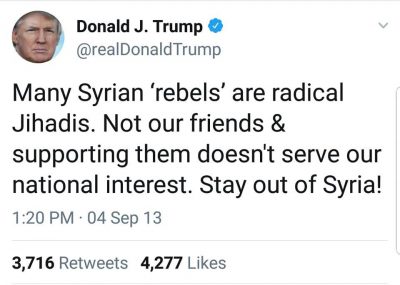
In September 2015 Trump accused his
Republican primary opponents of wanting to “start World War III over
Syria. Give me a break. You know, Russia wants to get ISIS, right? We
want to get ISIS. Russia is in Syria — maybe we should let them do it?
Let them do it.”
Last week Trump warned Russian and Syria not to
attack Idlib. Trump faces perhaps his biggest test as president: whether
he can resist his neocon advisers and not massively attack Syria, as
Obama chose not to, or risk the wider war he accused his Republican
opponents of fomenting.
Reprinted with permission from Consortiumnews.com.
No comments:
Post a Comment