1.2 Million-Person Study Shows How Much Exercise You Need to Benefit Mental Health from Dr. Mercola
1.2 Million-Person Study Shows How Much Exercise You Need to Benefit Mental Health from Dr. Mercola
September 06, 2018
Story at-a-glance
Exercise three to five days a week for 45 minutes is the “sweet spot” that leads to the greatest mental health gains
Going beyond
this and exercising for more than five days a week or for more than 90
minutes per session was linked to worse mental health
On average,
people reported 3.5 days of “not good” mental health during the month,
but among those who exercised, that number dropped to two
All types of
exercise improved mental health, including that from housework, lawn
mowing, child care and fishing, but three stood out above the rest in
terms of offering the greatest mental health gains: team sports, cycling
and aerobic and gym activities
By Dr. Mercola
It’s no secret that exercise is beneficial for your physical and
mental health. Less clear, however, is how much exercise it takes to
achieve meaningful benefits. Increasingly, we’re seeing that less is
more when it comes to exercise, provided it’s done correctly and at
high enough intensity.
The latest research, published in The Lancet Psychiatry, seems to
confirm this, finding that exercise three to five days a week for 45
minutes is the “sweet spot” that leads to the greatest mental health
gains.1
Going beyond this and exercising for more than five days a week or for
more than 90 minutes per session was actually linked to worse mental
health.
The Exercise ‘Sweet Spot’ to Better Mental Health
In a large study involving 1.2 million U.S. adults, participants
reported their activity levels for one month along with rating their
mental well-being. On average, people reported 3.5 days of “not good”
mental health during the month, but among those who exercised, that
number dropped to two.
All types of exercise improved mental health, including that from
housework, lawn mowing, child care and fishing, but three stood out
above the rest in terms of offering the greatest mental health gains:
team sports, cycling and aerobic and gym activities. Team sports may
have earned top ranking because they offer social connections on top of
exercise, further boosting mental health and resilience.
“In a large U.S. sample, physical exercise was significantly and
meaningfully associated with self-reported mental health burden in the
past month. More exercise was not always better,” researchers wrote, noting again that, “The
largest associations [between exercise and mental well-being] were
seen for … durations of 45 min[utes] and frequencies of three to five
times per week.”2
Those with existing mental health issues, namely depression,
also saw greater gains from exercise. While those who did not exercise
experienced 11 days of poor mental health a month, on average, those
who did exercise cut that number to seven days. The researchers were
also sure to point out that exercising too much could backfire.
Adam Chekroud, study author and assistant professor of psychiatry at
Yale University, told BBC News, "Previously, people have believed
that the more exercise you do, the better your mental health, but our
study suggests that this is not the case. Doing exercise more than 23
times a month, or exercising for longer than 90-minute sessions is
associated with worse mental health."3
Why Exercise Can Boost Your Mental Well-Being
Exercise makes you feel good, both in the short and long term.
During and after exercise, a neurotransmitter called anandamide is
produced in your brain. There’s a reason why this word is a derivative
of the Sanskrit word “bliss” — it blocks feelings of pain and
depression, temporarily.
A deficiency of anandamide is associated with anxiety and stress,4 and the neurotransmitter may also be involved in producing the euphoric feelings, or “runner’s high,” many people experience after exercise.5
Exercise also boosts levels of potent brain chemicals like serotonin,
dopamine and norepinephrine, which may help buffer some of the effects
of stress.
Also intriguing, exercise has been found to create new neurons designed to release the GABA neurotransmitter, which inhibits excessive neuronal firing, helping to induce a natural state of calm.6 There are indirect benefits of exercise that may also improve your mood, namely:
Lower risk of diseases like Type 2 diabetes, heart disease and cancer
Writing in The Primary Care Companion to the Journal of Clinical Psychiatry, researchers further noted:7
“[Exercise-related] improvements in mood are proposed to be
caused by exercise-induced increase in blood circulation to the brain
and by an influence on the hypothalamic-pituitary-adrenal (HPA) axis
and, thus, on the physiologic reactivity to stress.
This physiologic influence is probably mediated by the
communication of the HPA axis with several regions of the brain,
including the limbic system, which controls motivation and mood; the
amygdala, which generates fear in response to stress; and the
hippocampus, which plays an important part in memory formation as well
as in mood and motivation.”
Exercise Can Slash Your Risk of Depression
Exercise, even in small amounts, acts as an antidote to depression
for many people. In an 11-year study, people who engaged in regular
leisure-time exercise for one hour a week were less likely to become
depressed. On the flipside, those who didn’t exercise were 44 percent
more likely to become depressed compared to those who did so for at
least one to two hours a week.8
“The majority of this protective effect occurred at low levels of
exercise and was observed regardless of intensity,” the researchers
said, adding that, “assuming the relationship is causal, 12 percent of
future cases of depression could have been prevented if all
participants had engaged in at least one hour of physical activity each
week.”9
In 2013, a meta-analysis published in the Cochrane Database of
Systematic Reviews also found that exercise is moderately more
effective than a control intervention, which in some cases was
pharmaceuticals, for reducing symptoms of depression.10
Separate research published in the American Journal of Preventive
Medicine found that aerobic exercise “at a dose consistent with public
health recommendations” is an effective treatment for mild to moderate
depression.11
In addition to aerobic activity, mind-body exercise like yoga
has also shown promise. For instance, Iyengar yoga, which focuses on
detail and precise alignment of posture combined with deep breathing,
reduces symptoms of depression in those who are not taking medication
or who have been taking the same medication for at least three months.12 Strength training
can also relieve depression. A meta-analysis of 33 trials involving
nearly 2,000 people showed that strength training led to a significant
reduction in depressive symptoms.13
According to the study's lead author, Brett Gordon, a postgraduate
researcher in the department of physical education and sports sciences
at the University of Limerick in Ireland, the greatest improvements
were seen among people with symptoms of mild to moderate depression, as
opposed to those without depression, which suggests strength training
may be most effective for people with greater depressive symptoms.
Gordon noted in an email to Time that it may improve depressive symptoms as well as antidepressants and behavioral therapies.14
Many different strength training programs turned out to be
beneficial, so Gordon recommended strength training for two days a week,
with eight to 12 repetitions of eight to 10 strength-training
exercises, to boost mental health, which are the guidelines suggested
by the American College of Sports Medicine.
Mental Illness May Hinder Motivation to Exercise
Beyond giving your mood a superficial boost, it’s known that
exercise can improve health outcomes in people with severe mental
illness. However, those in this population often have low levels of
physical activity. Researchers conducted a study to determine what was
motivating, or hindering, people with mental illness in regard to
exercise.15
Health and well-being were noted as top motivators, especially
losing weight, improving mood and reducing stress. In a catch-22, low
mood and stress were the most common barriers identified that were
keeping people from exercising. Lack of support was also mentioned by
about half of the participants.
“Many of the desirable outcomes of exercise for people with SMI
[severe mental illness], such as mood improvement, stress reduction and
increased energy, are inversely related to the barriers of depression,
stress and fatigue which frequently restrict their participation in
exercise,” the researchers noted.16
Finding and maintaining the motivation to exercise
is therefore crucial to gleaning its benefits, physical and mental
alike. Dan Ariely, Ph.D., professor of psychology and behavioral
economics at Duke University, has conducted research showing that most
people are more motivated by the intrinsic value of what you’re
creating than the extrinsic benefits you may experience.
Yet, most people anticipate how hard the workout will be, and most
focus on external reasons to exercise — such as better health, toned
body and slowed aging process. Ariely believes the mistake being made
is that value is being placed on extrinsic incentives, like your health
and fitness goals, instead of on the immediate experience of boosting
your mood during exercise.17
The solution, then, may be to focus on how good exercise will make
you feel in the immediacy, placing less emphasis on its longer-term
benefits.
Other common sense tips to increase your motivation to exercise including working out with a buddy
and making exercise into a habit that’s automatically triggered by a
cue, such as hearing your morning alarm and heading for the gym first
thing in the morning without even thinking about it (pack your gym bag
the night before).
Try This Four-Minute Workout to Boost Your Mood Right Now
The more you exercise, the more you’ll likely want to do it, as the
mental health gains will be fresh in your mind. Ideally, engage in a
comprehensive exercise routine that incorporates high-intensity interval training (HIIT) with strength training, flexibility work, core work and regular walking.
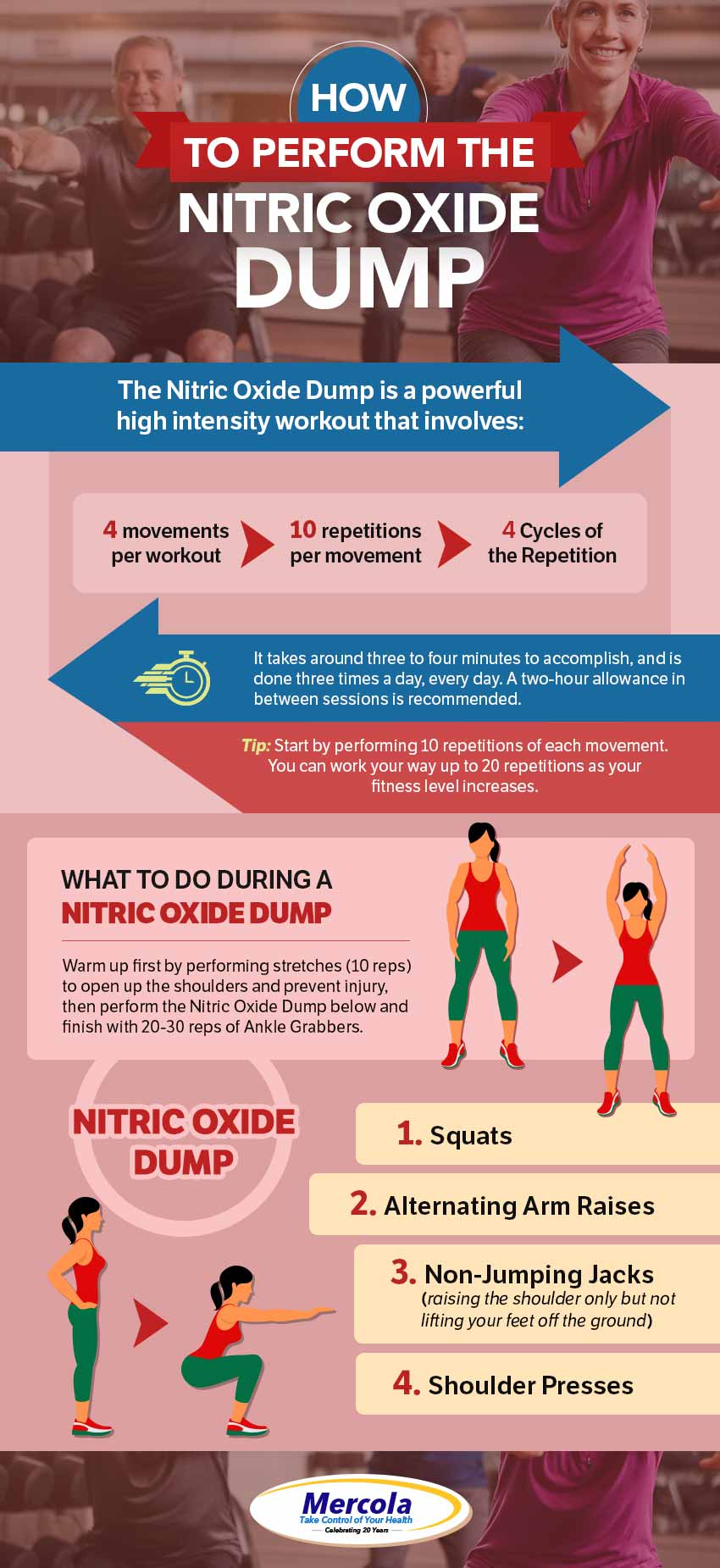
You can also take an extra three to four minutes and engage in the Nitric Oxide Dump,
one of the best (and quickest) workouts to stimulate your body’s
release of nitric oxide (NO), improving your mitochondrial health,
slowing down age-related muscle decline and boosting heart health and
mental health, right now.
I typically do a modified version of the Nitric Oxide Dump workout
developed by Dr. Zach Bush. There are only four movements to learn, and
make sure you're breathing through your nose and not your mouth, as your nose regulates more than 30 physical processes, including the release of NO.
Start with four sets of 10 repetitions, moving to 20 repetitions as
your fitness level increases. You can also add in weights (I use
8-pound weights) as you progress, but most people will want to start
without weights initially. Do this workout three times a day, with a
minimum of two hours between each workout. Form is everything, so be
sure you carry out each movement correctly, even if you need to go at a
slower pace at first. Squats (10)
Begin by standing with your feet hip-width apart, feet parallel,
toes pointing forward and the weight of your body distributed evenly
between your heels and the ball of your foot.
Perform 10 squats in rapid sequence, keeping your quadriceps
engaged. Your butt should move back as though you’re going to sit in a
chair while your arms move forward for balance. You can do a shallower
squat if you have knee or back pain.
Alternating Arm Raises (10)
Alternate swinging your arms at a 90-degree angle
Keep your form tight and avoid keeping your muscles controlled, avoiding swinging your arms too high or too low
This will work a number of muscles in your deltoids, which are the
rounded, triangular-shaped muscles on the uppermost part of your arm
and the top of your shoulder. Non-Jumping Jacks (10)
Begin standing straight with your arms down, fists touching in front of your pelvis.
Use a broad rotation, circle your arms upward on each side to touch your fists over your head.
Circle back down to hit your fists at the bottom and repeat 10 times.
If you have shoulder problems with your rotator cuffs, try this variation instead:
Start with your hands at a prayer position in front of your chest.
Keep your hands pressed together lightly as you extend them above your head.
Circle your arms out to the sides to release before bringing them back to the prayer position. Repeat 10 times.
Shoulder Presses (10)
Bring fists above your shoulders on each side of your head, elbows bent.
Extend your arms straight above your head.
Return to position with fists just over your shoulders and repeat 10 times.
When you’re done, you should feel your fingertips tingling, and this
is a great sign because it means nitric oxide is freely flowing
through your body. For quick reference, the below infographic gives you
all the details on how to perform the Nitric Oxide Dump workout. Try
it now to give your mind and body an immediate pick-me-up.


No comments:
Post a Comment