In the Wake of Fukushima: Japan’s Dangerous Nuclear Waste on the Cutting Board. Towards a Renewables Future?


Japan’s Abe Shinzo government is
commonly held to be in thrall to nuclear power, not least because it
came into office in December 2012 committed to nuclear restarts and
other policies promoted by the nuclear village. Yet clearly much has
changed over the past three years. The Abe government’s repositioning on
energy is evident in an accelerating shift away from support for the
nuclear village, in spite of a few restarts, and towards an increasingly
impressive commitment to energy efficiency and renewable energy. The
evidence is striking: On top of proposing massive increases in its
fiscal 2016 expenditures on energy efficiency and renewables, which we
reviewed in October,1 the cabinet is about to
undertake an administrative review targeting billions of yen in
controversial nuclear-related expenditures.
Specifically, from November 11 to 13,
2015 Japan will undergo an administrative review of YEN 13.6 trillion
worth of expenditure requests in the over YEN 102 trillion proposed
budget for fiscal 2016. This “Fall Review” (Aki no rebyuu) will be open to the public and broadcast online, as was the case with previous administrative review processes.2
But among the many unusual aspects of this year’s initiative is that
the review will be overseen by the resolutely antinuclear Liberal
Democratic Party cabinet minister (since October 7, 2015) Kono Taro.
Kono’s team of outside advisors will
also include such explicitly antinuclear experts as the Japan Renewable
Energy Foundation’s (JREF) Director Ohbayashi Mika3 and JREF Senior Research Fellow, Fujitsu Research Institute Research Fellow and Tsuru University Professor Takahashi Hiroshi.4
Kono and his colleagues in the LDP have been working hard in advance of
the review to draw attention to its focus on nuclear-related
expenditures, resulting in significant and steadily increasing press
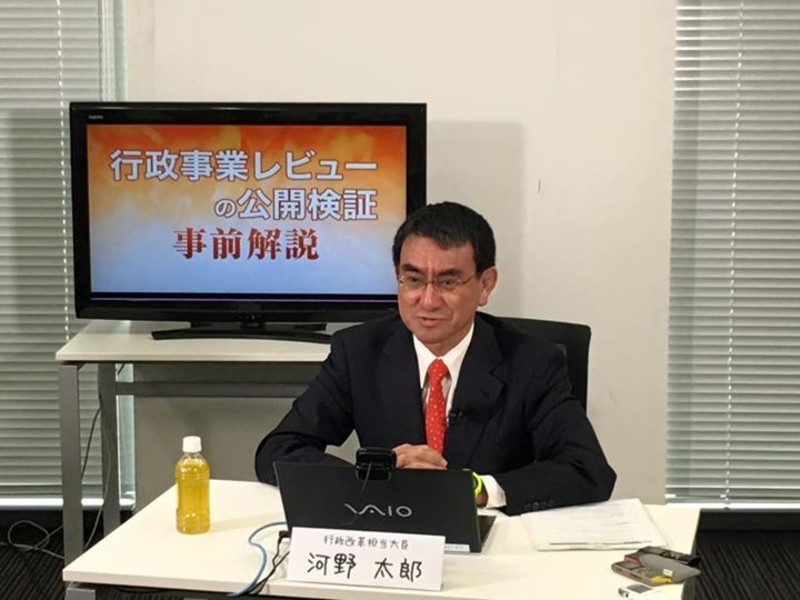
coverage. In addition, Kono has taken the apparently unprecedented step
of producing a 1-hour video, released on November 9, to explain the
process and its focus on nuclear-related expenditures. He prefaces his
detailed arguments about the content of the review with (at the 5:50
mark) an unambiguous declaration that he not only cleared the substance
of the review with Prime Minister Abe, but also received the latter’s
encouragement.5
 |
 |
 |
| Kono Taro explains his review | Ohbayashi Mika | Takahashi Hiroshi |
The Administrative Review
These “Fall Review” procedures were
initiated by the Democratic Party of Japan Government, in 2010. They
also matter, as is evident from the fact that the Fall Review of 2014
(for the FY 2015 budget) resulted in over YEN 360 billion in cuts and
repayments to public funds.6 The previous year had seen even deeper cuts, amounting to roughly YEN 500 billion in expenditure reductions.7
Of the Japanese central government’s
over 5000 spending programs, 55 have been chosen for this year’s review.
While that number may seem small, as noted earlier these programs total
over YEN 13.6 trillion and thus represent over 10% of the proposed YEN
102 trillion fiscal appropriations for the 2016 budget. Given that
Japan’s public debt load of 226% of GDP is unprecedented in the history
of the OECD,8 the pressure for cuts is likely to be
stronger than in previous years. Particularly significant is the fact
that the items slated for review are heavily oriented towards energy.
Indeed, fully 24 of the 55 items are energy- and environment-related,
and the vast majority of those are devoted to nuclear facilities as well
as to measures related to achieving the recycling of nuclear waste in
breeder reactors.9
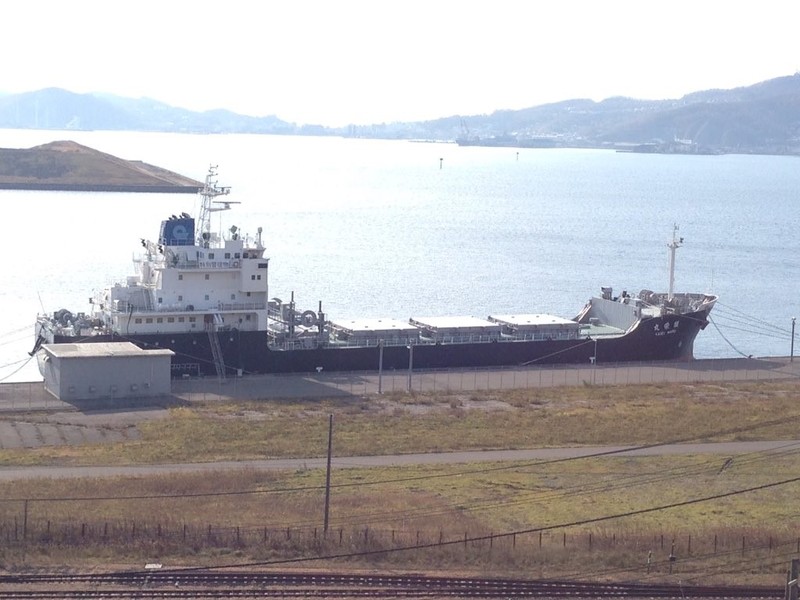 The Nuclear Fuel Carrier Kaieimaru The Nuclear Fuel Carrier Kaieimaru |
One target that is ripe for scrutiny is
the Kaieimaru, a nuclear fuel ship built in 2006 and used four times to
transport a total of 16 tonnes of spent fuel to the Tokai Mura facility10
in Ibaragi Prefecture. Since the vessel has not been used to transport
fuel since its most recent trip in 2009, Kono has included it in the
review. Between 2010 and 2014, the cost of its upkeep totalled just
under YEN 5.8 billion, and its projected costs to 2031 would see an
additional YEN 18.1 billion spent on it. The ship has been featured in
recent television broadcasts, including a TBS broadcast on November 9,
and has featured in the Japanese Wall Street Journal,11 the Tokyo Shimbun,12 and other national and local press. Kono has skillfully chosen a striking symbol of extravagance for review.
An additional nuclear-related facility
targeted by Kono’s review is the “Recycle Equipment Test Facility
(RETF).” This is yet another costly and risky element of Japan’s very
controversial accumulation of infrastructures and programs to reprocess
spent nuclear fuel. The RETF’s construction began in January 1995, and
has received tens of billions of yen worth of investment even though it
has not been used. Precisely 20 years ago, Shaun Burnie, Senior nuclear
campaigner with Greenpeace Germany, warned that the true importance of
the RETF, and the great risk that it poses: “is that it and the
facilities that will follow will give Japan access to plutonium that is
even purer than weapons-grade. The reason for this is that the plutonium
produced in the uranium blanket of FBRs (ed. “fast breeder reactors”)
and reprocessed by the operators is what is called supergrade. With a
large-scale deployment of FBRs in Japan, and the reprocessing facilities
to support the reactors, large quantities of weapons grade material
will be available for non-peaceful use.”13
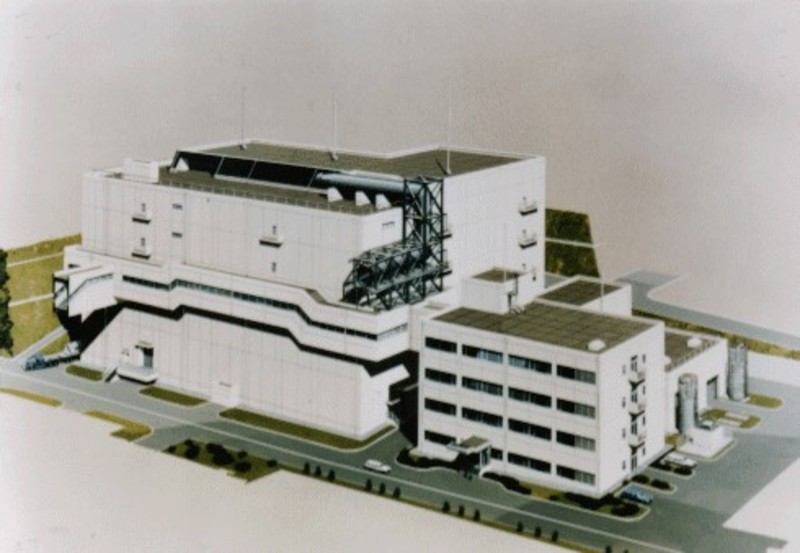 Japan’s “Recycle Equipment Test Facility Japan’s “Recycle Equipment Test Facility |
In their 2010 book In Defence of Japan: From the Market to the Military and Space Policy,
Saadia M. Pekkanen (Professor, University of Washington) and Paul
Kallender-Umezu (PhD Candidate, Keio University) cite Burnie, showing
that his concern remains quite relevant. Indeed, they add to the warning
by emphasizing that “the point about supergrade plutonium is that very
little is required to produce nuclear warheads (possibly 800 to 900
grams); it is thus especially suitable for miniaturized nuclear warheads
like MRIV-type ICBMs.14
The above examples are especially
noteworthy, but are only two of the nuclear–related items up for
consideration in this administrative review. Others include subsidies
for securing uranium from overseas projects, storing the uranium,
locating and constructing nuclear facilities, as well as funds for PR
supporting nuclear power in the Japanese public debate.15
What is almost as impressive as the
focus on nuclear is the complete absence of any targeting of expenditure
programs for efficiency and renewables. Japan’s FY 2016 budget
allocations for these items show dramatic increases over the current
fiscal year. So one would hardly be surprised to see at least a couple
of renewable-related programs put on the table, if only to placate the
presumably outraged nuclear interests. But the only clearly non-nuclear
energy programs included in the review relate to carbon-capture and
storage (CCS). And if putting CCS on the block indicates that Japan is
backing away from coal, that is another reason for applause.
Let us conclude with a note on Kono
Tarohimself. He is a major figure in the Liberal Democratic Party, first
elected in 1996. Like many LDP members, he comes from a family of
politicians. But unlike most LDP politicians, he is resolutely
antinuclear and is a strong internationalist. His website comes with Korean and Chinese versions as well as an English version.
In the wake of March 11, 2011 (3-11)
natural and nuclear disasters, centred on the Fukushima Daiichi plant,
Kono became well-known among international observers as a strong
opponent of the domestic nuclear village and its plans to increase
Japan’s dependence on nuclear to over 50% of power by 2030 as well as
recycle waste in breeder reactors.
In addition to numerous public
appearances, books, and interviews in which he was critical of the
nuclear village and its dominance of the Japanese power industry, he
maintained a blog with regular contributions critical of the Fukushima
incident and its aftermath. He also criticized the Abe government’s
efforts to restart nuclear reactors.
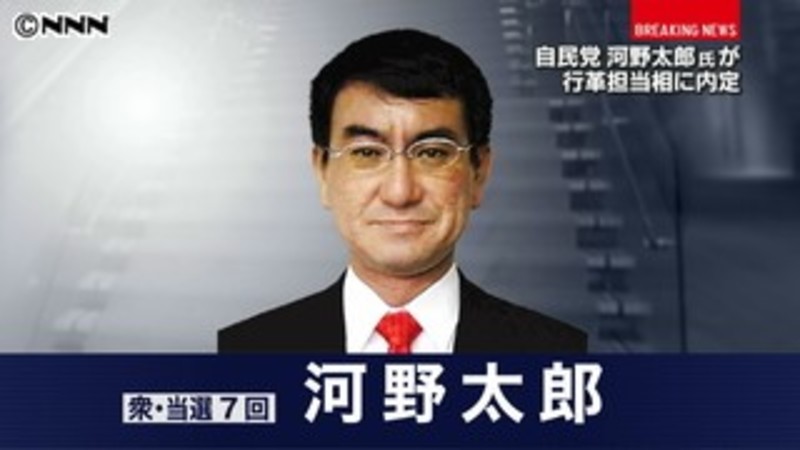 Kono Taro enters Abe Cabinet, Oct 7, 2015 Kono Taro enters Abe Cabinet, Oct 7, 2015 |
But when Abe undertook his October 7,
2015 cabinet revision, Kono surprised many by entering the cabinet as
Minister in charge of Administrative Reform as well as Civil Service
Reform, Consumer Affairs and Food Safety, Regulatory Reform and Disaster
Management (the latter three portfolios being Minister of State
positions).16
Upon entering the cabinet, Kono’s blog
posts became inaccessible. Not a few observers interpreted Kono’s
simultaneous entry into the cabinet and suspension of his heavily
antinuclear blog as an indication that he had been effectively silenced
as an exponent of abandoning nuclear and ending Japan’s dangerous and
expensive effort to create a plutonium-based nuclear economy.
However, this interpretation ignored
Kono’s argument that he could be more effective in achieving his
objectives from within the cabinet than from without.
The proof of the pudding is, as they
say, in the eating. It would appear that Kono is setting up a feast this
week. And it certainly merits attention from those interested in
Japan’s fiscal sustainability, its energy policy on the eve of climate
talks in Paris, its plutonium problem, and the ongoing transformation of
the LDP.
Andrew DeWit is
Professor in Rikkyo University’s School of Policy Studies and an editor
of The Asia-Pacific Journal. His recent publications include “Climate
Change and the Military Role in Humanitarian Assistance and Disaster
Response,” in Paul Bacon and Christopher Hobson (eds) Human Security and Japan’s Triple Disaster (Routledge, 2014), “Japan’s renewable power prospects,” in Jeff Kingston (ed) Critical Issues in Contemporary Japan
(Routledge 2013), and (with Kaneko Masaru and Iida Tetsunari)
“Fukushima and the Political Economy of Power Policy in Japan” in Jeff
Kingston (ed) Natural Disaster and Nuclear Crisis in Japan: Response and Recovery after Japan’s 3/11
(Routledge, 2012). He is lead researcher for a five-year (2010-2015)
Japanese-Government funded project on the political economy of the
Feed-in Tariff.
Notes
1 On the budget increases and other green measures, see Andrew DeWit, “Japan’s Bid to Become a World Leader in Renewable Energy”, The Asia-Pacific Journal, Vol. 13, Issue 39, No. 2, October 5, 2015.2 An introduction (in Japanese) to this and previous years’ administrative review processes is available at the Japanese Cabinet Secretariat’s website.
3 Ohbayashi’s JREF profile is here.
4 On the participation of Ohbayashi and Takahashi, see (in Japanese) “List of 30 Participants in Administrative Review Released,” Nikkei Shimbun, November 11, 2015.
5 The broadcasts (in Japanese) are available at: (part 1), (part 2)
6 See (in Japanese) “Reflection of the Fall Review in the FY 2015 Budget (Outline),” MOF Budget Bureau, January, 2015.
7 Kansai University Professor (Public Finance) Uemura Toshiyuki explains the 2013 process and its outcome in detail (in Japanese) in “Towards a half-trillion yen in cuts to the 2014 budget,” January 30, 2014.
8 See p. 4 OECD Economic Surveys, Japan, April 2015. OECD.
9 On this, see (in Japanese) “Power Facility Location Disbursements and others are the focus of Administrative Review,” Denki Shimbun, November 9, 2015.
10 On the facility, see Japan Atomic Energy Agency, “Nuclear Fuel Cycle Engineering Laboratories,” (no date).
11 See (in Japanese) “Nuclear-related budgets slated for review: Monju, Nuclear Fuel Ship,” October 30, 2015.
12 See (in Japanese) “Maintenance for Spent-Fuel Ship Costs YEN 5.9 Billion,” Tokyo Shimbun, October 29, 2015.
13 See p. 38 in Shaun Burnie, “50 Years after Nagasaki: Japan as Plutonium Superpower,” in (ed by Douglas Holdstock and Frank Barnaby) Hiroshima and Nagasaki: retrospect and prospect. Frank Cass: London, 1995.
14 See their footnote 27 on p. 357. Saadia M. Pekkanen and Paul Kallender-Umezu, In Defence of Japan: From the Market to the Military and Space Policy. Stanford University Press: 2010.
15 The full list of items is available [in Japanese] in the “Projects for Consideration in the Annual Fall Public Review,” Cabinet Office, Japan, October 30, 2015.
16 See the list of posts at the English-language site “Prime Minister of Japan and His Cabinet”.
The original source of this article is Asia-Pacific Journal Vol. 13, Issue. 44, No. 2
Copyright © Andrew Dewit, Asia-Pacific Journal Vol. 13, Issue. 44, No. 2, 2015

Become a Member of Global Research

No comments:
Post a Comment