The U.S. government is planning to launch an “overwhelming” COVID-19 vaccine campaign in November
It’s still
unclear exactly when a vaccine will be available, but it could be as
early as October, or as late as January 2021. According to a White House
administration official, the advertising campaign will be tailored to
specific subsets of the population, depending on the people the vaccine
is likely to benefit the most
Yale University
is studying the effectiveness of various messages about vaccinating
against COVID-19 to ensure maximum vaccine uptake
The primary
outcome measure is willingness to get the COVID-19 vaccine. Secondary
outcome measures include the participants’ confidence in the vaccine,
their willingness to persuade others to get vaccinated, their fear of
those who have not been vaccinated and the level of social judgment of
those who choose not to vaccinate
Evidence that
technocracy is gaining ground and is in the final stages of
implementation are all around. Technocracy is an economic system, not a
political one, which hinges on the skillful implementation of social
engineering
By the looks of it, we are about to face one of the most aggressive vaccine campaigns ever created. According to Reuters,1
the U.S. government is planning to launch an "overwhelming" COVID-19
vaccine campaign come November, provided the U.S. Food and Drug
Administration gives one or more vaccine candidates the green light.
Considering former FDA commissioner Dr. Scott Gottlieb2 is now on Pfizer's board of directors,3
and Pfizer's COVID-19 vaccine is one of the lead candidates, jaded
minds might assume the FDA isn't going to put up any significant
roadblocks.
According to Reuters, the COVID-19 vaccine campaign "will likely be
compressed into a short period of time, around four to six weeks, to
eliminate any lag between when Americans are alerted to the vaccine and
then they can get vaccinated." An unnamed "senior White House
administration official" is quoted saying:4
"The fine line we are walking is getting the American people
very excited about vaccines and missing expectations versus having a
bunch of vaccines in the warehouse and not as many people want to get
it. You may not hear a lot about promoting vaccines over the airwaves
in August and September but you'll be overwhelmed by it come November."
It's still unclear exactly when a vaccine will be available, but it
could be as early as October, or as late as January 2021. According to
the administration official, the advertising campaign for the vaccine
will be tailored to specific subsets of the population, depending on
the people the vaccine is likely to benefit the most. Such details are
expected to be teased out during ongoing clinical trials.
Study Underway to Identify Most Effective Messaging
The idea that the vaccine promotion might be more "overwhelming"
than what we're used to is further supported by a clinical study5 on ClinicalTrials.gov, the aim of which is to identify the most "persuasive messages for COVID-19 vaccine uptake."
The study, conducted by Yale University, will test "different
messages about vaccinating against COVID-19 once the vaccine becomes
available."
A total of 4,000 participants will be randomized to receive one of
12 different messages (10 messaging variations, one control message and
one baseline message), after which they will "compare the reported
willingness to get a COVID-19 vaccine at three and six months of it
becoming available." The messaging slants under investigation include:6
Personal freedom message — A
message about how COVID-19 is limiting people's personal freedom, and
how society, by working together to get enough people vaccinated, can
preserve its personal freedom.
Economic freedom message — A
message about how COVID-19 is limiting people's economic freedom, and
how society, by working together to get enough people vaccinated,
can preserve its economic freedom.
Self-interest message — A message
that COVID-19 presents a real danger to one's health, even if one is
young and healthy, and how getting vaccinated against COVID-19 is the
best way to prevent oneself from getting sick.
Community interest message — A
message about the dangers of COVID-19 to the health of loved ones:
The more people who get vaccinated against COVID-19, the lower the
risk that one's loved ones will get sick. Society must work together
and all get vaccinated.
Economic benefit message — A
message about how COVID-19 is wreaking havoc on the economy and the
only way to strengthen the economy is to work together to get enough
people vaccinated.
Guilt message — A message is about
the danger that COVID-19 presents to the health of one's family and
community. Therefore, the best way to protect them is not only by
getting vaccinated, but to get society to work together to get enough
people vaccinated. Then a test question asks the participant to
imagine the guilt they will feel if they don't get vaccinated and
then spread the disease.
Embarrassment message — A message
is about the danger that COVID-19 presents to the health of one's
family and community: The best way to protect them is by getting
vaccinated and by working together to make sure that enough people
get vaccinated. Then it asks the participant to imagine the
embarrassment they will feel if they don't get vaccinated and spread the
disease.
Anger message — The message is
about the danger that COVID-19 presents to the health of one's family
and community. The best way to protect them is by getting vaccinated
and by working together to make sure that enough people get
vaccinated. It then asks the participant to imagine the anger they
will feel if they don't get vaccinated and spread the disease.
Trust in science message — A
message about how getting vaccinated against COVID-19 is the most
effective way of protecting one's community, that vaccination is
backed by science: If one doesn't get vaccinated that means that one
doesn't understand how infections are spread or you are one who ignores
science.
Not brave message — A message which
describes how firefighters, doctors and front line medical workers
are brave: Those who choose not to get vaccinated against COVID-19
are not brave.
While the study was completed July 8, 2020, results have yet to be
publicly posted. Clearly, this is not the first time researchers have
investigated the most effective propaganda angles, but the types of
messages listed above really demonstrate just how insidious these types
of campaigns can be.
It's really all about manipulation — pushing the right mental and
emotional hot-buttons to fire up a desired response, all while
overriding more logical thought processes.
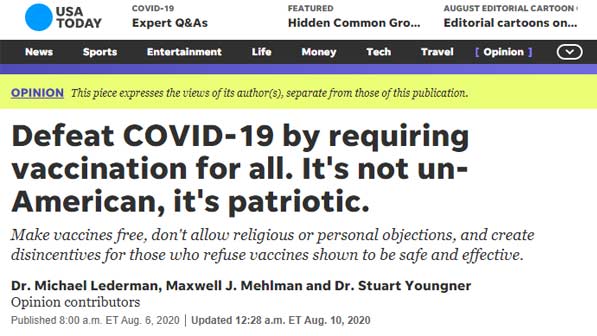
The propaganda push has already started, it seems, with USA Today publishing an article7
titled “Defeat COVID-19 by Requiring Vaccination for All. It’s Not
Un-American, It’s Patriotic.” This is precisely the kind of PR we can
expect more of in the months to come.
The manipulation aspect is equally if not more evident in the listed secondary outcome measures, which include:
Participants' confidence in the safety and effectiveness of the vaccine
Participants' willingness to persuade others to get vaccinated
Their fear of those who have not been vaccinated
The social judgment of those who choose not to vaccinate
Effective Totalitarianism Relies on You Enjoying Servitude
A quote from Aldous Huxley's dystopian 1932 book, "Brave New World," reads:
"A really efficient totalitarian state would be one in which the
all-powerful executive of political bosses and their army of managers
control a population of slaves who do not have to be coerced, because
they love their servitude."
Huxley's quote starts off a thought-provoking article8
on The Burning Platform that reviews the rise of totalitarianism and
parallels presented in popular works of fiction. The author notes
Huxley's book came on the heels of Edward Bernays' 1928 book,
"Propaganda" — a must-read for anyone interested in understanding the
historical foundations of modern public relations. The article points
out that, in his book, Bernays:9
"… revealed the existence of an invisible government who used
propaganda to manipulate the minds of the public to insure those
controlling the levers of power were able to engineer their desired
outcomes."
A contemporary to Huxley and Bernays was George Orwell, who wrote
the cult classic "1984." In 1949, Huxley reportedly wrote to Orwell,
stating he believed the world's rulers would soon "discover that infant
conditioning and narco-hypnosis are more efficient as instruments of
government than clubs and prisons, and that the lust for power can be
just as completely satisfied by suggesting people into loving their
servitude as by flogging and kicking them into obedience."10
Huxley believed the nightmarish existence presented in "1984" was
"destined to modulate into the nightmare of a world having more
resemblance to that which I imagined in 'Brave New World'" and that
this transition would be the result of "a felt need for increased
efficiency." While Huxley did not use the word "technocracy," that's
essentially what he was talking about.
Technocracy 101
Technocracy is an economic and social engineering system that got
started in the 1930s during the height of the Great Depression, when
scientists and engineers got together to solve the nation's economic
problems.
The Trilateral Commission's co-founder Zbigniew Brzezinski, a
Columbia University professor, brought the concept of technocracy into
the Commission in 1973, with the financial support of David
Rockefeller. Technocrats have silently and relentlessly pushed forward
ever since, and their agenda is now becoming increasingly visible.
At its heart, technocracy is an economic system, not a political
one. It actually calls for, indeed demands, the total dismantling of the
political system, which includes the U.S. Constitution. In fact, the
Constitution is the only thing that has kept technocracy at bay this
long in the U.S.
The system also hinges on the skillful implementation of social
engineering. Once fully implemented, people won't have the ability to
effectively fight it, but until then, through peaceful civil
disobedience, the sharing of information and the exercise of political
power, we still have a chance to prevent it.
Time is running short, however. As noted by The Burning Platform,11
"Since 9/11, the United States has unequivocally moved in the
direction of Orwell's 1984 vision," and "We are now experiencing a
dystopian amalgamation of the worst of both novels," referring to "1984"
and "Brave New World."
Unfortunately, many still cannot see the full picture, nor understand
the ultimate real-world danger of unquestioning compliance with
ever-more illogical and freedom-quenching recommendations and mandates.
Technocracy Demands the Abolishment of Political Systems
Under technocratic rule, nations are to be led by unelected leaders
who decide which resources companies can use to make certain products,
and which products consumers are ultimately allowed to buy. Technocracy
is essentially a resource-based economic system in which energy and
social engineering run the economy rather than pricing mechanisms such
as supply and demand.
Patrick Wood — an economist, financial analyst and American
constitutionalist — has devoted a lifetime to uncovering the mystery of
what is controlling most of the craziness we're currently seeing, and
which has been exacerbated by the COVID-19 pandemic. I go into more
details on technocracy in my interview with Patrick Wood.
His two books, "Technocracy Rising: The Trojan Horse of Global Transformation" and "Technocracy: The Hard Road to World Order" delve into this new world order in greater depth. You can listen to our interview below.
Importantly, science is a primary tool used to manipulate society and
keep the economic engine running under the technocratic system. As
explained by Wood, technocracy uses science to issue suggestions, to
start. But those suggestions rapidly turn into mandates, which is
precisely what we've been seeing during this pandemic. We've also seen
this with vaccines in general.
But the COVID-19 pandemic has also revealed there's a much larger
plan that includes implantable digital identifications, medical records
and vaccine passports, digital currency and banking — all of which will
ultimately be tied together so that algorithms and automation will be
able to keep everyone in line, everywhere, all the time.
Rule by Algorithm
An important tool used to drive the technocratic agenda forward is
what Huxley pointed out, namely efficiency. In the name of efficiency
and convenience, we are being inundated with an ever-increasing amount
of "smart" technology that tracks everything everyone says and does,
and artificial intelligence that sorts, interprets and spits out
recommendations based on all that data.
This technological infrastructure is crucial for the technocracy, as
the ultimate goal is to essentially automate slavery. The idea is that
society will be ruled by automated algorithms, thus rendering a
political structure irrelevant. Everyone will be automatically kept in
line by technology.
For example, you might be told via text message that it's time to get
your annual vaccination. You go there, get the shot, and receive a
digital vaccine certificate. Should you get the bright idea to refuse,
your bank accounts get automatically frozen, the electronic door pass
to your office won't work, and you won't be allowed to pass through the
electronic check point at the grocery store.
No human authority is required in that system. There won't be anyone
to complain to or debate with. You're herded into compliance by the
fact that you have to do certain things in order to be allowed to
participate in society. It sounds crazy, but if you look around, you'll
see clear evidence that this system has been slowly implemented all
around us, for decades.
And, when you look at the statements from people like Bill Gates, in
conjunction with the technologies he and others are implementing in
various parts of the world (such as digital identification, currency,
vaccine certificates and medical records, along with implantable chips
to track employee attendance, smart appliances and entire smart cities,
just to name a few), you can begin to see how the control loop is
closing in around us.
In her book, "The Age of Surveillance Capitalism,"
professor Shoshana Zuboff exposes the stunning capacities currently
available to surveil, analyze and manipulate our behavior. It's crucial
to realize that as bad as it is today, the predictive power of
technology is advancing at an exponential rate, which means their
ability to manipulate behavior is increasing at a pace we cannot fully
comprehend.
Regaining Control of Local Government Is Key
Importantly, technocrats are currently making an end run around
national sovereignty. Rather than a frontal assault on the system,
which has never been successful, they've simply eroded national
sovereignty piece by piece. What can we can do to thwart the steady
march of technocracy?
As explained by Wood, the most effective way is through local
activism. The technocratic system was built from the bottom up, so we
cannot tear it down from the top down. They're already far too powerful
for that. So, to begin the dismantling process, we must regain control
of our local governments, and work our way up from there.
One of the most important elected local officials that you should
concern yourself with is your sheriff. Sheriffs are responsible for
enforcing tyrannical edicts from local, state and federal government,
and if they choose not to, government has no power. City councils also
have a lot of power. They can pass binding resolutions to protect
citizens against the technocratic agenda.
1 Person in 40 Is Injured by Vaccines
Getting back to the issue of the COVID-19 vaccine, I urge you to
keep a cool head once the PR machine gains speed. Read through the
propaganda messages again (above) and familiarize yourself with them so
you can identify the buttons they're trying to push.
Remember, the COVID-19 vaccines currently leading in development
have never before been licensed for human use, and there's no possible
way to ascertain what the long-term ramifications might be when you
turn your body into a viral protein factory. I've discussed the theory
behind mRNA vaccines in several previous articles, including "Gates Tries to Justify Side Effects of Fast-Tracked Vaccine."
Coronavirus vaccine efforts gained speed in early 2002, following
three SARS epidemics. However, such efforts have proven highly
problematic as coronavirus vaccines have a stubborn tendency to trigger
paradoxical immune responses.
In my interview with Robert F. Kennedy Jr., who chairs the board of directors of the Children's Health Defense,12
he reviewed some of the failed efforts to produce a viable coronavirus
vaccine and highlighted the dangers of vaccine exaggeration of the
immune response:
"The Chinese, the Americans, the Europeans all got together and
said, 'We need to develop a vaccine against coronavirus.' Around 2012,
they had about 30 vaccines that looked promising. They took the four
best of those and … gave those vaccines to ferrets, which are the
closest analogy when you're looking at lung infections in human beings.
The ferrets had an extraordinarily good antibody response, and
that is the metric by which FDA licenses vaccines … The ferrets
developed very strong antibodies, so they thought, 'We hit the
jackpot.' All four of these vaccines ... worked like a charm.
Then something terrible happened. Those ferrets were then exposed
to the wild virus, and they all died. [They developed] inflammation in
all their organs, their lungs stopped functioning and they died."
So please, review ALL the vaccine studies BEFORE you get the COVID
vaccine because as far as I have read, this essential part of the study —
ensuring that no paradoxical immune enhancement will occur — has not
yet been done.
Even with conventionally manufactured vaccines, data from the U.S.
Department of Health and Human Services Agency for Healthcare Research
Quality suggests vaccine damage occurs in 2.6% of all vaccinations.
This means 1 in 40 people — not 1 in 1 million, which is what we've
been repeatedly told — is injured by vaccines. Kennedy Jr. reviewed
this data in a recent online vaccine debate13 with attorney and legal scholar Alan Dershowitz.
The U.S. Vaccine Court has also paid out $4 billion to patients
permanently damaged or killed by vaccines, and that's just a small
portion of all the cases filed. According to Kennedy, less than 1% of
people who are injured ever get to court, due to the high bar set for
proving causation.
Will the novel mRNA COVID-19 vaccines be more dangerous than
conventional vaccines, or will they be safer? Considering these
vaccines are being fast-tracked and are forgoing all traditional animal
testing and long-term evaluation, I suspect they may end up having far
more unanticipated complications.
So, as the vaccine campaign rolls out, remember to weigh whatever
potential risks and benefits that might apply in your particular
situation, and avoid falling for emotional triggers.
Regardless of what you decide, also try to accept the personal
decisions of others. The PR campaign will clearly try to manipulate you
into fearing those who chose not to vaccinate, and trigger you into
condemning them. Hopefully, knowing that you are being manipulated will
help ease these tendencies.


No comments:
Post a Comment