The bodies of some of the seven US navy sailors missing
after their destroyer collided with a container ship off the east coast
of Japan have been found.
US and Japanese ships and aircraft launched a huge air and
sea search for the crew but “a number of bodies” were found on Sunday in
the flooded quarters of the damaged destroyer USS Fitzgerald, the US 7th fleet said in a statement.
“As search and rescue crews gained access to the spaces that
were damaged during the collision, the missing sailors were located in
the flooded berthing compartments,” it said.
“They are currently being transferred to naval hospital
Yokosuka where they will be identified. The families are being notified
and being provided the support they need during this difficult time. The
names of the sailors will be released after all notifications are
made.”
The Fitzgerald, with the help of tugboats, had arrived back
at its home port of Yokosuka naval base, south of Tokyo, on Saturday
evening. The other vessel involved in the pre-dawn collision, the
Philippine-flagged ACX Crystal, berthed at Tokyo’s Oi wharf, where its
crew was questioned by investigators.
Three people aboard the destroyer were medically evacuated,
including Commander Bryce Benson, who was reportedly in a stable
condition after being airlifted to the US naval hospital at the Yokosuka
base, the navy said. The other two injured crew members were treated at
the hospital for cuts and bruises.
The US 7th Fleet said the collision damaged two berthing
spaces, a machinery room and the ship’s radio room. Most of the more
than 200 sailors aboard the Fitzgerald would have been asleep at the
time of the incident.
Water had to be pumped out of flooded areas before the
crushed mid-right side of the ship could be searched, the statement
said.
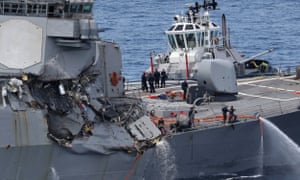
This picture shows damage on the guided missile destroyer USS Fitzgerald. Photograph: AFP/Getty Images
“This has been a difficult day,” said vice-admiral Joseph
Aucoin, commander of the 7th Fleet on Saturday. “I am humbled by the
bravery and tenacity of the Fitzgerald crew. Now that the ship is in
Yokosuka, I ask that you help the families by maintaining their privacy
as we continue the search for our shipmates.”
Advertisement
Rear-admiral
Charles Williams, commander of the naval taskforce in the area, said:
“I want to highlight the extraordinary courage of the Fitzgerald sailors
who contained the flooding, stabilised the ship, and sailed her back to
Yokosuka despite the exceptionally trying circumstances.”
Donald Trump tweeted thanks
to Japan for its assistance in the search mission, saying: “Thoughts
and prayers [are] with the sailors of USS Fitzgerald and their
families.”
Initial fears that the guided missile destroyer was at risk
of sinking receded after US navy officials said flooding in three
damaged sections of the vessel had been brought under control.
While the cause of the accident has yet to be determined,
Japan’s public broadcaster NHK said the ACX Crystal had made a sharp
turn shortly before the collision.
Nippon Yusen KK, the Japanese company that charters the
container ship, said in a statement it would cooperate fully with the
coastguard’s investigation. All 20 Filipino crew members aboard the ship
were safe, it added.
Japanese and US officials were discussing how to conduct the
investigation. Japan is permitted to investigate since the collision
happened in its waters, but under the countries’ status of forces
agreement the US has primary jurisdiction over incidents involving
vessels such as the Fitzgerald.
Japan’s coastguard and the US navy plan to question crew
members from the ACX Crystal, and could treat the collision as a
possible case of endangerment of traffic caused by professional
negligence, Kyodo news said.
At about 29,000 tons displacement, the container ship is
more than three times the size of the 8,315-ton Fitzgerald, and was
carrying 1,080 containers from the central Japanese port of Nagoya to
Tokyo.
“Once an investigation is complete then any legal issues can be addressed,” a spokesman for the US 7th fleet said.
The Fitzgerald, part of an eight-ship squadron based in Yokosuka, had in February completed $21m worth of upgrades and repairs. US military
commanders in Japan briefed locally based relatives at a family support
centre at 9.45am. Before the meeting,one concerned parent wrote on the
ship’s Facebook page: “The news just reported 7 missing sailors, this is
making my heart ache, please let us know soon! Praying for all aboard!”
Another posted: “My daughter is on this ship as well. We are mess here. Praying for all sailors.”
Rita Schrimsher, whose 23-year-old grandson Jackson
Schrimsher was aboard, told the Associated Press about the agony of
waiting for news from Japan until he contacted her to say he was safe.
She tweeted: “Just heard the sweetest voice and saw a wonderful face. He’s okay. Thank you all for the prayers.”
For relatives who could not make it to the support centre, the military provided phone numbers to call for information.
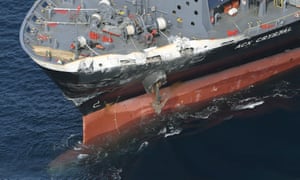
The damage of Philippine-registered container ship ACX Crystal. Photograph: Iori Sagisawa/AP
Aerial news footage showed the ACX Crystal’s bow on the left
side had been dented and scraped, but it did not appear to have
suffered major structural damage.
The Fitzgerald, an Arleigh Burke-class guided missile
destroyer, was commissioned in 1995 and was originally based in San
Diego, California. It was deployed in a carrier strike group that
assisted the war in Iraq in 2003.
The Fitzgerald changed its home port to Yokosuka in 2004 as
part of a deployment “to counter ballistic missile threats worldwide”,
according to the official history.
In November 2011, the then US secretary of state Hillary Clinton met
the Philippine foreign affairs secretary, Albert del Rosario, onboard
the ship to sign the Manila declaration backing multilateral talks to
resolve maritime disputes.
The Fitzgerald had been active in Japanese waters to monitor
the Korean peninsula following a series of ballistic missile launches
by North Korea. It also took part in relief efforts after the March 2011
earthquake and tsunami in Japan.
Since you’re here …
… we have a small favour to ask. More people are reading
the Guardian than ever but advertising revenues across the media are
falling fast. And unlike many news organisations, we haven’t put up a paywall – we want to keep our journalism as open as we can.
So you can see why we need to ask for your help. The Guardian’s
independent, investigative journalism takes a lot of time, money and
hard work to produce. But we do it because we believe our perspective
matters – because it might well be your perspective, too.
I appreciate there not being a paywall: it is more democratic
for the media to be available for all and not a commodity to be
purchased by a few. I’m happy to make a contribution so others with less
means still have access to information.
Thomasine F-R.
If everyone who reads our reporting, who likes it, helps to support it, our future would be much more secure.



No comments:
Post a Comment