By Dr. Mercola
With drug-resistant infections
on the rise, disinfecting yourself and your surroundings may seem like
a good idea. However, research has clearly shown that this may
exacerbate problems rather than solve them.
When it comes to preventing the spread of contagious disease, handwashing tops the list of effective strategies.1 The key is to do it, and to do it correctly, using proper products and techniques.
Studies suggest compliance with handwashing practices in healthcare
settings is surprisingly low, typically no higher than 40 percent.2
An estimated 1 in 4 patients also leave the hospital with a superbug on
their hands, suggesting patients also need to become more mindful
about handwashing when in a health care setting.3
Unfortunately, many still labor under the mistaken assumption you need antibacterial soap
to get the job done right. Many also believe using an air dryer is
preferable to using a towel when in a public restroom. Surprising as it
may seem, air dryers may actually spread FAR more germs than paper
towels!
Moreover, as we're learning more about the human skin microbiome,
researchers have noted that fewer bacteria are not necessarily better.
Diverse communities of bacteria thrive on perfectly healthy skin. In
fact, they're very much needed for optimal health. Hence "clean" does
not mean bacteria-free.
Redefining Cleanliness
In their paper, "Cleanliness in Context: Reconciling Hygiene With a Modern Microbial Perspective,"4
microbial ecologists at the University of Oregon argue that
cleanliness isn't as simple as ridding your skin of as many microbes as
possible.5
A "scorched earth" strategy may actually do more harm than good, as by
removing too many beneficial bacteria you become vulnerable to more
harmful ones. According to the authors:
"Most evidence suggests that the skin microbiota is likely of
direct benefit to the host, and only rarely exhibits pathogenicity …
The skin is a complex immunological organ with both innate and
adaptive immune cells, including multiple dendritic and T-cell subsets;
antimicrobial peptides, proinflammatory cytokines, and chemokines that
are secreted by keratinocytes to support an immune response …
This complex ecological context suggests that the conception of
hygiene as a unilateral reduction or removal of microbes has outlived
its usefulness.
As such, we suggest the explicit definition of hygiene as 'those
actions and practices that reduce the spread or transmission of
pathogenic microorganisms, and thus reduce the incidence of disease.'"
In their paper, the scientists examine different methods of hand
drying as an aspect of this redefinition of cleanliness. As it stands,
there are studies showing both pros and cons of hot air or jet drying
and using paper or cloth towels.
"Utilizing a definition of hygiene that explicitly relies on
reduction in disease spread rather than alterations to bulk microbial
load would address concerns raised on both sides of the debate," the scientists note.
The Problem With Hot Air and Jet Dryers
Public restrooms have largely traded out paper or fabric towel
dispensers for warm air dryers or jet dryers. But research suggests
this may actually be counterproductive, promoting rather than
preventing the spread of disease-causing bacteria.
Warm air driersblow heated air for 30 to 40 seconds per use. According
to the featured paper, "most research has shown that warm air dryers
may increase the number of bacteria on the hands after use." The reason
for the increase in bacterial load is thought to be due to:
Bacteria inside the dryer mechanism being blown out during use
Bacteria-enriched air being recirculated
Bacteria found in the deeper layers of skin being liberated when rubbing your hands together beneath the hot air stream
Some combination of the above
Moreover, the authors note that the temperature of the air in these
dryers is not hot enough to actually kill bacteria. Their purpose is
solely to promote evaporation so your hands become dry.
Jet dryers are a newer alternative. These units use a high-speed jet of
unheated air, drying hands in as little as 10 to 15 seconds, again by
promoting the rapid evaporation of water. According to the authors:
"Many jet air dryers (e.g., the Dyson AirbladeTM) are marketed as
designed with a high-efficiency particulate air (HEPA) filter built
into the airflow system, which reduces the risk of redistribution of
airborne microbes to the hands.
However, there is concern about the propensity of such rapid air
movement to aerosolize microbes from users' hands or the surrounding
environment … Particular attention has been paid to the distance such
rapid air movement is capable of dispersing potentially contaminated
droplets from the hands …"
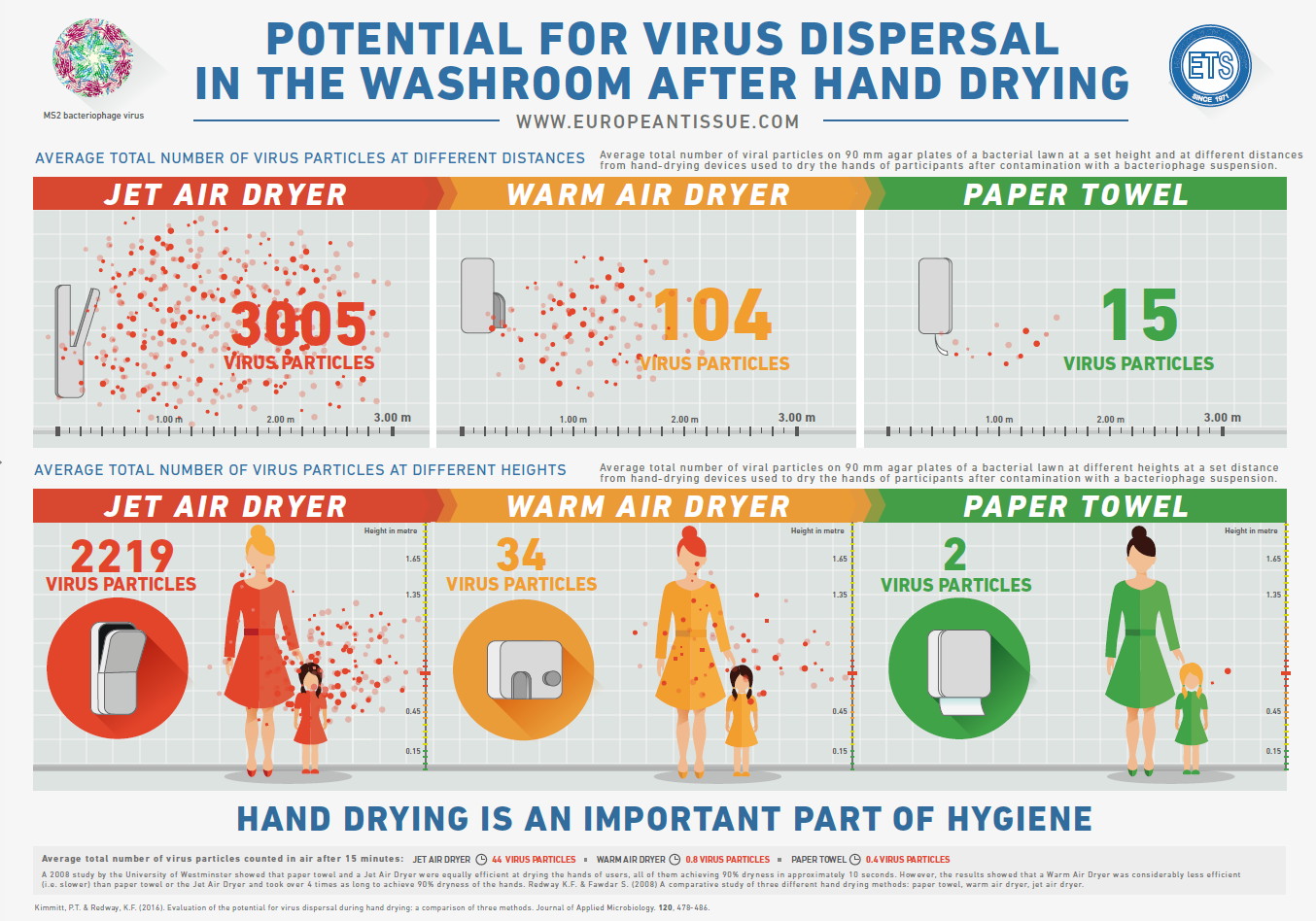
In one recent study,6
jet dryers were found to spray 1,300 times more viral material into
the surrounding area than paper towels, dispersing the viral load up to
10 feet away from the dryer.7,8
Paper Versus Cloth Towels
In healthcare settings, the Centers for Disease Control and Prevention
(CDC) and World Health Organization (WHO) both advise using paper
towels to dry your hands.
The reason for this is because the bulk of the data suggests paper
towels can effectively remove surface bacteria from your hands, and
effectively prevent the spread of contaminated water droplets from your
hands into the environment.
As noted in a 2012 meta-analysis of a dozen studies published in the Mayo Clinic Proceedings:9
"[M]ost studies suggest that paper towels can dry hands
efficiently, remove bacteria effectively, and cause less contamination
of the washroom environment.
From a hygiene viewpoint, paper towels are superior to electric air
dryers. Paper towels should be recommended in locations where hygiene
is paramount, such as hospitals and clinics."
That said, the waste paper can be a source of bacteria, and depending
on how the paper towels are manufactured and stored, the paper itself
could be a source of contamination, especially if the paper towels are
produced with recycled materials.
Cloth towels are the fourth and final alternative, typically used in
private homes, although some public restrooms will still use a
roller-type fabric towel rack. Not surprisingly, cloth towels have the
highest risk of cross-contamination, although they're comparable to
paper towels when you're measuring the reduction of bacteria on your
hands after drying.
According to a 2014 University of Arizona study,10
towels may be the most germ-ridden item in your home. Tests revealed a
staggering 89 percent of kitchen towels and nearly 26 percent of
bathroom towels were contaminated with coliform bacteria — microbes
associated with food poisoning and diarrhea.
The primary reason for this is the moisture cloth towels retain, which
serves as a perfect breeding ground for bacteria. To properly cleanse
towels of potentially harmful bacteria, be sure to wash them in HOT
water, as most of these organisms live at body temperature.
Source: European Tissue Symposium based on Redway's research. (Image credit: ETS)
No. 1 Disease-Prevention Strategy — Proper Hand Hygiene
While the issue of hand drying is important, it should not overshadow
the issue of actually washing your hands in the first place. As noted
by The Verge:11
"All this discussion of drying, though, ignores one obvious,
overwhelmingly important fact: [I]t's washing your hands that's key
when it comes to personal hygiene, and people just don't wash their hands enough.
When you look at advice and research from agencies tasked with
public health like the CDC and WHO, there's scant mention of drying
techniques because getting people to wash is tricky enough. In a U.K.
study,12
99 percent of people visiting a public bathroom said they had washed
their hands after going to the toilet. Recording devices showed that
only 32 percent of men and 64 percent of women actually had."
Anytime you visit a health care facility. Before leaving the premises, be sure to wash your hands
Before and after food preparation, especially if you're cooking
poultry, raw eggs, meat or seafood. It's also advisable to wash your
hands directly before sitting down to eat
After you've used the restroom, and after each diaper change
Before and after caring for someone who is ill, and/or treating a cut or wound
How to Properly Wash Your Hands
Hand washing
is a simple and effective way to reduce your exposure to potentially
disease-causing germs and reduce your chances of getting sick and/or
spreading disease to others. Unfortunately, research14
suggests as little as 5 percent of people wash their hands in a way
that will actually kill infection and illness-causing germs. To be
truly effective for disease control, be sure to follow the following
handwashing guidelines:
1. Use warm, running water and a mild
soap. You do NOT need antibacterial soap, and this has been
scientifically verified. Even the U.S. Food and Drug Administration
(FDA) has stated15
"there is currently no evidence that [antibacterial soaps] are any more
effective at preventing illness than washing with plain soap and
water."
Not only does antibacterial soap promote the development of drug-resistant bacteria,
compounds such as triclosan have also been linked to a number or
harmful health effects, especially in young children, including allergies, thyroid dysfunction, endocrine disruption, weight gain and inflammatory responses.16,17
It's even been found to aggravate the growth of liver and kidney tumors.18 In pregnant women, triclosan has been shown to affect hormone regulation, and may interfere with fetal development.19,20,21,22
Alcohol-based products are also best avoided. While they've been shown
to significantly reduce bacterial diversity on your hands, this
decreased bacterial diversity may actually increase your likelihood of
carrying potential pathogens on your hands by eliminating
naturally-occurring protective species.23 2. Work up a good lather, all the way up
to your wrists, scrubbing for at least 15 or 20 seconds (most people
only wash for about six seconds). 3. Make sure you cover all surfaces,
including the backs of your hands, wrists, between your fingers and
around and below your fingernails. See suggested techniques in the video
above. 4. Rinse thoroughly under running water. 5. Thoroughly dry your hands, ideally
using a paper towel. In public places, also use a paper towel to open
the door as a protection from germs that the handles may harbor.
As noted at the beginning of this article, your skin is actually an
important primary barrier against germs, so obsessive-compulsive
washing, especially in dry environments, can actually increase your
risk of getting sick by drying out your skin, allowing potentially
harmful bacteria entrance into your body. So, maintain a balance — wash
when advisable (see above) but avoid washing your hands to the point
of irritating your skin.


No comments:
Post a Comment