Ann McLean and Patricia N. Saffran, The New American Museum, Judge, Jury and Executioner
Ann McLean and Patricia N. Saffran
American museums used to have art exhibitions that dignified the
human spirit. By contrast, today’s museums promote the wonton
destruction and desecration of great works of art, mainly targeting the
South, as in LA’s Monuments Exhibition. Museums currently have policies that are more in keeping with Joseph Goebbels who
said, “We shall reach our goal, when we have the power to laugh as we
destroy, as we smash, whatever was sacred to us as tradition, as
education, and as human affection.”
The museums’ new role is to cover up what the public wants as well. On October 24, 2025, the Valentine Museum, Richmond VA, was supposed to release the results of their survey about Richmond’s Confederate statues, done jointly with the Black History Museum (BHM).
The monuments are either currently sitting next to a sewer near the
James River, Richmond, or they were sent secretly, without the approval
of the public, to LA’s Monuments Exhibition, where they’re on display
unrestored with paint splashes to help ridicule the South.
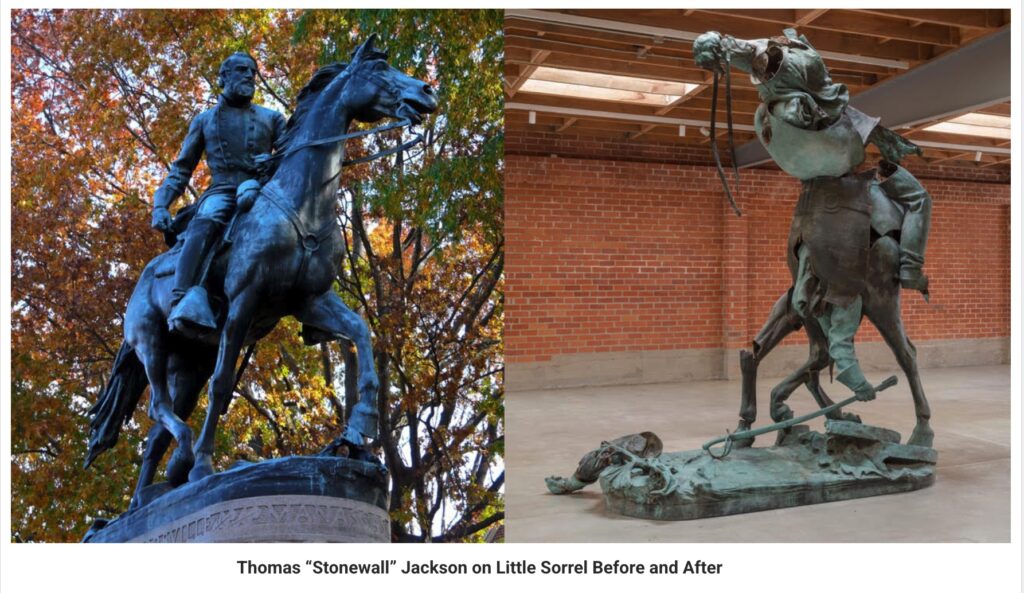
(Charlottesville’s Beaux Arts monuments faired worse with Lee melted down by the Jefferson School African Heritage Center, and Keck’s masterpiece of Thomas “Stonewall” Jackson, bought by LA and subsequently destroyed by Kara Walker to make into a new monster sculpture, Unmanned Drone, for LA’s show. She ignored that Jackson taught black children to read and write.)
Over a period of more than three years and repeated requests, the Valentine Museum has never released the results and the survey is
still up at the BHM. The questions have changed a bit over the years.
Formerly, it asked what do you think should be done with Richmond’s
Confederate monuments? Melt down, place in a museum, put back on Monument Avenue
with added signage, and so on. Perhaps the results of those questions
went counter to what museum officials in Virginia in general want the
public to believe, that they’re responsible professionals whose training
taught them how to preserve precious historic sculptures in their
charge. The reality is the public still wants their monuments standing
and not brought down by over two thirds, and it’s museum curators and
other officials who are condemning, destroying or allowing degradation
of those historic monuments. They’re actually guilty of malpractice.
According to Tate museum’s art-term dictionary, a curator “is someone employed by a museum or gallery to manage a collection of artworks or artifacts…and acquire, care for and develop a collection.” Curators also arrange displays and interpret the collection “in order to inform, educate and inspire the public.” The problem at hand is that “care for” has been abandoned by certain contemporary ‘curators’, who, like Goebbles, have politicized western art away from its Judeo-Christian tradition, disparaging the memetic classically trained Beaux arts sculptors. “Curator” Andrea Douglas of the Jefferson School African Heritage Center in Charlottesville, went against curatorial protocol and actually oversaw the complete melting down of Shrady/Lentelli’s equestrian statue of Robert E. Lee, ingots of which are now on display at the LA Monuments show.
The curatorial malpractice extends to cancelling– never discussing— important theological tenets surrounding the historical context of the statues. For instance, the Lost Cause which formed a landscape of memory, was a post-war movement in the South to memorialize the noblest aspects of the Confederacy’s struggle for Independence, which was deemed a given by those subscribing to the original Constitution of 1787, where the states were in a voluntary compact of their own choosing. Current museum curators such as Hamza Walker of LA Monuments who refuse to follow conservation principles, brazenly describe the Lost Cause as a “myth” rather than a natural response to widespread carnage (over 300,000 killed in the South) and altering of the Constitution as they understood it. The Lost Cause was suffused with a Judeo-Christian ethic, from speeches to ceremonies, to clergy giving long-form sermons and eulogies, to hymns and prayers.
The new radical curators and art historians disparage and seek to redefine the Lost Cause away from its provable aims Thus, those academics as well as the curators, commit a form of malpractice in their interpretation of the leaders who fought against actual invasion of their homeland and destruction and theft of their farms and property. Complexitites of the slave issue, notwithstanding, the life and death aspect of the struggle seems to further the real American myth of the virtuous North fighting to liberate slaves in the wicked South. (See Lincoln’s first inaugural address.) As to the BHM survey it also now concentrates on monuments created during the Confederacy and the Lost Cause, 1870 to 1955 but never really clarifies why it’s emphasizing the Lost Cause.
It’s not just in the South where officials, and politicians, are condemning historic monuments. Mayor-elect Mamdani wasted
no time in singling out for the chopping block the Columbus statues at
Columbus Circle, NYC, and the one in Astoria for which he posed giving
it the “finger,” which angered Italian-Americans. The history of Gaetano
Russo’s Columbus Circle statue alludes
him and apparently all he can think about is Columbus’s possible
connection to slavery. As a socialist, Mamdani should have known that small contributions from
Italian-Americans funded the monument, which should have made it
sacrosanct. City officials are currently trying to landmark both pieces
to protect them from Mamdani removing them.
As to the Monuments Exhibition in L.A., it presupposes in its PR
releases that the U.S. remains a “racist,” “white supremacist” society
against an overwhelming body of evidence to the contrary — not the least
of which is the near-monolithic conviction among artists and museum
curators themselves who dominate popular culture and propagate their
unhistorical version of history.
No comments:
Post a Comment