The Cancer Connection: How Dental Health Indicates Disease Risk


TTAC is experiencing heavy censorship on many social media channels since we’ve been targeted by the mainstream media sellouts, social media bullies, and political turncoats. Be sure to get the TRUTH by subscribing to our email list. It’s free.

Video Transcript: The Cancer Connection: How Dental Health Indicates Disease Risk
Ty Bollinger: Did you know that there’s a connection between oral health and disease risk?
Charlene Bollinger: Join Dr. Stuart Nunnally as he shares more on how your dental health can reveal more serious health problems.
Dr. Stuart Nunnally: And I’m going to talk first about the obvious cancer connection. There is an obvious cancer connection because there are some aspects of dentistry that we need to really be concerned about in terms of a one to one progression of the disease.
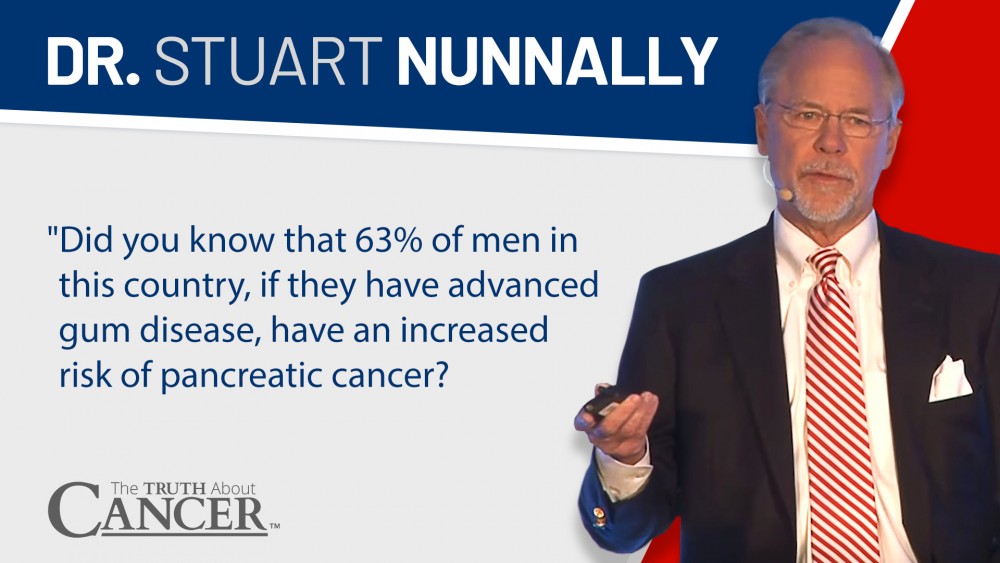
And that is this: Did you know that 63% of men in this country, if they have gum disease, advanced gum disease, have an increase chance of prostate [sic] cancer? 63%. From a Harvard Study. And also, just with moderate gum disease, which many of us in this room probably have, 33% have an increased risk of lung cancer. There’s a 50% increase in the risk of kidney cancer and there’s a 30% increase of blood
cancer such as leukemia.Most of this may not be a direct result of the bacteria or the pathogens that are involved with these, but they set up a constant inflammatory state. And as you know there’s just not a disease that we deal with that doesn’t have an inflammatory component to it.
This particular man, Gerald Curatola, has just written a book and literally was just released, that deals—and he has distilled the information very nicely there for you to see what kinds of impact dentistry can have on our systemic health. So, I recommend it to you.
Then there’s the not-so-obvious cancer connection, and that is the one that most of us in here are familiar with, and that is what in the world do we do if we have a mouth full of these? As you know, these have been debated for years, and quite frankly, I think we had the opportunity as an organization, as an American dental organization, to say years ago,
You know what? We made a mistake. We made a mistake. We never should have put mercury in any form in anyone’s body.”
And yet we can’t own up to it. We can’t own up to it. It’s a very, very sad thing, so we continue to do it. And when we don’t do it, instead of doing it here, we ship it to some poor country that has no other filling material to use and we ask them to use it.
So, it’s hard to believe that even today, about 40% of the dentists in this country are still placing mercury amalgam fillings. Now the sad thing about this is that’s 50% mercury. 50% mercury, there’s copper 30%, silver, zinc, and tin make up the rest of it. Now in most compounds, when you see that something is 50% or more of the compound you would call it a mercury amalgam filling, but for some reason in this country for years we’ve called it a silver amalgam filling.
It’s time to change. It’s time to change and here’s what we can do about it.
Well, let’s just talk first about a few more facts. First of all, this is the second most toxic element known to man. It’s an extremely potent neurotoxin. It’s second in toxicity only to plutonium. It’s very difficult to think that we would place that in someone’s body.
There is no biological barrier. It accumulates in the fetus. In fact, the fetus is a magnet for mercury. When the mom has mercury fillings, or if she’s had a vaccine that has mercury in it, the fetus is actually a magnet. You will see higher levels in the tissues of the fetus then you will see in the mom. Of course, it’s a depressant and that’s one of the reasons why so many people in this country are depressed.
In fact, if you want to depress a laboratory animal or initiate an autoimmune disease, most often it’s done in the laboratory with mercury. It almost makes me sick.
I was listening to a radio show the other day and there was a physician on the show, and he said, “Oh no, there is no reason.” The caller called in and said, “Is there any reason for me to have my mercury amalgam fillings removed?” And the physician said, “Of course not. There’s no mercury that comes from that material.” Well, the physician has lost and forgotten his ninth-grade chemistry, because the truth of the matter—
And here’s the example that he used. I want you to be prepared for this in the future, should you hear it.
He said, “If you take sodium, which is toxic, and you take chlorine, which is toxic, and you combine them together you get sodium chloride. Now, is salt toxic? Is salt toxic?” And the listener said, “Well, I guess not.” And hung up.
Well, the truth of the matter is, the poor physician has lost all sense of his chemistry background, because that’s not what happens when you mix metals together. When you mix mercury together with silver, zinc, tin, and copper, it doesn’t stay there. It’s an amalgam and it leaks out very, very freely to the environment. And the only reason it’s really been used, in my opinion, is because it’s dirt cheap.
I mean it just takes—there’s almost nothing in there that’s expensive, it’s easy to place, it contributes to cracked teeth. As you saw a while ago, you saw all the frayed edges around those mercury fillings, and what happens is that you chew on one of those for twenty years and finally you fracture off a cusp of your tooth, and then you are destined for a crown. And then you are destined for the root canal that follows and then you are destined for one thing after another as you know.
Ty Bollinger: That’s some amazing information on the importance of oral health from Dr. Nunnally.
Charlene Bollinger: If you learned something new, please share this on your social media and let your family know about The Truth About Cancer. Thank you and God bless!

Turmeric has been used in the Chinese and Indian pharmacopoeia for thousands of years... and many have even called it the most amazing herb in the world.
>>Read more

No comments:
Post a Comment