
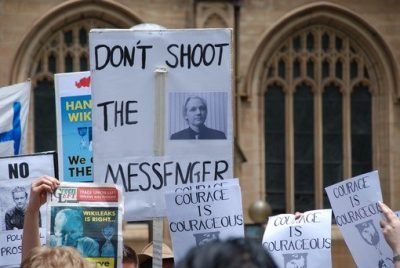
When the superseding indictment was returned by a federal grand jury in the Eastern District of Virginia against Julian Assange
on May 23, 2019, there was one glaring omission. It was an
achievement, it might even be said the achievement, that gave the
WikiLeaks publisher and the organisation justified notoriety. Collateral Murder,
as the leaked video came to be called, featured the murderous exploits
by the crew of Crazy Horse 1-8, an Apache helicopter that slew 11 people
on July 12, 2007 in east Baghdad. Among the dead were Reuters
photographer Namir Noor-Eldeen and a driver and fixer, Saeed Chmagh.
As WikiLeaks announced at the time,
“Reuters has been trying to obtain the video through the Freedom of Information Act, without success since the time of the attack. The video, shot from an Apache helicopter gun-sight, clearly shows the unprovoked slaying of a wounded Reuters employee and his rescuers. Two young children involved in the rescue were also seriously wounded.”
It is worth remembering at the time that the current stable of media outlets, including the New York Times, preferred to see something rather different: that the video was purposely edited
by WikiLeaks to convey maximum public impact while giving the
impression of US venality in battle. Patriotism, and the blinding of
the record, comes first.
This conveniently sidestepped the vacillations taking place in the Pentagon over the incident and its recording. Dean Yates,
who was Reuters Baghdad chief at the time, recalls in horrid vividness
the unfolding events, including the seizure of Namir’s cameras and the
US military statement:
“Firefight in New Baghdad. US, Iraqi forces kill 9 insurgents, detain 13.”
As Yates, who has been painfully silent over this episode, told the Guardian,
“The US assertions that Namir and Saeed were killed during a firefight was all lies. But I didn’t know that at the time, so I updated my story to take in the US military’s statement.”
On the return of
the tampered cameras, no evidence of insurgent activity, or clashes with
US forces, were evident. Yates and a Reuters colleague subsequently met
two US generals responsible for overseeing the investigation, all off
record, of course. They were told of the request by Crazy Horse 1-8 to
engage “military-aged males” supposedly armed and acting
“suspiciously”. Photographs of AK-47s and an RPG [Rocket-propelled
grenade] launcher, where produced. Yates was left wondering “how much
of that meeting was carefully choreographed so we could go away with a
certain impression of what happened.” For a time, he conceded, “it
worked” with poisonous effect.
What niggled was
the revealing of some footage from the camera of Crazy Horse 1-8, a
miserly three minutes. Cue the permission sought by the Apache to
engage on seeing Namir crouching with his long-lens camera, supposedly
mistaken for an RPG. The appearance of the van later in the scene,
ostensibly to assist, was airily dismissed by the generals as an act of
aid for insurgents. Yates, disturbed, was left with the mistaken
impression that Namir had somehow been responsible for his own demise
and those of his companions.
In the meantime,
Reuters persisted in their vain attempts to secure the full video, even
as they continued good faith off-the-record meetings with the US
military for reasons of safety. Yates wished to break the arrangement on
the video; his superiors thought otherwise. The symptoms of
post-traumatic stress disorder began to show. Sleeplessness crept in.
When the video was released on April 5, 2010, Yates was with is family
walking in Cradle Mountain national park, Tasmania.
The video casts a
shadow over the indictment, despite being a screaming omission. It is
crude, expressive, and unequivocal in disclosing a war crime and its
cold blooded execution. It codifies a form of deliberate, incautious
violence. It reveals breathtaking cruelty at play: “Look at those dead
bastards; “Nice”; “Good shoot’n”. As Christian Christensen remarked, “These particular images were, in many ways, the crystallization of the horrors of war.”
Barrister Greg Barns, a tireless advisor to the Australian Assange Campaign claimed it
to be “very much part of the broader prosecution case [because of what
it illustrates about the US rules of engagement] and it is one of the
many reasons to oppose what is happening to Assange”.
Australian
politicians otherwise unaccustomed to distract themselves from the teat
of the US imperium have also noted the potency of the video, and the act
of evading it in the indictment. “The omission of the leaked
Collateral Murder footage from the indictment surprised me,” suggested
Australian Greens Senator Peter Whish Wilson of the Parliamentary
Friends of the Bring Julian Assange Home Group, “but on reflection of
course it’s not in the US government’s interests to highlight their own
injustices, deceit and crimes.” The effort to indict Assange for
espionage charges is fatuous but dangerously calculating: to bury a
narrative; to make history, at least as it is told by the leakers,
disappear.
*
Note to readers: please click the share
buttons above or below. Forward this article to your email lists.
Crosspost on your blog site, internet forums. etc.
Dr. Binoy Kampmark
was a Commonwealth Scholar at Selwyn College, Cambridge. He lectures
at RMIT University, Melbourne. He is a frequent contributor to Global
Research and Asia-Pacific Research. Email: bkampmark@gmail.com
Featured image is by Elekhh – CC BY-SA 3.0
The original source of this article is Global Research
Copyright © Dr. Binoy Kampmark, Global Research, 2020
Comment on Global Research Articles on our Facebook page
Become a Member of Global Research
No comments:
Post a Comment