How Negative Emotions Can Affect Your Health from Dr. Mercola
How Negative Emotions Can Affect Your Health
May 17, 2018 • 112,927views
Story at-a-glance
Every feeling
you have affects some part of your body. While positive emotions such as
gratitude have been scientifically linked to a number of beneficial
health effects, negative emotions and stress can wreak havoc
Certain
emotions are known to be associated with pain in certain regions of your
body. For example, depressed individuals will often experience chest
pains, even when there’s nothing physically wrong with their heart
A biochemical
cascade occurs during a bout of anger. Adrenaline and noradrenaline are
released, raising your blood pressure, heart rate and breathing rate.
Blood is pushed to your extremities, including your face, which may turn
red
To maintain or
regain emotional control at this point, you need to engage your
prefrontal cortex — the area of your brain that controls complex
cognitive behavior, willpower, decision making and judgment
Scientifically
proven ways to strengthen your prefrontal cortex and improve your
self-control include eating a healthy diet, getting enough quality
sleep, exercising regularly and managing daily stress. Brief daily
meditation has been shown to increase activity in the prefrontal cortex
in as little as eight weeks
By Dr. Mercola
Did you know that every feeling you have affects some part of your body? While positive emotions such as gratitude
have been scientifically linked to a number of beneficial health
effects, negative emotions and stress can wreak havoc — especially if
you're not exercising or eating right, as both of these can ease
pessimism and help keep stress in check.
It's interesting to note that certain emotions are known to be
associated with pain in certain regions of your body, even though
science cannot explain exactly why this is. For example, those
suffering from depression will often experience chest pains, even when
there's nothing physically wrong with their heart. Extreme grief can
also have a devastating impact, and research confirms that in the days
following the loss of a loved one, your risk of suffering a heart
attack increases by 21 times.
While the exact mechanics of these mind-body links are still being
unraveled, what is known is that your brain, and consequently your
thoughts and emotions, play a distinct role in your experience of
physical pain, and can contribute to the development of chronic
disease. As a result of these kinds of findings, there's been an
upwelling of mind-body therapies that take this interrelatedness
between your emotions and physical health into account.1
The Science of Anger
The featured video reveals the biochemical cascade that occurs
during a bout of anger. In the example given, someone cuts you off in
traffic, and in response you get angry. When that happens, stress
chemicals associated with the fight-or-flight response are released,
preparing your body for quick action.
The stress response begins in your brain. When your eyes or ears
register a sudden threat (the car encroaching into your lane),
information is sent to the amygdala, a brain area that interprets
images and sounds and is involved in the processing of emotions.
Interpreting the sights and sounds as an impending threat, your
amygdala sends a distress signal to your hypothalamus, which can be
likened to a central command center for your entire body. It
communicates with various body parts and organs via the autonomic
nervous system, which is responsible for involuntary bodily functions
such as breathing, heart rate, blood pressure, dilation and constriction of blood vessels and so on.
Your autonomic nervous system has two "branches" — the sympathetic
nervous system, which triggers the fight-or-flight response, and the
parasympathetic nervous system, which promotes the "rest and digest"
response that calms your body back down once you're no longer in
danger. As the amygdala sends its distress signal, your hypothalamus
activates the sympathetic nervous system, triggering your adrenal glands
to release adrenaline (also known as epinephrine) and noradrenaline
(norepinephrine).
The sudden release of stress chemicals cause your heart rate and blood pressure
to increase, which in turn makes you breathe more rapidly. It also
releases glucose and fats from storage sites in your body, thereby
giving your body a quick boost of energy. Blood is also flushed toward
your extremities, including your face. This is why anger can literally
make you turn red. This chain of events occurs so quickly, it's already
in full swing before your brain's visual center has fully processed
what's happening on the road.
The Importance of Your Prefrontal Cortex
To maintain or regain emotional control at this point, you need to
engage your prefrontal cortex — the area of your brain that controls
executive functions, including complex cognitive and social behavior,
personality expression, willpower, decision making and judgment.
Without the engagement of your prefrontal cortex, you're incapable of
self-constraint and logical thought processing.
As noted in a 2015 study looking at how subliminal anger messages
affect your decision-making skills, "The behavioral and physiological
impact of anger states compromises the efficiency of cognitive
processing through action-ready changes in autonomic response that skew
regional neural activity." While the featured video does not go into
how you might go about activating your prefrontal cortex,
scientifically proven ways to strengthen this brain region and improve
your self-control include:2
Eating a healthy diet with high-quality fats
Getting enough quality sleep (most adults need seven to nine hours a night)
Getting regular physical exercise. When it comes to strengthening your prefrontal cortex, both relaxing exercises like Tai Chi or yoga and intense workouts will provide ample benefits
Managing your daily stress. Your prefrontal cortex starts to lose
the battle when chronically flooded with stress chemicals. By not
allowing stress to turn chronic, you'll be far better able to maintain
self-control during challenging situations. Brief daily meditation has
been shown to increasing activity in the prefrontal cortex in as little
as eight weeks, thereby improving stress management and self-awareness
When anger strikes: Stop, and take a few deep breaths to reoxygenate your brain before responding
Short-Fused People Live Shorter Lives
Frequent anger is associated with a heightened risk of high blood
pressure and heart problems, including heart attack and stroke.3
The biological reason for this is because epinephrine and
norepinephrine constrict your blood vessels, making your heart work
harder. They also increase the levels of glucose and fatty acids in
your blood, which when chronically elevated damage your blood vessels
and contribute to atherosclerosis. Research has also shown that people who get angry easily tend to die sooner than their mellower peers.
In a study4
of 1,300 men who were followed for 40 years, compared to those in the
least-angry quartile, those in the angriest quartile had 1.57 times
the risk of dying early. Even after accounting for other factors that
correlate with mortality, like income level, marital and smoking status
— even personality traits (like higher levels of cognitive ability,
which can be protective) — the association still remained. As noted by
the lead author:5
"It's not just about being angry occasionally… These people
were likely to have been consistently angry. It's OK to have a cross
afternoon, or even a year. This question may capture not transient
anger, but a predisposition to anger."
That said, even an intense bout of anger has its risks. In one study,6
an individual's risk of a heart attack rose nearly fivefold and their
risk of stroke increased more than threefold in the two hours following
an angry outburst (compared to being calm and relaxed). The risk was
even greater among those who had a history of heart problems.
Research published in Circulation further showed that men who
frequently felt anger and hostility had an increased risk of atrial
fibrillation (irregular heart rhythm).7 Other negative emotions such as depression and loneliness have also been linked to a higher risk of heart disease and stroke.8
Suppressing Negative Emotions Makes Matters Worse
Suppressing your anger is not the answer, however. It too has been
found to triple your risk of heart attack, and the risks associated
with the suppression of anger were even greater when people felt they'd
been treated unfairly.9 According to Iris Mauss, associate professor of psychology at UC Berkeley and author of a study10 on the health effects of repressing versus accepting dark emotions:11
"We found that people who habitually accept their negative
emotions experience fewer negative emotions, which adds up to better
psychological health. Maybe if you have an accepting attitude toward
negative emotions, you're not giving them as much attention. And
perhaps, if you're constantly judging your emotions, the negativity can
pile up."
In other words, trying to pretend you don't feel what you feel, or
judging your emotions harshly, tends to cause more stress than just
feeling it and moving on. By contrast, people who allowed sadness,
disappointment, anger or resentment to simply run its course had fewer
symptoms of mood disorders. Accepting "what is," including your
emotions, is what many meditation and yoga practices teach you. But why is accepting your emotions so important? Psychology Today explains:12
"When you try to deny or stifle any 'parts' of yourself
— whether undesirable emotions, desires or fears — you become
fragmented. But you need a sense of integration; of wholeness inside,
to grow your well-being and capacity to handle the ups and downs, the
successes and failures; all part of the relentless change and
impermanence that characterizes life."
Repressed emotions such as anger, fear, frustration and rage may also be
a factor contributing to chronic pain, especially back pain. I wrote
about this in "Is Most Back Pain Caused by Repressed Emotions?"
— an article focused on the groundbreaking work of the late Dr. John
Sarno, who used mind-body techniques to treat patients with chronic,
severe back pain.
Chronic Anger May Increase Your Dementia Risk
Your brain health also suffers negative consequences if you're
chronically angry. For example, a form of chronic anger known as
"cynical distrust" has been linked to a significantly higher risk of dementia. Cynical distrust13 is described as the belief that most people are out for themselves as opposed to looking out for others.
In one study,14
seniors with a high degree of cynical distrust had a more than 2.5
times greater risk of developing dementia than those with low levels.
The finding adds to growing research showing that negative emotions,
and cynicism in particular, contributes to poor health. It's dangerous
in a number of ways. For instance, research has shown:
Women with cynical, hostile attitudes are more likely to die
prematurely and have higher rates of death from coronary heart disease
than women with "positive future expectations"15
People with cynical attitudes may suffer more from stress, and do
not get as much of the stress-buffering benefits offered by positive
social support16
Cynical hostility is associated with poor oral health17
Cynical hostility is associated with increased markers of inflammation, which may contribute to heart problems18 and dementia
Cynical hostility is associated with increased metabolic burden among middle-aged and older adults19
Mapping Emotions in Your Body
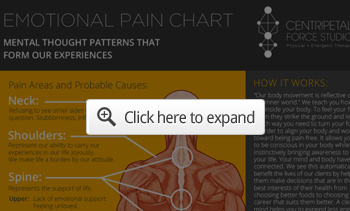
The chart above, by Centripetal Force Studio,20
details some of the possible emotions underlying aches and pains
manifesting in different parts of the body. For example, neck pain is
often related to stubbornness and emotional inflexibility, while
shoulder pain is associated with a lack of joy.
Finnish researchers have attempted to establish a more definitive
map of where emotions are felt in the body. Seven hundred volunteers
were asked to think about one of 14 predetermined emotions, and then
paint the areas of a blank silhouette that felt stimulated by that
particular emotion. Using a second blank silhouette, they were asked to
paint in the areas that felt "deactivated" during that emotion.
To help them generate the appropriate emotion, they could read a
short story, or view a video. The experiment concluded that emotions
indeed tend to be felt in ways that are generally consistent from one
person to the next, irrespective of your age, sex or nationality. As
reported in The Atlantic:21
"The mapping exercise produced what you might expect: an angry
hot-head ... a depressed figurine that was literally blue (meaning
they felt little sensation in their limbs). Almost all of the emotions
generated changes in the head area, suggesting smiling, frowning, or
skin temperature changes, while feelings like joy and anger saw upticks
in the limbs — perhaps because you're ready to hug, or punch, your
interlocutor.
Meanwhile, 'sensations in the digestive system and around the
throat region were mainly found in disgust,' the authors wrote. It's
worth noting that the bodily sensations weren't blood flow, heat, or
anything else that could be measured objectively — they were based
solely on physical twinges subjects said they experienced …
[T]he results likely reveal subjective perceptions about the
impact of our mental states on the body, a combination of muscle and
visceral reactions and nervous system responses that we can't easily
differentiate."
How to Nurture Emotional Wellness
Anger is a normal human emotion and certainly can have its place. It
may serve as a warning that something is wrong or alert you to an
impending physical or psychological trauma. Anger, with its
accompanying surge of adrenaline, may give you energy to resist a real
physical threat. Anger can also help you learn to set healthier
physical and emotional limits and boundaries.
Whether your anger eventually harms your health or not may be
related not only to its frequency but also to how it's expressed, and
how you cope with its aftermath. The key is to channel your anger into a
controlled and constructive outward expression. This can actually help
release tension and stress.
An example of this would be using your anger to fuel an intense
exercise session, or to clean house. Constructive anger, in which
people discuss (as rationally and calmly as possible) their angry
feelings and work toward solutions, has also been shown to benefit both
health and interpersonal relations.
If you tend to have a short fuse, I recommend using energy psychology techniques such as the Emotional Freedom Techniques (EFT).
EFT can reprogram your body's reactions to the unavoidable stressors
of everyday life by stimulating different energy meridian points in
your body. It's done by tapping on specific key locations with your
fingertips while custom-made verbal affirmations are repeated. This can
be done alone or under the supervision of a qualified therapist.
Making a point to be more mindful — focusing on what you're doing and the sensations you're experiencing in the moment — can
also improve your mental and emotional outlook. When you're mindfully
present, your mind will have less chance to wander and ruminate on
stressful or anger-provoking incidents, which can help you to let go of
your angry feelings.
Also, make sure you get plenty of restorative sleep, as without it you
are far more likely to lose emotional control. Exercise is yet another
foundational strategy for emotional wellness. Studies have shown that
during exercise, tranquilizing chemicals (endorphins) are released in
your brain. It's a natural way to bring your body pleasurable
relaxation and rejuvenation, and has been shown to help protect against
the physical effects of daily stress.
Last but not least, consider taking the advice of Susie Moore, a
Greatist life coach columnist and confidence coach. When something or
someone pushes your hot button, just ask yourself, "So what?" Unkind
statements, insults even, are not a reflection of your true worth, nor
is getting cut off in traffic an indication of the Universe conspiring
to ruin your day.
"There's an almost ancient wisdom to this two-word question — 'So
what?' — when you think about it, and there are a million ways to
apply it," she writes in "These Two Simple Words Can Cure Your Anger."22"'So
what?' means … Don't worry about other people. Everything's OK. Talk
about a Buddhist-style edge … Now let me ask you: What are some
situations that you can reply to with a 'So what?'
• Not being included or invited to something that you wanted to be a part of? • Not being asked on a second date? • Not getting the job you applied for? • Paying a late fee for the 7 a.m. workout class you skipped for much-needed sleep instead? • Screwing up dinner?
No comments:
Post a Comment