Part II The CIA Torture Report: Inside the fight to reveal the CIA's torture secrets by Spencer Ackerman from The Guardian
Inside the fight to reveal the CIA's torture secrets
The first part of the inside story of the Senate investigation into
torture, the crisis with the CIA it spurred and the man whose life would
never be the same
Daniel Jones had always been friendly with the CIA personnel who stood outside his door.
When he needed to take something out of the secured room where he
read mountains of their classified material, they typically obliged. An
informal understanding had taken hold after years of working together,
usually during off-peak hours, so closely that Jones had parking
privileges at an agency satellite office not far from its McLean,
Virginia, headquarters. They would ask Jones if anything he wanted to
remove contained real names or cover names of any agency officials,
assets or partners, or anything that could compromise an operation. He
would say no. They would nod, he would wish them a good night, and they
would go their separate ways.
After midnight in the summer of 2013, Jones deliberately violated that accord.
Jones, a counter-terrorism staffer, had become the chief investigator
for the Senate intelligence committee, the CIA’s congressional
overseer, on its biggest inquiry. For five years, he had been
methodically sifting through internal CIA accounts of its infamous
torture program, a process that had begun after the committee learned –
thanks to a New York Times article, not the agency – that a senior
official had destroyed videotapes that recorded infamously brutal
interrogations. The subsequent committee inquiry had deeply strained a
relationship with Langley that both sides badly wanted to maintain. The
source of that strain was simple: having read millions of internal
emails, cables and accounts of agency torture, Jones had come to believe
everything the CIA had told Congress, the Bush and Obama White Houses
and the public was a lie.
There was one document in particular that proved it. Jones and his
team had found it years before, placed mysteriously onto a shared
computer network drive the Senate intelligence committee investigators
were using in northern Virginia, not far from CIA headquarters. But they
hadn’t appreciated its full significance until the agency, in an
attempt at refuting a report that was still far from publication, told
Barack Obama’s staff that the committee was pushing a hysterical
interpretation of the agency’s fateful post-9/11 embrace of torture. The
document, prepared for Leon Panetta when he was CIA director, had
reached the same conclusions about the torture program that Jones had.
As long as Jones had it, he would be able to show that the agency knew
full well how brutal the torture was; how ineffective its torturers
considered it to be; and how thoroughly the CIA had covered all of that
up.
As long as Jones had the document, that is. Lurking in the back of
his mind was the event that had led him to devote five years of
ceaseless work, through nights and weekends: the CIA had already
destroyed evidence of torture. It did that before the Senate had
launched an investigation, and long before that investigation had turned
acrimonious.
Inside the small room in Virginia the CIA had set up for the Senate
investigators, Jones reached for his canvas messenger bag. He slipped
crucial printed-out passages of what he called the Panetta Review into
the bag and secured its lock. Sometime after 1am, Jones walked out,
carrying his bag as he always did, and neglecting to tell the agency
security personnel what it contained. After years of working together,
no one asked him to open the bag.
Outside the CIA satellite office in Virginia
Jones walked to the parking lot until he found his black Porsche
Boxster. He tossed the bag onto the passenger seat and drove across the
Potomac river, not stopping until he reached the Hart Senate office
building on Capitol Hill. It was hours before dawn, but Jones walked
into the building, sped to the second floor where the committee did its
work, and placed the locked bag into a committee safe.
Jones, by accord, had significant access to classified agency
material. He would not be leaking the Panetta Review to the public. He
was ensuring its preservation so Congress could exercise its
constitutionally mandated oversight on an agency with a vivid recent
history of document destruction on precisely this issue. But Jones, in
his first-ever interview, acknowledged to the Guardian: “We had crossed a
bridge. For the first time we had knowingly violated a CIA agreement.”
It was an unfathomable turn of events, and it would have severe
repercussions. Jones had years of training and experience handling
classified material: before joining the Senate committee staff, he was
an FBI counter-terrorism analyst. The Senate committee was not favorably
inclined toward absconding with intelligence documents: its leadership
was spending summer 2013 excoriating NSA whistleblower Edward Snowden as
a traitor. But, Jones said: “I was afraid [the document] would be
destroyed … I was the one saying, ‘We have to do this.’”
Jones takes “full responsibility” for taking the document, but will
not clarify who actually made the decision. Senators on the committee
say they learned about it after the fact rather than directing him to
take the document, and support the decision to this day.
“I don’t disagree with it. I mean, look, Director [John] Brennan
tried very hard to cover up the Panetta Review,” said Senator Ron Wyden,
an Oregon Democrat and longtime intelligence committee member.
The Panetta Review saga would spur a furious CIA to take an
extraordinary step: it would spy on its own legislative overseers –
especially Jones. The episode would spill out publicly the following
March, when top committee Democrat Dianne Feinstein, who had already
taken a huge political risk in pushing the torture inquiry, accused the
CIA on the Senate floor of triggering what she called a constitutional
crisis. Both sides requested the justice department pursue a criminal
investigation on the other. The bitterness would nearly overshadow a
landmark report, a fraction of which was released to the public in December 2014, that documented in chilling detail the depravations CIA inflicted on terrorism suspects after 9/11.
Advertisement
The
CIA has stopped defending its torture program but not its personnel.
While it has reknit its relationship to the committee, thanks to a GOP
leadership that has all but disavowed the torture investigation, it
continues to maintain that the torture report is inaccurate. Obama,
whose trusted aide John Brennan runs the CIA, kept the report at arm’s
length, with his administration declining even to read it.
But the CIA has gone beyond successfully suppressing the report. In a
grim echo of Jones’s fears, the agency’s inspector general, Langley
recently revealed, destroyed its copy – allegedly an accident.
Accountability for torture has been the exclusive province of a
committee investigation greeted with antipathy by Obama. While Obama
prides himself on ending CIA torture, the Republican presidential
nominee, Donald Trump, has vowed if elected to “bring back a hell of a lot worse than waterboarding”.
Key CIA leaders defending the agency against the committee, including
Brennan and former director Michael Morrell, are reportedly seeking to
run Langley under Hillary Clinton.
This is the inside story of the Senate investigation into torture and
the crisis with the CIA it spurred. It is formed from interviews with
critical players in the drama, supported by voluminous internal reports
and publicly available documents. Jones agreed to provide new details
but would not discuss classified information with the Guardian. When
it came time for Brennan to talk publicly about the Senate inquiry,
long after Jones’s predawn drive, he spent five minutes fitting the
CIA’s torturers into the context of 9/11. But 9/11 changed Jones’s life
as well.
A native of central Pennsylvania, Jones, now 41 years old, taught in
Baltimore in his early 20s as part of the Teach for America program
encouraging service in inner-city schools. After 9/11, he recalled, he
wanted to influence public policy over the emerging war on terrorism,
and sought work on Capitol Hill. An aide to Tom Daschle, then the Senate
Democratic leader, advised Jones to instead spend several years at a
counter-terrorism agency, like the CIA or FBI. The aide would eventually
cross paths with Jones in a different capacity – he was Denis
McDonough, the Obama confidant who would become White House chief of
staff.
Current Time 0:00
/
Duration Time 4:29
Loaded: 0%
Progress: 0%
Mute
Daniel Jones: the Senate staffer spied on by the CIA
Jones arrived at the FBI in 2003 and spent the next four years there.
The bureau was in the midst of a transformation: a generation after
Congress had drastically reduced its domestic intelligence-gathering
functions, following Nixon-era scandals, 9/11 had compelled its re-entry
into the business of pre-empting homegrown terrorists. Jones set up
shop in the counter-terrorism division as an analyst, primarily focused
on al-Qaida and Sunni extremist groups and occasionally traveling
overseas for his work. At one point, he was even detailed to the CIA.
Advertisement
But
his future in the bureau was always limited, as he wasn’t a special
agent, the field operatives who form the heart of the FBI. Sticking to
his plan, Jones arrived on the Hill in January 2007, where his
intelligence credentials helped find him a place working for Jay
Rockefeller, a West Virginia Democrat and the chairman of the Senate
intelligence committee.
Rockefeller told the Guardian that while Jones’s FBI experience
qualified him to work on counter-terrorism issues on the committee,
Jones’s time as a Baltimore teacher attracted Rockefeller’s interest.
“His decision to make this contribution before he began his career in
national security told me something about his character and it was
something to which I could relate. He impressed me then and I have only
come to admire him more in the years since,” Rockefeller, who retired
from the Senate in 2015, said.
The intelligence committee is a culture all to itself. Unlike most
congressional panels, the vast majority of its work occurs in secret.
The byzantine rules of classification restrict staffers who might
bolster legislators’ knowledge from accessing significant relevant
information. Membership, particularly on committee leadership, instantly
boosts the profile of ambitious legislators, who become de facto
surrogates for intelligence officials on cable news. All of this means
that a committee tasked as the primary avenue for imposing
accountability on secret agencies faces the ever-present risk of
becoming captive to the agencies they oversee.
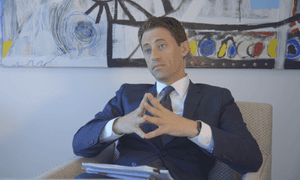
Daniel Jones
Photograph: Laurence Mathieu-Léger for the Guardian
Each element of the 16-agency intelligence community responds to the
committee differently. As every intelligence service carries an inherent
risk of scandal, they all have an abiding interest in keeping the panel
on its side. The National Security Agency, the most powerful and
technically sophisticated aspect of US intelligence, tends to send
briefers to the Hill who wax loquaciously about the complicated details
of its digital surveillance – which lends them an advantage over
legislators afraid to admit what they don’t understand. The CIA,
however, tends to duck uncomfortable questions by telling senators
they’ll send responses later, the better to ensure accurate answers, and
secure in the knowledge that busy legislators won’t often follow up.
Yet its high-handed style tends not to provoke legislators who would
prefer a close relationship with an agency many are inclined to see as
performing unsavory tasks for the greater national good.
Advertisement
The
committee’s internal politics also operate outside the partisan
straightjackets that the broader Congress eagerly wears. Aside from the
vanishingly few public hearings it holds – an annual threat briefing, a
budget briefing, nominations for senior intelligence appointees – its
work occurs in secret. That secrecy prevents the public from knowing the
overwhelming amount of activity about its intelligence services. It
also affords committee members the leeway to take positions in tensions
with party leadership or to ask questions of intelligence briefers that
don’t track conveniently with what their more ideological constituents
would prefer. While there is a limit to how bipartisan or
cross-ideological the committee will behave – former staffers are quick
to point out that their work still occurs on the hyper-partisan Hill –
both senators and staff describe the closed-door committee work as a
venue where unity concerning national security can occur.
“It’s absolutely what people hope Congress is,” Jones recalled.
The torture report began in such a manner.
In November 2005, a senior CIA official named Jose Rodriguez
destroyed 92 videotapes depicting the brutal 2002 interrogations of two
detainees, Abu Zubaydah and Abdel Rahim Nashiri. Rodriguez’s tapes
destruction remained a secret to his congressional overseers for two
years, until a 6 December 2007 New York Times article revealed it;
they barely even knew the CIA taped interrogations at all. Outrage was
swift and, while tilted toward the Democrats, bipartisan, to include the
éminences grises of the 9/11 commission. Even the US justice department began an ultimately fruitless inquiry. The Senate committee, then controlled by the Democrat Rockefeller, demanded an explanation.
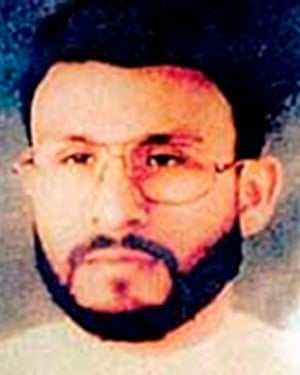
Abu Zubaydah. Photograph: AP
Michael Hayden, the CIA director, provided an assurance. The CIA did
not destroy evidence, Hayden told them, because the agency had extensive
records of the interrogations, from field cables, memoranda and
internal emails. It was the first time the committee had learned about
the documentation of one of the agency’s major operations. Jones, a
committee lawyer named Alissa Starzak and two Republican staffers were
tasked with combing through Langley archives and documenting what would
have been on the destroyed tapes.
Both Jones and Starzak – who declined comment to the Guardian – knew
they would be looking through a soda straw. (The GOP staffers stopped
coming to Langley after two or three visits, Jones recalls.) The
material they reviewed covered only April to December of 2002. It
occurred around only one black site, in Thailand, and concerned just two
detainees. The heavily redacted material went only one way: cables back
to headquarters, containing nothing about what agency leaders
instructed their field operatives to do. Yet the material was extensive:
the paper documents the agency permitted the staffers to see looked to
Jones like an Encyclopedia Britannica.
Advertisement
What
they found, over a half a year’s work examining just two detainees’
interrogations from the first year of the torture program, shocked them.
It was widely known by 2008 that Abu Zubaydah was tortured. But Jones
and Starzak did not expect to see internal accounts detailing, by the
minute, what the CIA did to him. They didn’t know, for instance, that
interrogators had tortured him to the point that he would obey, like a
dog, when they would snap their fingers, nor that they left a man
suspected of knowing al-Qaida’s secrets alone for 47 days. The cables
describe Abu Zubaydah as kept naked, filthy, stinking, shaking with
fear, shoved inside a filth-riddled wooden box, defecating on himself.
Agency personnel, in the official communications, get emotional and
request transfers rather than continue torturing men they come to
believe lack relevant information on terrorism. It immediately raised
the question of what the CIA was really doing to dozens of other
detainees at its black sites.
“I don’t think the CIA even knew what they were giving us, to be honest,” Jones said.
“These cables were the most graphic of all the cables to exist. Later
on, as you go through the program, the cables get less and less
detailed. To the credit of the agency personnel who were working on it,
they were very detailed. … Everything that we were told was basically
the opposite of what happened.”
That detail gave Jones his first recognition of the gulf between what
the CIA actually did and what it told everyone outside of Langley that
it did. Jones ended up creating a 29-page Microsoft Excel spreadsheet of
the early days of CIA torture.
Behind closed doors in the Hart building, Jones presented his
findings to the committee on 11 February 2009. Both Republicans and
Democrats were shocked by “the incredible brutality of the program at a
level beyond which anybody imagined,” Jones said.
The Hart Senate office building 11 February 2009
“At the back of the report, for what we called the ‘tapes
investigation’, the staff created a chart that depicted the most
torturous 17 days of Abu Zubaydah’s interrogation. It was almost a
minute-by-minute chronology of what the CIA was doing to Abu Zubaydah,
and how Abu Zubaydah reacted,” recalled Rockefeller.
“I think everyone on the committee – Democrat and Republican alike –
was quite taken by this section of the report. It was hard to deny the
ineffectiveness of the CIA interrogations, the brutality, or the fact
that the committee had been deeply misled by the CIA.”
Some senators, particularly Republicans, were taken aback at the idea
that the CIA would perform such acts. But Jones’s presentations that
CIA interrogators knew the torture was useless – contradicting years of
agency spin – did not attract significant interest from the senators.
“To me, I thought that’s what people would be taken with – holy shit,
we’ve been sold a bill of goods,” he said. “But what they were really
taken with was the brutality. … There was a bipartisan consensus that
this can’t be the end, there’s got to be a final product, there’s got to
be more here.”
Less than a month later, on 5 March 2009,
the committee voted 14-1 to expand the investigation, the dissenting
vote being Georgia Republican Saxby Chambliss. Instead of examining
Rodriguez’s destruction of the videotapes, now the Senate committee
would investigate the entire torture program. Part of Jones’s new
mandate was to assess whether the CIA “accurately described” its torture
program within the Bush administration and to Congress. Still, some of
the Republican members imposed limits on the investigation’s scope:
Jones couldn’t look at the Bush White House, just the CIA.
The announced inquiry came at an uncomfortable time for the CIA and
the White House. Since Obama won the presidency in November, human
rights groups had spent four months pressing for a reckoning with
torture.
While Obama shut down the torture program on his second day in office, he also said that his focus as president would be to “look forward as opposed to looking backwards”.
A senior campaign aide and former senior CIA official, John Brennan,
became his chief White House adviser for counter-terrorism, a signal
that Obama did not wish to have antagonistic relations with Langley. His
choice for CIA director, after Brennan’s equivocations on torture
raised red flags for liberals, was Leon Panetta, a longtime Democratic
congressman and consummate insider.
President-elect Barack Obama in January 2009.
Obama’s eagerness to turn the page on torture alarmed some of his
allies. The Democratic chairmen of the House and Senate judiciary
committees, Patrick Leahy and John Conyers, were pushing for broad
investigations into both torture and mass surveillance.
Advertisement
In
February 2009, Antonio Taguba, the army major general who blew the
whistle on Abu Ghraib, joined a coalition of 18 human rights groups
pressing Obama and the Democratic Congress for an independent truth commission on torture. They had support from very senior Democratic legislators, including House speaker Nancy Pelosi,
Senate judiciary chairman Patrick Leahy and House judiciary chairman
John Conyers. Activists petitioned attorney general Eric Holder to appoint a special prosecutor for the agency.
If the White House and the CIA didn’t like the intelligence committee
looking into the CIA’s recent past, they would like an unpredictable
9/11 Commission-style panel and an independent prosecutor far less. The
secretive panel, with its longstanding ties to Langley and its
Democratic leadership, seemed like a safer option. An added political
benefit was the committee’s new chair: Dianne Feinstein of California,
who had a long history of disappointing liberals over national security.
Still, the CIA had some caveats. Usually,
when the Senate committee investigates the intelligence agencies, it
does so on its home territory. The business of the committee, to include
investigations, occurs in secure, locked rooms at the Hart building.
Members and staff leave their phones outside; staff who lack the
appropriate security clearances do not enter. The entire premise of the
intelligence committees, established in the 1970s, was their unique
fitness within Congress to handle classified material in order to
provide accountability on secret agencies.
Panetta wanted a different arrangement. The CIA was forecasting the
provision of between three and six million pages of relevant documents.
Panetta’s aides voiced concern that they could not abide names of
operatives, locations of black sites and countries cooperating in the
torture program transiting to Capitol Hill. Either the committee would
have to wait on the delivery of the documents until after the agency
painstakingly redacted its material – a process with no defined endpoint
and likely to last months, if not years – or it could set up shop in a
satellite CIA facility in northern Virginia.
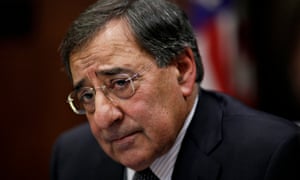
Leon Panetta
At CIA headquarters in Langley in February 2009. Photograph: J Scott Applewhite/AP
“Every other investigation the committee conducted when I was
chairman was done from the intelligence committee’s offices – offices
that are fully secured and certified to hold the most sensitive and
classified information that exists,” said Rockefeller.
Advertisement
“The CIA’s detention and interrogation program was the exception.”
The proposed arrangement discomfited the committee. Both Jones and
Louis Tucker, the GOP staff director, agreed that the investigation
should unfold in the Hart building, the same as any the panel would
conduct.
Feinstein was giving their concerns teeth. Her meetings with Panetta, whose “intelligence and integrity”
she praised in his confirmation hearing that February, showed a hard
edge. Behind closed doors, in early June, Feinstein pressed Panetta for
access to documents. Panetta, a salty politician, raised his voice,
referenced their long history together, and said she was asking for
unprecedented access. Feinstein raised hers back, and threatened to send
subpoenas to the CIA. Here were two fixtures of decades of California
Democratic politics, sizing each other up to determine who would
dominate whom.
But the committee had to consider the reality of the task it was
confronting. It had taken over a year to investigate just two
interrogations related to the tapes, and in truth, primarily one, as
Nashiri did not come into CIA custody at the Thai black site until
December 2002, the tail end of the period Jones and Starzak
investigated. The CIA did not produce any documents until the middle of
2008. How much time would they lose if they waited for the agency to
redact at least 3m documents concerning more than 100 detainees?
The CIA offer came to look acceptable. Jones and his team would drive
out to the satellite location. They would have an office, lit bright
white and windowless, in its basement. While there, Jones believed, they
would receive access to a computer network, known as RDINet – for
“Rendition, Detention and Interrogation” – hived off from the internet,
accessible to them alone, onto which the CIA would place the documents.
It was unusual, but they found, compared to the alternatives, they could
live with it. Jones’s team set to work at the site on 18 May.
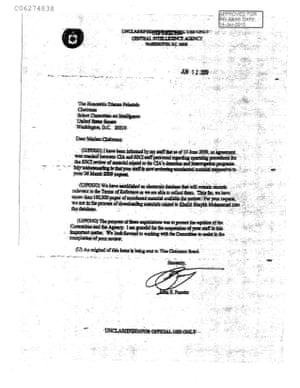
Days later, Panetta and Feinstein came to a final agreement on
access. Several letters document their accord, with a final one from
Panetta on 12 June saying “an agreement was reached between CIA and SSCI
staff personnel regarding operating procedures for the SSCI review of
material related to the CIA’s detention and interrogation programs.” The
letter said the CIA would establish “a walled-off network share-drive”
that only the Senate staff would access for work, and that “CIA access
to the walled off network shared drive will be limited to CIA
information technology staff, except as authorized by the committee or
its staff.”
Letter dated 12 June 2009 from CIA director Panetta to Dianne Feinstein. Photograph: CIA
An earlier accord, dated 28 May, also referred to establishing a
“share-drive [that] can be segregated with only SSCI access and
walled-off CIA IT administrators, except as otherwise authorized by
SSCI.” That document was titled Memorandum of Understanding Senate
Select Committee on Intelligence’s Review of CIA’s Detention and
Interrogation Program – something agency reviews would later claim, as
controversy over the inquiry reached a crisis point, did not exist.
Ironically for an agency whose concerns were premised on security
breaches, now it had to hire IT contractors to set up the network for
the committee staff. Documents did not actually arrive until 22 June,
and then, they were maddeningly difficult to search through, as the
agency insisted on using an obscure and not terribly functional search
tool. The staff the CIA posted to liaise with the investigators were
“openly hostile”, Jones said, and dragged their feet on responding to
Jones’s concerns.
Then the CIA was hit by what seemed like a bombshell. In August 2009,
US attorney general Eric Holder expanded the remit of the prosecutor
looking at the tapes destruction, John Durham, to include the torture
program, much as the Senate committee had. The justice department’s new
mandate was not as broad as the Senate’s. It would only concern itself
with torture that exceeded the boundaries set for the CIA by the
Bush-era justice department. Still, for all of Obama’s emphasis on
looking forward and not backward, now the CIA had to face its greatest
fear since launching the torture program: possible prosecution.
Advertisement
Holder’s
decision, ironically, would ultimately hinder the committee more than
the CIA, and lead to a criticism that the agency would later use as a
cudgel against the Senate.
Typically, when the justice department and congressional inquiries
coincide, the two will communicate in order to deconflict their tasks
and their access. In the case of the dual torture investigations, it
should have been easy: Durham’s team accessed CIA documents in the exact
same building that Jones’s team did.
But every effort Jones made to talk with Durham failed. “Even later, he refused to meet with us,” Jones said.
Through a spokesman, Durham, an assistant US attorney in Connecticut, declined to be interviewed for this story.
The lack of communication had serious consequences. Without Durham
specifying who at CIA he did and did not need to interview, Jones could
interview no one, as the CIA would not make available for congressional
interview people potentially subject to criminal penalty. Jones could
not even get Durham to confirm which agency officials prosecutors had no
interest in interviewing. “Regrettably, that made it difficult for our
committee to do interviews. So the judgment was, use the record,” said
Wyden, the Oregon Democrat on the panel.
But when the Senate investigators discovered discrepancies between
what the cables they read indicated and what CIA leaders represented
internally or publicly, they would be unable to solicit answers from the
people in question.
Durham’s investigation led to the first partisan break on the
committee. The committee’s vice-chairman and top Republican, Kit Bond of
Missouri, informed Feinstein that GOP members and staff were
withdrawing. The special prosecutor had put the committee – and CIA
officials – in an untenable position, Bond said publicly on 25
September: “What current or former CIA employee would be willing to
gamble his freedom by answering the committee’s questions?”
By then, the Republican staff had largely withdrawn from the
investigation already, with many not bothering to show up to the
Virginia facility. Feinstein had already complained about that to Bond
in early April. And other strains were evident in the committee’s
bipartisanship: a top Republican aide, Kathleen Rice, maintained it
would be too onerous to require the CIA to list for the investigators
all its black-site detainees.
Bond did not stop at withholding Republican support for the investigation.
In early April 2010, Feinstein, frustrated with the lack of access to
agency personnel, wrote to Panetta requesting interviews. It was a
preliminary step: at that point, she sought little more than Panetta’s
assurance to begin processing interviews on the committee’s behalf.
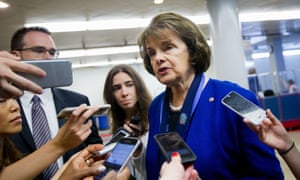
Dianne Feinstein
Photograph: Pablo Martinez Monsivais/AP
Bond rejected Feinstein’s request – not only in a letter to her two
weeks later, but in a letter to Panetta a few days after that, urging
him not to make CIA officials available to the committee. His stated
rationale was the same: steering agency employees out of criminal
danger. But as Bond also objected to document requests of the sort
Panetta had already agreed to provide, Jones suspected other motives.
Advertisement
Jones
had lost the support of the committee Republicans. “At this point,
they’re working on behalf of CIA,” he said. Bond did not reply to a
request for an interview.
Panetta, and his successors, never approved any interviews the
committee sought with agency personnel. It wasn’t only officials
involved in the program who were constrained in speaking with Jones. In
October 2009, during a visit to Langley, Jones sought to interview staff
from the inspector general’s office, which had investigated
interrogations in 2004. Stephen Preston, the CIA’s lead attorney, stood
in the hallway outside his office and insisted he be able to attend the
meeting, explicitly to monitor what they discussed on behalf of Panetta.
Voices were raised, and Jones’s team marched out of Langley rather than
hold the meeting on those terms. Preston – who declined comment to the
Guardian – finally relented, and an unmonitored meeting occurred the
following month.
“When Director Panetta agreed to provide [the committee] with
unprecedented access to CIA documents to pursue its review, the Office
of General Counsel was established as the sole conduit for requests and
responses to the committee,” said CIA spokesman Ryan Trapani.
“There was a meeting with [committee] staff and OIG where the General
Counsel participated in that role. It is our understanding that when
topics moved to issues unrelated to the review, the General Counsel left
and the meeting between [committee] staff and the OIG proceeded.”
Jones’s fight with the CIA was just beginning. It
turned out that those contractors the committee thought the CIA hired
to aid in collecting responsive documents were also acting as
gatekeepers. They would review torture documents three times before
disseminating them to the investigators to determine not only relevance,
but whether higher-ups ought to make the call to turn them over. In
some cases, the chain went up to the White House, to review for
executive privilege – advisory conversations with White House staff, a
broad category that typically keeps a record within the hands of an
administration.
White House counsel Greg Craig, his successor Bob Bauer, and Don
Verilli were involved in the review, with their colleague Kate Shaw
trekking to the off-site location. The attorneys would describe the
documents flagged for them to Jones and Starzak, case by case, and ask
if they were interested in them. In several cases, the volume of
documents meant the CIA had already unwittingly turned over copies of
documents flagged for executive privilege review – and, once informed of
that, the White House attorneys would roll their eyes and move on.
The White House involvement helped Feinstein navigate the first
outright crisis in CIA-committee relations over the torture inquiry. In
March 2010 Jones and his colleagues started noticing that they had
difficulty accessing documents they knew they already had. Simple search
terms weren’t retrieving certain records anymore.
Advertisement
“We noticed they were gone right away,” Jones said.
It would have been easy to disappear documents, even in substantial
amounts. The agency had provided millions of pages. The only way it
could have happened was for the agency to have removed the information
from a computer network the CIA set up for the Senate that Jones did not
know the agency could access.
Confronted, the CIA pointed to the tech consultants. Then they
pointed the finger at the White House, suggesting that Obama’s attorneys
ordered them to remove the documents – a much bigger accusation, with
serious implications. Feinstein, alarmed, turned to the White House, and
on 12 March, Jones met with White House lawyers, who denied ordering
the removal of anything.
In a process that remains opaque to Jones, the CIA investigated internally and, months later, determined they had removed over 900 documents
from the committee. It happened twice – with another, smaller wave of
removals occurring in May, months after Feinstein first brought the
issue to the White House. And it was a violation of the agreements the
agency had reached with the committee about the conduct of the inquiry.
“This really upset us early on, because it would never have happened
if we had conducted this investigation like we conducted every other CIA
and intelligence community investigation, which is that it happens at
our location, on our computers,” Jones said.
Ultimately, new White House counsel Bauer conveyed verbally to the
chairwoman that the CIA would not remove any more documents. On 17 May,
the CIA apologized to Feinstein as well. The committee never got the
removed documents back, but at least had alternate copies of some .
“It wasn’t like, we thought, they would enter into our computers and
search them, or go through them,” Jones said, with a wry laugh.
Around then, the CIA’s contractor staff largely turned over. The new
crew were “more cordial, open, informal”, Jones remembered. (“Those
working relationships were professional and I am unaware of any need for
bolstering,” the CIA’s Trapani said.) They dragged their feet on
document requests less. Some would even complain, in shared frustration
with Jones’s team, that their superiors were taking too long to release
material.
Jones attempted to accommodate his CIA counterparts. Agency officials
would occasionally come to him, expressing concern that some documents
they provided were marginally related to interrogations, but they
contained information about ongoing and unrelated operations. Some of
them contained material that was especially sensitive, particularly for
contemporary agency activities, but didn’t shed significant light on
torture. He let them “pull the documents … This happened throughout,
even up until the very end.”
The agency made other changes that eased the committee’s task. Later
in 2010, CIA got rid of the clunky old search tool, following
longstanding complaints from both Jones and Durham’s investigators, and
replaced the network search function with a Google interface. Easier
sifting was “hugely important”, Jones said, as the agency kept piling
material on.
The year 2010 gave way to 2011 and 2012. Panetta left to run the
Pentagon and David Petraeus, the retired general, took his place.
Petraeus seemed “supportive” of the inquiry, recalled Jones. Yet as the
committee staff worked nights and weekends at the satellite CIA office,
some wondered if the deluge of documentation was a tactic to ensure the
investigation collapsed under the weight of accumulated material.
Even with the glut of documentation, the Senate team did not have
sufficient evidence to give an account of a major aspect of the CIA’s
post-9/11 apparatus: rendition.
Advertisement
Renditions,
used before 9/11, were extrajudicial transfers of captured people;
after 9/11, a variant, called “extraordinary rendition”, sent captives
to the custody of allied intelligence services, neither American nor the
country of a detainee’s origin. Some of the CIA’s closest rendition
partners worked for the world’s most brutal dictators: Syria’s Bashar
al-Assad, Libya’s Muammar Gaddafi, Pakistan’s Pervez Musharraf, Egypt’s
Hosni Mubarak.
The rendition infrastructure was even bigger than that of the black
sites, which the CIA itself ran. More detainees ran through it than the
at least 119 held at the black sites. But once detainees moved into a
different intelligence service’s custody, the records the CIA retained
of them were scant, or secondhand, or both. It posed a problem for an
investigation that sought rigorous internal documentation for every
claim it would make. The more time the Senate spent attempting to run
down rendition leads, the more it would delay its investigation of the
CIA’s interrogations and detentions. And after all, the mandate for the
inquiry set by the committee was to determine what the CIA did to men it
detained, not what its partners did.
“It was a killer not to cover it, but you’ve got to draw a line,”
Jones said. Much CIA documentation the committee had referring to
rendition amounted to “hearsay”, not enough to responsibly present.
“Those rendition records don’t involve people who were technically
detained by the CIA. These are transients. The records are just not
there.”
But the consequence of that decision was profound. While ultimately
the classified version of Jones’s report would contain information on
CIA renditions, the vast majority of the CIA’s renditions operations –
operations that left still-untold numbers of people disappeared,
severely wounded, and likely worse – have been lost to history.
Among legislators, the inquiry became background noise. Bond had
relinquished the vice-chairmanship to Saxby Chambliss of Georgia, who in
2009 had been the only dissenting vote against launching the
investigation. Feinstein, on five different occasions, asked the GOP to
rejoin the inquiry, to no avail.
It took until August 2012 for the CIA to cease the bulk document
production. (The CIA disputes this, and Trapani said it continued to
“facilitate and support” Senate document access until December 2014.) By
then, the staff estimated they had the equivalent of two urban
libraries. Jones had been writing the classified report incrementally.
Starting in October 2011, Feinstein had him send pieces of the report to
the committee, Democrats and Republicans, so no one was taken by
surprise.
In December 2012, Jones finished the report. It was at that point
6,200 pages long and entirely secret. In a sign of the diminished
partisan consensus around torture, the vote to adopt the report was 9-6,
with Maine moderateOlympia Snowe the only Republican to assent. Now would come the next fight: to declassify the report.
But since the committee had a more immediate task, Feinstein and the
Democrats decided to leverage it. On 7 February 2013, Obama confidant
John Brennan had his confirmation hearing with the panel to run his
beloved CIA. By now, the CIA had overcome its major fear over torture
accountability: Durham’s investigation had concluded in summer 2012 and
had prosecuted no one. There would be no criminal accountability for
torture, and it was an open question whether the public would ever read
Jones’s report. The committee sought Brennan’s attitude toward the
inquiry.
John Brennan
Brennan is sworn in to testify at his confirmation hearing on 7 February 2013. Photograph: Jason Reed/Reuters
Brennan equivocated on torture throughout the hearing. Although he
was the agency’s deputy executive director when the program began, he
minimized his knowledge of it. (A former CIA officer who has long known
Brennan and who has since criticized torture, Glenn Carle, told the
Guardian: “He has never been a proponent of this stuff.”) Brennan called
waterboarding “reprehensible” but would not, under repeated
questioning, call it torture. He promised outright to provide the
committee with his “full and honest views” after reading the torture
report, but when pressed on declassifying it, said: “I would have to
take that declassification request under serious consideration,
obviously.”
No response was forthcoming to the declassification request. But on
27 June 2013, the CIA sent a 100-plus page response to the committee
raising a host of objections to the Senate’s conclusions.
The agency dissented from the conclusion that torture “did not
produce unique intelligence that led terrorist plots to be disrupted,
terrorists to be captured, or lives to be saved.” That “flawed
conclusion” led to another, the agency claimed: that the CIA “resisted
internal and external oversight and deliberately misrepresented to
Congress, the executive branch, the media, and the American people” the
truth about its torture.
Rejecting an assessment that the agency “misrepresented” the program –
lied about torture, less euphemistically – the agency said: “The
factual record maintained by the agency does not support such
conclusions.”
Jones was stunned, and for a very particular reason. For years, he
had been in possession of a specific agency document that not only
supported those conclusions, it reached them itself – what a senator on
the committee, Mark Udall of Colorado, would later call a “smoking gun”.
The document was the Panetta Review. Much of it remains a mystery to
Jones even today: whether he or another staffer found it on the network,
whether the agency meant them to receive it, or if an agency
whistleblower slipped it onto the Senate drive. Nor does the CIA have an
answer to the puzzle: “CIA does not know how [Senate] staff acquired
the unauthorized documents,” Trapani said. But Jones recalls discovering
it around 2010 and “pretty immediately” understanding its significance.
“When we saw this document, we weren’t like, ‘Oh, great, we got the
CIA.’ It was: ‘Oh, Jesus Christ, thank God – we’re not crazy,’” he said.
“This was high stakes. A lot was riding on it. It was a relief.”
They called it the Panetta Review because the agency prepared a
summary of its renditions, detentions and interrogations work for
Director Panetta, who had come to Langley after Obama shut the program
down. One version was a Microsoft Word document, clearly a draft, with
the function allowing users to see each others’ changes enabled. Another
version, apparently more final, was a PDF. Iterations by CIA were clear
on view: “You could see the attorneys looking at it and saying, ‘Well,
let’s make sure we can back this up, can you add more citations?’”
The final version of the Panetta Review, Jones said, was more than
1,000 pages long. The CIA has represented it as “summaries of documents
being provided to the [committee] … highlighting the most noteworthy
information contained in the millions of pages of documents being made
available,” as agency attorney Martha Lutz would tell a court after Vice
reporter Jason Leopold sought to acquire the still-classified document.
Jones said that description is incorrect.
“It’s a narrative, plain and simple. ‘This is Abu Zubaydah’s
interrogation.’ ‘This is KSM [Khalid Shaikh Mohammed].’ They’re topic
oriented: ‘These are the inaccurate things we told the president.’ It’s a
final findings document. It has 13 findings. And one is, basically,
they provided inaccurate information to support the use of EITs,” or
enhanced interrogation techniques, the agency’s preferred euphemism for
torture.
Lutz would later tell a federal court that “even the post polished
versions remained drafts and were subject to change”. The CIA stopped
compiling the Panetta Review in 2010 after Durham told Preston that CIA
risked complicating any prosecution if it “made different judgments than
the prosecutors had reached”, Charlie Savage reported in his 2015 book
Power Wars.
Useful as the document was, it took on brand new significance now
that the CIA was denying the conclusions that it had endorsed in the
Panetta Review.
“I did not think they were going to say: ‘None of this is right,
you’re all wrong.’ I expected to receive the Panetta Review,” Jones
said.
“What’s so shocking about that is that we thought this problem – the
CIA providing inaccurate information to the president – was limited to
the Bush administration, to [ex-directors] Tenet, Goss and Hayden. This
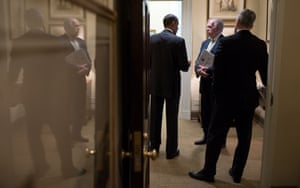
is John Brennan’s CIA, Obama’s CIA. There’s a famous picture of Brennan
briefing the president with their response in May of 2013, before we
received their response. They’re providing inaccurate information to the
president of the United States in the present day.”
Obama, Brennan and McDonough
Barack Obama talks with John Brennan, center, and chief of staff Denis
McDonough in the West Wing of the White House, May 2013. Photograph:
Pete Souza/The White House
And the CIA, Jones knew, had a very recent history of destroying
videotapes recording torture. It was the reason he had spent five and a
half years sifting through the agency’s darkest secrets. Even more
recently, the CIA had removed hundreds of documents, surreptitiously and
in violation of the understanding the committee thought it reached with
the agency, from the Senate files.
Jones walked to his car and drove to the satellite CIA office. His life would never be the same.
Next: ‘A constitutional crisis.’ An incensed CIA spies on Jones. Accusations fly between the CIA and the Senate.
This article was amended on 10 September 2016. The original version
said tenure on the Senate intelligence committee is term limited. A 2005
law repealed those limitations.


No comments:
Post a Comment